
The days when Wall Street treated crypto like radioactive waste are officially over. The launch of spot ETFs, the passing of the CLARITY Act, and the establishment of US sovereign strategic reserves—which now officially gobble up not just BTC, but key alts too—have turned venture chaos into a heavily structured, institutional market.
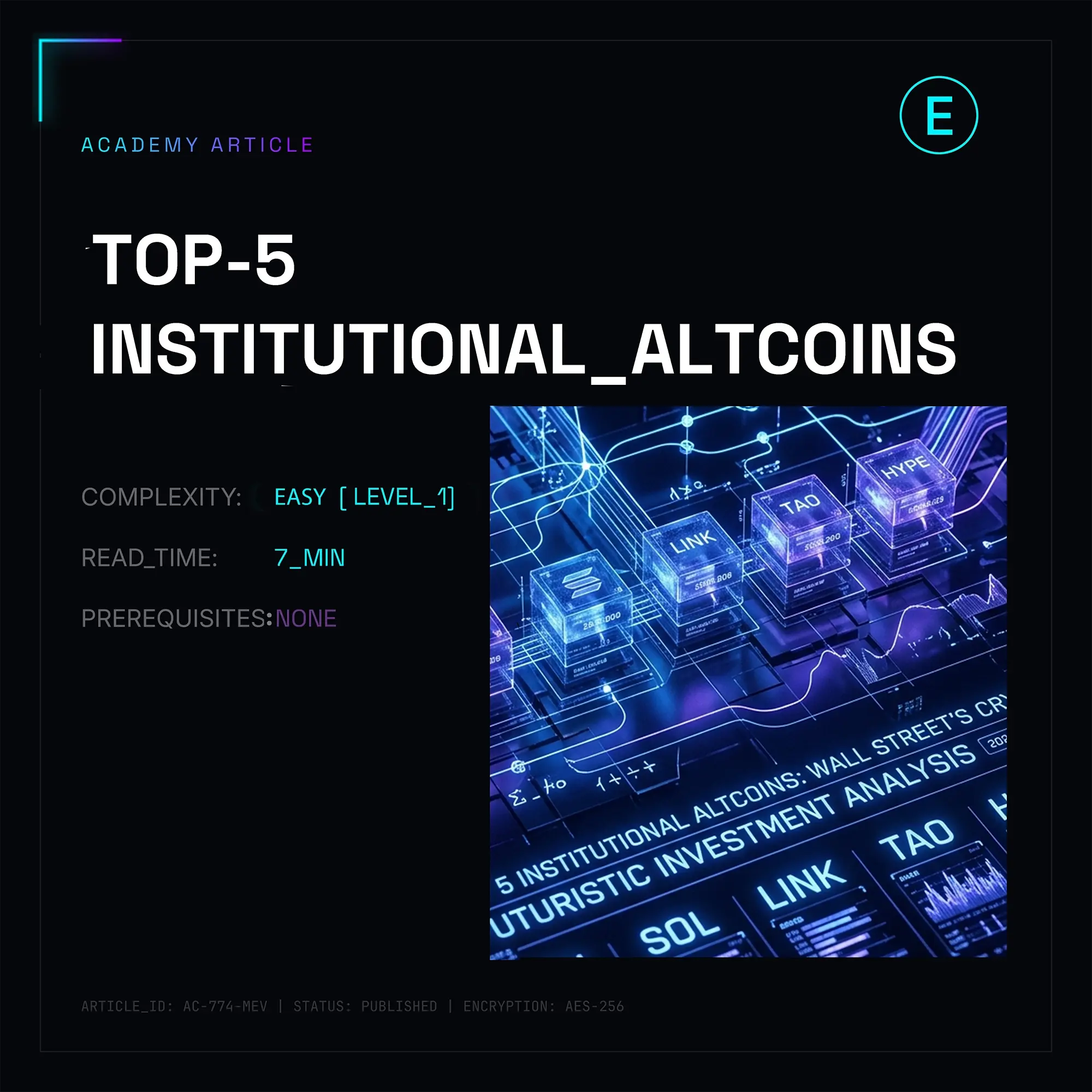
The mega funds (BlackRock, Fidelity, Bitwise, Grayscale) are no longer aping into random coins hoping for a brainless pump. They are betting on core infrastructure, deep liquidity, and specific tech pain points that a project solves for the market. Cut through the tons of marketing fluff, and the institutional smart money is laser-focused on five specific assets.
Top 5 Alts in Wall Street Portfolios
1. Ethereum (ETH) - The Infrastructure Standard
Institutions don't look at Ether as a payment rail; they see it as a global decentralized computer powering RWA—the migration of real-world assets (stocks, bonds, real estate) onto the blockchain via tokenization. Since moving to Proof-of-Stake (PoS)—the consensus mechanism where network security relies on locking up coins (staking) rather than mining rigs—the network has turned deflationary, thanks to burning a portion of the base gas fees.
For funds, ETH’s core value proposition lies in its liquidity depth and the stability of L2 networks (like Base or Arbitrum), which handle the microtransactions while the mainnet acts as the ultimate security arbiter. Big capital is building its permissioned banking subnets right on top of EVM (Ethereum Virtual Machine) infrastructure, making ETH the ultimate, irreplaceable settlement collateral.
2. Solana (SOL) - The High-Speed Settlement Layer
Wall Street is piling into Solana because they desperately need cheap, end-to-end throughput for high-frequency trading (HFT) and instant payment gateways, where a two-second lag means losing millions. The current integration of the Alpenglow consensus protocol (engineered by Anza) and the rollout of the independent Firedancer validator client directly fix the network's biggest historical pain points: random outages and congestion during peak volume.
The new Votor architecture cuts block finality down to 100–150 milliseconds, putting on-chain settlement neck-and-neck with traditional payment networks like VISA. This has made SOL the clear number-two alt for spot fund filings.
3. Chainlink (LINK) - The TradFi Data Bridge
Institutional smart contracts are sandboxed inside the blockchain and have no idea what Apple stock is trading for on NASDAQ or whether a cargo ship just docked in Rotterdam—until Chainlink’s decentralized oracles feed that data on-chain. Without LINK, the entire multi-trillion-dollar RWA ecosystem is just a broken distributed database, lacking any secure way to verify off-chain real-world events. Through CCIP (Cross-Chain Interoperability Protocol), Chainlink basically plugs Swift straight into dozens of different chains, letting funds shift liquidity between legacy banks and DeFi in a single click.
4. Bittensor (TAO) - The Decentralized AI Marketplace
Funds are aggressively chasing AI-crypto synergy, and TAO became the main beneficiary of this narrative after successfully training Covenant-72B (a 72-billion-parameter model) entirely via a distributed network of independent nodes. The Dynamic TAO architecture and the expansion of subnet capacity from 128 to 256 created a tight economic loop: to launch an AI subnet or tap computing power for machine learning, enterprise players have to buy and lock native TAO tokens from the open market.
Validation rewards are distributed automatically via smart contracts, bypassing centralized cloud giants. This cuts compute costs significantly and draws in hedge funds looking to deploy proprietary trading algorithms.
5. Hyperliquid (HYPE) - Institutional-Grade On-Chain Derivatives
This is the weapon of choice for Wall Street market makers and desk traders: a decentralized L1 perp trading platform that is going toe-to-toe with major CEXs in trading volume and order book depth. The project’s aggressive tokenomics dictate that 97% to 99% of all generated trading fees are automatically funneled into buying back HYPE from the market and burning it forever. Total buybacks have already crossed the $1.5 billion mark, providing a constant, organic demand floor for the token even when the broader market bleeds.
Wall Street Asset Matrix
| Altcoin | Core Institutional Narrative | 2026 Tech Driver | Key Holding Risks |
|---|---|---|---|
| ETH | RWA Tokenization, deflationary collateral | L2 dominance (Base, Arbitrum) | High L1 gas fees during network spikes |
| SOL | Retail payments, high-speed DeFi | Alpenglow & Firedancer upgrades | Historical track record of network outages |
| LINK | Oracle infrastructure, CCIP protocol | SWIFT & clearing house integration | Slow value capture by the native token |
| TAO | Decentralized Compute/AI | Subnet capacity expansion to 256 | High volatility driven by halving cycles |
| HYPE | Institutional derivative DEX | 99% fee buyback and burn engine | CEX competition and regulatory crackdowns |
How to Copy the Smart Money: A Practical Playbook
Whales never market-buy an entire position in one go; they don't want to blow up the order book and spike the price against themselves. Instead, they run algorithmic TWAP (Time-Weighted Average Price) execution—buying in equal slices at fixed intervals—which retail investors know as DCA (Dollar-Cost Averaging).
- The Custody Rule. Institutions use enterprise custodians (Coinbase Custody, BitGo) backed by multi-sig authorization and hardware security modules (HSMs). For retail, your only option is getting your assets off exchanges completely and using hardware cold storage for true self-custody, with your seed phrase backed up on physical media.
- Liquidity Risk Management. Do not go all-in on assets with sub-$5 billion market caps unless you are comfortable holding bags through months of drawdowns. Legit funds diversify risk: 70% of the portfolio goes into heavy, liquid blue-chip rails (BTC/ETH), 20% into infrastructure L1s/L2s (SOL, LINK), and no more than 10% into high-beta tech sectors like AI (TAO) or aggressive DEX tokens (HYPE).
- Whale Tracking. Funds are legally required to flash their portfolios via 13F SEC filings or monthly asset reports from Grayscale and Bitwise trusts. Always monitor net ETF inflows/outflows and on-chain metrics before deploying capital on local market dips.