
We’re used to trading bots being rigid sets of rules: "if the price hits the moving average, buy." But in 2026, the game has completely changed. "Algorithmic trading" has been sidelined by Agentic Trading.
In this post, we’re breaking down systems where AI doesn't just "give a heads-up"—it actually lives on the market. These agents hunt for liquidity, argue with themselves over risk levels, and pivot based on news faster than you can refresh your feed.
1. What is Agentic Trading in plain English?
Imagine that instead of a single trading bot, you’ve got a whole virtual hedge fund working for you. It’s got its own analyst, a risk manager, and an execution trader.
- Classic Algo-Trading: Think of a train on tracks. If there’s a wreck ahead (like a black swan news event), it’s going to crash right into it because "that’s what the code says."
- Agentic Trading: This is a self-driving car. It knows the destination, but it decides on the fly how to bypass a traffic jam, where to fuel up, and when to ease off the gas because of a storm.
The game-changer here is "Reasoning." Agentic AI (running on models like GPT-5.4, Claude 4.6, or Gemini 3.1) can actually read the room. If news breaks about a protocol hack, the agent doesn’t just see the price tanking; it understands why and can preemptively dump positions across the entire ecosystem, not just in one specific token.
2. System Architecture: Multi-Agent Systems (MAS)
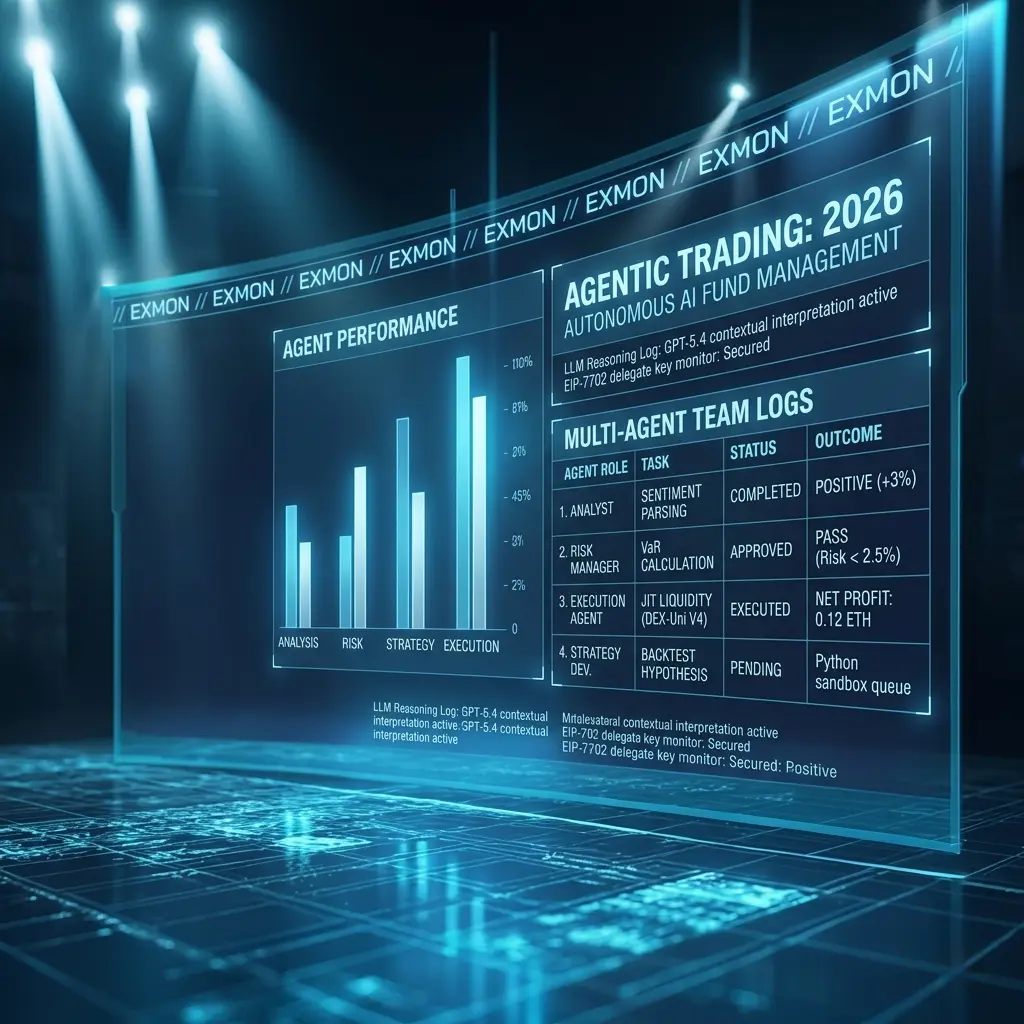
Modern setups are built on the multi-agent principle. A single "brain" is too prone to hallucinations, so tasks are split between specialized agents.
Here’s what a typical agent squad looks like:
| Agent Role | Function | Tools |
|---|---|---|
| Analyst | Scrapes data and hunts for patterns. | Parsing X (Twitter), Glassnode, Bloomberg terminals. |
| Strategy Developer | Tests hypotheses on the fly. | Backtesting engines, Python sandboxes. |
| Risk Manager | Vetoes dangerous trades. | VaR (Value at Risk) calculations, leverage control, correlation monitoring. |
| Execution Agent | Sniffs out the best price and liquidity. | Smart Order Routers, MEV-protected RPCs, DEX aggregators. |
3. Real-World Execution: Liquidity Hunting and Intent-Based Trading
One of the hottest topics of 2026 is Intent-centric trading. An agent doesn’t just blast a transaction to the blockchain. It formulates an "Intent."
Example: "I want to buy 100 ETH using no more than 350,000 USDC, with slippage capped at 0.1%, and I want full protection from MEV bots."
The execution agent then looks for "solvers"—other AIs or algorithms that compete to fill that order at the best possible price.
The Deep Cut: JIT Liquidity
Advanced agents are now acting as Just-In-Time (JIT) liquidity providers. If an agent spots a massive order in the mempool, it can inject liquidity into a tight range (like Uniswap v3/v4) for a single transaction, pocket the fee, and pull the funds immediately. All of this happens autonomously within one block.
4. Practical Example: A Simple Python Agent
To build an agent today, people usually grab frameworks like LangChain or CrewAI. Here’s a conceptual look at the logic for an agent that double-checks market sentiment before pulling the trigger.
import openai
from trading_library import ExchangeAPI
# Simplified Analyst Agent Logic
def agent_decision_logic(ticker):
    # 1. Grab the latest headlines via a search tool
    news_summary = search_tool.get_latest_news(f"{ticker} price impact")

    # 2. AI crunches the context
    prompt = f"Based on this news: {news_summary}. Should we go long on {ticker}? Answer briefly: YES or NO and give your reason."

    response = openai.ChatCompletion.create(
        model="gpt-5-turbo", # The standard 2026 model
        messages=[{"role": "user", "content": prompt}]
    )

    decision = response.choices[0].message.content
    return decision
# 3. Execution with a "Risk Manager" check
if "YES" in agent_decision_logic("BTC"):
    if risk_manager.check_exposure(current_balance):
        ExchangeAPI.place_order("BTC", side="buy")
5. The Risks: When AI Becomes Your Own Worst Enemy
As powerful as it is, agentic trading brings some nasty new threats to the table:
- Computational Hallucinations: An AI might mess up a decimal point when calculating position size. That’s why in 2026, "Hard-coded Guardrails"—software limits that the AI can't touch—are the gold standard.
- Prompt Injection: Bad actors might try to manipulate agents by planting fake news stories with specific keywords designed to "trick" an AI into making a stupid trade.
- Cascading Failures: If thousands of agents are leaning on the same model (like GPT-5.4), their simultaneous reaction to a single event can trigger a Flash Crash.
6. Pro-Tips for Getting Started
- Don't trust "Black Boxes": If you're using a pre-built trading agent, make sure it has a Self-Reflection module. This is an agent that writes a report after every trade: "Here is why I did that and where I messed up."
- Use EIP-7702 (for Crypto): In 2026, this is the standard for safely delegating signing rights to an agent without handing over your private keys.
- The Hybrid Approach: Start in "Copilot" mode—let the AI draft the trade plan and the reasoning, but keep your finger on the "Execute" button.
7. The Math of JIT Liquidity: How Agents "Squeeze" Into Trades
We touched on Just-In-Time (JIT) liquidity earlier. To a regular user, it sounds like voodoo, but for an agentic system, it’s pure math. In the Uniswap v4 architecture, agents use "hooks" to sniff out incoming transactions.
The Agent’s Profit Formula
Before an agent decides to inject liquidity, it calculates this condition in a heartbeat:
Pnet = (Vtrade × fee) - (Gasin + Gasout) - ILexpected
Where:
- Vtrade: The volume of the third-party transaction we are "servicing."
- fee: The pool's fee percentage (e.g., 0.05% or 0.3%).
- Gasin/out: The cost of adding and immediately yanking the liquidity.
- ILexpected: The expected Impermanent Loss during the time spent in the block.
The Pro Tip: Modern agents operate through Flashbundles. They package transactions so that their liquidity appears exactly before the user's trade and vanishes exactly after, killing the risk of someone else sniping that price.
8. Local LLMs for Trading: Why the Cloud is a Liability
By 2026, pro-level agentic systems are ditching OpenAI or Anthropic APIs. There are two main reasons: Latency and Privacy.
- Latency: By the time your request hits a server in the US and bounces back, the market has already moved. A local model based on Llama 4 or DeepSeek-V3, running on a home server with beefy GPUs, spits out a decision in milliseconds.
- Privacy: When you send your strategies and prompts to the cloud, you’re basically "training" someone else’s model with your alpha.
The Recommended Stack for a Local Agent:
- Hardware: At least 2x RTX 5090s (to handle 70B+ parameter models at 4-bit quantization).
- Software: vLLM or Ollama paired with the Python library ccxt to talk to the exchanges.
- Models: Specialized FinLLMs fine-tuned on order book logs.
9. Advanced Risk Control: The Arbitrator Agent
The most "under the radar" yet effective tactic is using an Arbitrator Agent. This is an independent AI instance whose sole job is to play devil's advocate and grill the main trading agent’s moves.
A typical internal dialogue looks like this:
- Trading Agent: "I’m seeing a pump on $XYZ meme token, let's buy in with 5% of the bag!"
- Arbitrator Agent: "Request denied. The growth is coming from a single wallet; 90% of the pool's liquidity is held by the dev. This smells like a Rug Pull. Look at the smart contract—there’s a mint function."
- Trading Agent: "Copy that, aborting. Switching to hunt for an arb window between CEX and DEX."
10. Step-by-Step Plan to Go Agentic
If you’re looking to move from manual trading to an agent-based setup, follow this roadmap:
- Define the "Voice": Write a detailed System Prompt for your agent. Don’t just describe WHAT to buy, but WHO it is (e.g., "You are a conservative trader who values capital preservation over moonshots").
- Set Up the Tools: An agent shouldn't just "chat." Give it access to API functions: get_price(), get_social_sentiment(), execute_swap().
- The Sandbox (Paper Trading): Run the agent on a demo account. In 2026, agents learn from their mistakes via RAG (Retrieval-Augmented Generation), saving bad trades into a vector database so they don't screw up twice.
- The Kill Switch: Always have a physical or software script that kills all positions and shuts off API keys with one command if the AI starts acting glitchy.
11. The Future: Autonomous On-chain Entities
We are moving toward a world where trading agents become full-blown "digital personalities." They’ll have their own wallets, their own reputations on networks like EigenLayer, and maybe even their own legal identities in forward-thinking jurisdictions. They won't just trade; they’ll actively vote in Governance to lobby for changes that help their portfolios.
The Bottom Line:
Agentic Trading isn't about replacing the trader; it's about giving them a massive upgrade. The winner isn't the one with the best "gut feeling," but the one who builds the most efficient and secure ecosystem of autonomous agents.
Summarize this blog post with: