
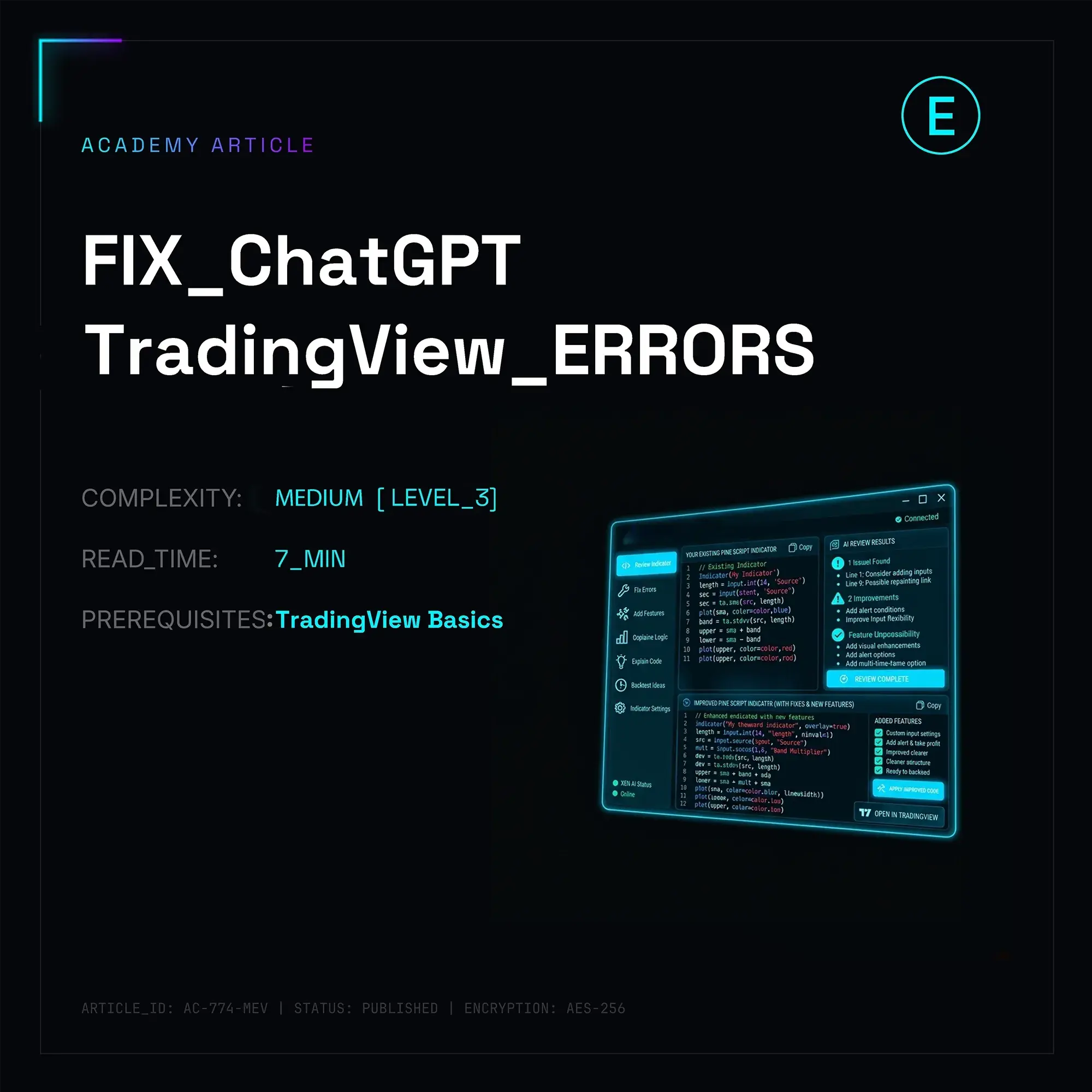
Every single day, local algo-trading chat groups welcome yet another "Holy Grail." The script is always the same: someone asks ChatGPT to whip up a custom indicator or a plug-and-play bot, the LLM spits out a couple hundred lines of code, TradingView shows a ridiculous 800% annual return with a microscopic drawdown, and the moment you try to run this masterpiece on a live account, your capital evaporates in three trading sessions. Or even simpler: the code completely refuses to compile because the terminal starts screaming about variables that never existed in this universe.
If you've ever tried automating your strategy via neural networks, you've definitely run into this wall. Let's skip the textbook theory and break down why language models keep inventing non-existent syntax, how to spot these hallucinations, and how to actually force AI to deliver working code instead of pure optical illusions.
Architectural Glitch: Why AI Hallucinates Pine Script
ChatGPT doesn't compile code. It doesn't understand math, it has no clue how the TradingView engine ticks, and it lacks any concept of execution context. The language model is literally just predicting the next most probable token based on the dataset it was trained on.
And that's where the trap springs. The training set is a wild, toxic waste dump containing:
- Ancient Pine Script v2, v3, and v4 scripts that are deeply deprecated and throw breaking errors in modern terminals.
- Thousands of custom GitHub libraries where authors brazenly overrode core functions.
- Random snippets of Python, C++, and MQL5 thrown into the mix.
When you ask the AI to "write an adaptive RSI with dynamic overbought zones," the model grabs a familiar function name from Python, mixes it with old Pine Script v3 syntax, slaps a nice ta. prefix on it, and hands you a monstrosity like ta.optimized_rsi().
To the neural net, it looks totally harmonious and logical. To the TradingView compiler, it's absolute garbage.
Top 4 Fake Variables and Fatal ChatGPT Hallucinations
1. Imaginary Wrappers in the ta. Namespace
In Pine Script v5, all technical indicators were moved into the ta. module. The network learned this rule well, but then started slapping this prefix everywhere indiscriminately.
- What the AI invents: ta.supertrend_indicator(), ta.smart_macd(), ta.volume_accumulator().
- How it actually works: The built-in Supertrend function returns a tuple of two values: [value, direction] = ta.supertrend(factor, period), rather than a ready-to-use polished indicator in a single line.
2. Time Traveling via request.security (Look-ahead Bias)
This is the cardinal sin of neural networks. An indicator prints god-tier profits on a backtest solely because ChatGPT botched the multi-timeframe data query.
- What the AI invents: request.security(syminfo.tickerid, "D", close)
- Where the catch is: Without explicitly specifying the bar-merging parameters via barmerge.lookahead_off, a 5-minute chart strategy at 10:00 AM already "knows" what the daily candle's close price will be at 23:59. On historical data, this yields a 99% win rate. On live markets, it's an instant margin call, because nobody knows the future in real time.
3. Inventing Non-Existent Order Properties in strategy.entry
When trying to configure dynamic position sizing, ChatGPT regularly invents arguments that simply do not exist in the API.
- What the AI invents: strategy.entry("Long", strategy.long, risk_percent=2.0, max_slippage=3)
- How it actually works: Risk management is either declared in the strategy() annotation or calculated mathematically via the qty argument. There is no such thing as risk_percent inside the order call itself.
4. Non-Existent Timeframes and Data Types
The network loves writing "15m" or "1h" when passing timeframes into functions. However, Pine Script strictly requires strings like "15" for minutes and "60" or "240" for hours. Small detail? Sure, but it will crash the script right at compile time.
Breakdown: Phantom vs. Working Code
To settle this once and for all, look at these two examples. The first is a typical Frankenstein monster that ChatGPT generates by default. The second is clean, compilable Pine Script v5 code with sound logic.
AI Trash (fails to compile and hallucinates):
//@version=5
strategy("AI Hallucination Strategy", overlay=true)
// Error 1: ta.custom_adaptive_rsi function does not exist in Pine Script
rsi_val = ta.custom_adaptive_rsi(close, 14, 80, 20)
// Error 2: incorrect signature (ta.supertrend takes factor and atrPeriod, without source)
// and the tuple result is assigned to a single variable
st_val = ta.supertrend(close, 3.0, 10)
// Error 3: lookahead_on without [1] offset - historical EMA leaks data from the future
daily_ema = request.security(syminfo.tickerid, "D", ta.ema(close, 200), barmerge.gaps_off, barmerge.lookahead_on)
if (ta.crossover(rsi_val, 50) and close > daily_ema)
    // Error 4: strategy.entry does not have a risk_level parameter
    strategy.entry("Buy", strategy.long, risk_level=1.5)
Production-Ready Pine Script v5 Code:
//@version=5
strategy("Clean Quantitative Strategy", overlay=true, initial_capital=10000, default_qty_type=strategy.percent_of_equity, default_qty_value=10)
// Typed input parameters
rsi_len   = input.int(14, title="RSI Length", minval=1)
st_factor = input.float(3.0, title="Supertrend Factor", step=0.1)
st_period = input.int(10, title="Supertrend Period", minval=1)
// 1. Standard RSI
rsi_val = ta.rsi(close, rsi_len)
// 2. Supertrend returns the line and direction (-1 = uptrend, 1 = downtrend)
[st_line, st_dir] = ta.supertrend(st_factor, st_period)
plot(st_line, "Supertrend", color = st_dir < 0 ? color.green : color.red)
// 3. Daily EMA without lookahead bias and repainting:
//    value of the previous CLOSED day ([1]) + lookahead_on - standard safe pattern
daily_ema = request.security(syminfo.tickerid, "D", ta.ema(close, 200)[1], barmerge.gaps_off, barmerge.lookahead_on)
// Signals only on confirmed (closed) bars
long_condition  = barstate.isconfirmed and ta.crossover(rsi_val, 50)  and close > daily_ema and st_dir < 0
short_condition = barstate.isconfirmed and ta.crossunder(rsi_val, 50) and close < daily_ema and st_dir > 0
// Entering the opposite direction automatically flips the position
if (long_condition)
    strategy.entry("Long", strategy.long)
if (short_condition)
    strategy.entry("Short", strategy.short)
Checklist: How to Filter AI Bullshit Code
If you're using an LLM as a junior dev assistant to help write code, keep these rules in mind to save yourself hundreds of hours and a ton of nerves:
- Force the AI to write strictly in Pine Script v5. Explicitly state in your prompt: "Use strictly Pine Script v5. Do not use functions without ta. and request prefixes. Do not invent custom methods."
- Hunt for ghost functions in the Reference Manual. If you see an unknown function like ta.something() in the code, don't be lazy, look it up in the official TradingView reference docs. 90% of the time, it's not there.
- Audit request.security. Always check the arguments. If barmerge.lookahead_off is missing, your backtest is just a nice fairy tale that has zero to do with reality.
- Make the AI comment every single line. When the neural network explains the logic of a specific operator, it's much less likely to hallucinate made-up function names.
Risk Management: Where Reality Checks "AI Grails"
Even if your ChatGPT code compiles perfectly with zero syntax errors, keep market mechanics in mind:
- Slippage and Commissions. Neural networks never account for spreads and exchange fees when backtesting strategies. On a 1-minute timeframe, a script pulling 1,000 trades a day will look like a rocket ship on paper, but in reality, you'll hand your entire deposit over to the exchange in maker/taker fees. Always manually factor in commissions (at least 0.05% per trade) and 2-3 ticks of slippage in your strategy settings.
- Dynamic Stop Losses. Forget fixed 1% or 2% take-profits. Market volatility shifts every single day. Always anchor your protective stops to current volatility using ATR: Stop Loss Price = Entry Price ± (ta.atr(14) × 1.5)
You can and should use ChatGPT in trading, but only as a quick syntax assistant for routine operations. The moment you hand over the architecture and indicator logic design to an AI, you are guaranteed to get a bundle of hallucinations, pretty charts from the future, and imaginary functions that the market will eventually force you to pay for out of your own pocket.