

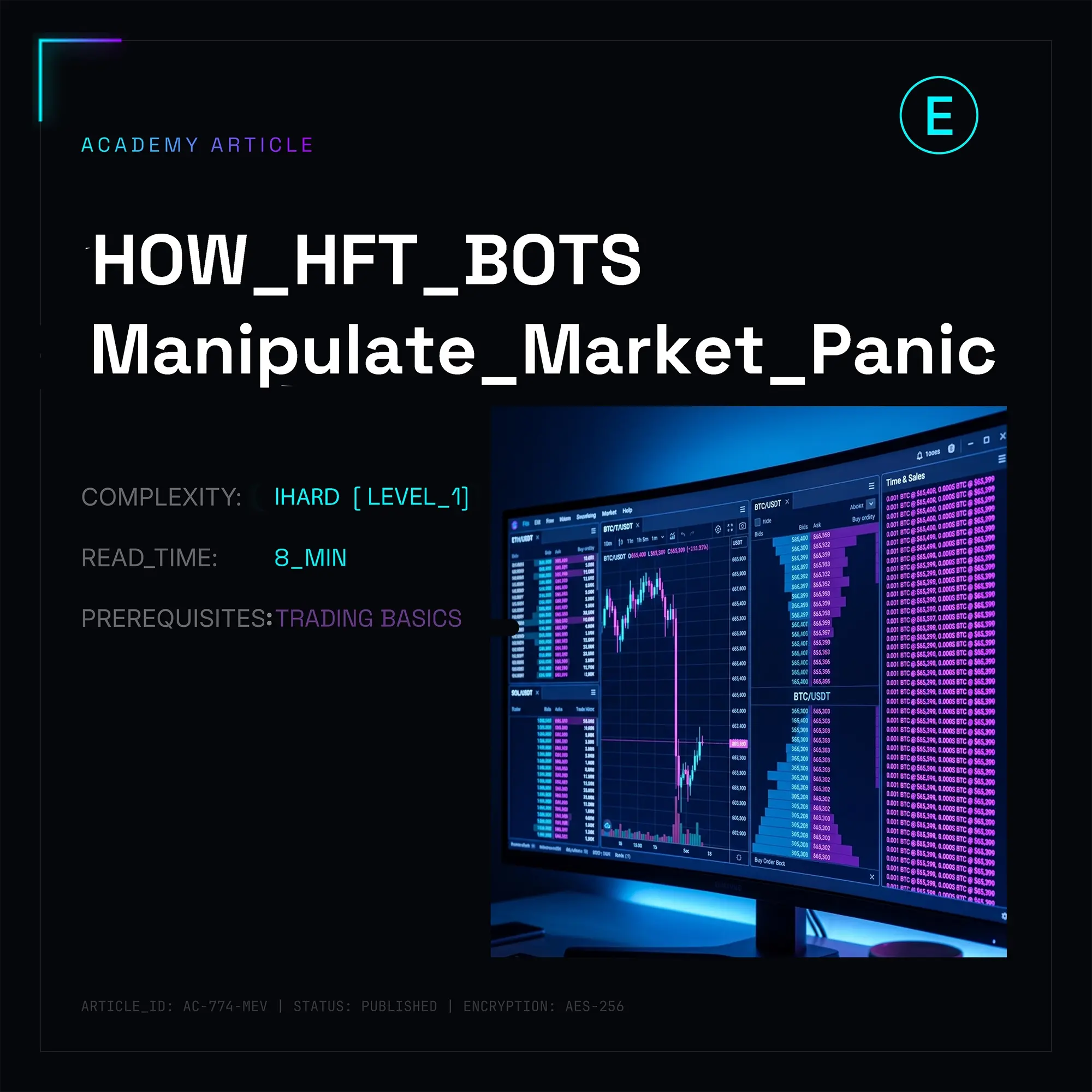
Picture this: you’re calmly sipping your coffee, keeping an eye on a Bitcoin chart or some tech stock. Everything looks steady. Then, out of nowhere—in literally 10 to 20 seconds—the price nosedives 15% into the abyss. The order book goes empty, social media hits full-blown panic mode, and your phone starts screaming with liquidation alerts. Another minute passes, and the price magically snaps back as if nothing ever happened.
Congratulations, you’ve just witnessed (or fallen victim to) a Flash Crash—an instantaneous collapse engineered by high-frequency trading (HFT) algorithms.
1. What is HFT and why do they want your fear?
High-Frequency Trading (HFT) isn't just "fast bots." These are infrastructure giants fighting for microseconds (10-6 seconds). Their goal isn't to "invest," but to exploit market inefficiencies and... human psychology.
The most precious resource on an exchange is liquidity. When the market is quiet, orders are plentiful. For a major player (a whale) to buy a massive amount of an asset without sending the price to the moon, they need people to start selling en masse. Ideally, in a state of pure panic.
2. Mechanics of the "Digital Trap"
The "artificial panic" play unfolds in several stages, and it's a mix of pure math and psychological warfare.
- Spoofing: A bot places massive sell orders just above the current price with no intention of filling them. The goal is to create the illusion of a "massive seller" entering the market. Retail traders and other bots see this, get spooked, and start selling first to "get out while they can."
- Quote Stuffing: HFT algorithms flood the system with thousands of micro-orders per second and immediately cancel them. This creates "white noise" that bogs down the exchange's gateways for regular users. While your terminal struggles to update a lagging chart, the bot already knows the price 100ms before you do.
- Triggering Stop-Losses: Under pressure, the price drops to levels where most traders have set their "stops." Triggering a single stop-loss generates a market sell order, which pushes the price lower, hitting the next stop. This creates a cascade effect.
- Liquidity Vacuum: As the avalanche gains momentum, HFT bots instantly pull their buy orders (the "bid side"). A hole opens up in the order book. The price drops almost vertically because there are simply no buy orders left to catch it.
3. Real-World Cases: When Algos Go Wild
| Event | Date | Outcome | Cause |
|---|---|---|---|
| The Flash Crash (DJIA) | May 6, 2010 | -9% in minutes | A large sell order triggered an HFT chain reaction. |
| Ethereum Flash Crash (GDAX) | June 21, 2017 | $319 -> $0.10 | Margin liquidations and a total lack of order book liquidity. |
| Terra Luna Flash Crash (LUNC) | May 2022 | Total wipeout | An algorithmic death spiral amplified by arbitrage bots. |
| USDe and wBETH on Binance | October 10, 2025 | USDe hit a low of $0.65 $19 billion in liquidations | Mass liquidations and a liquidity vacuum in the order book. |
4. Technical Nuance: The "Momentum Ignition" Layer
This rarely gets talked about, but advanced bots use Momentum Ignition algorithms. They execute a series of rapid-fire trades to provoke a sharp price move in one direction, tricking other algorithmic systems (trend-followers) into believing a powerful new trend has started. Everyone "piles into the trade," at which point the initiator reverses their position and closes out their trade against the newcomers.
Many pros use Order Book Imbalance analysis to figure out when they’re being "played."
import numpy as np
def detect_spoofing(order_book):
    # Calculate buy and sell volume across the top 5 levels
    bid_vol = sum([level['volume'] for level in order_book['bids'][:5]])
    ask_vol = sum([level['volume'] for level in order_book['asks'][:5]])

    # Imbalance ratio
    imbalance = (bid_vol - ask_vol) / (bid_vol + ask_vol)

    # If volume spikes on one side without trades being executed, it's a red flag
    if abs(imbalance) > 0.9:
        print(f"Warning: Abnormal imbalance {imbalance}. Potential spoofing detected!")
        return True
    return False
Note: In the real world, HFTs analyze not just volume, but the cancellation rate of every single order.
5. Pro Tips: How to Keep Your Money Away from the Robots
- Stop using market stop-losses in "thin" markets. In crypto or low-liquidity stocks, a market stop-loss is just a target for a market maker. Use stop-limit orders or, better yet, "mental stops" (if you have the discipline).
- Watch the volume. If the price is screaming lower but the Time & Sales tape shows no real volume, it’s a "hollow" move that will likely be bought back up.
- Diversify across exchanges. Flash crashes often happen on one specific platform due to a technical glitch or localized liquidity drain.
- The 5-Minute Rule. If you see a vertical drop, don't hit "Sell All" in the first 60 seconds. Let the algorithms finish eating each other. Often, the best exit (or entry) point appears after the first technical bounce.
We’ve covered the basic mechanics; now let’s dive into the "dirtier" tactics that don’t make it into trading textbooks—and how modern HFTs have adapted to the reality of 2026.
6. Dark Pools and "Liquidity Hunting"
Major players often avoid displaying their orders in public. They use Dark Pools—off-exchange venues where orders remain hidden. However, HFT bots have learned how to "ping" these pools.
They flood the market with microscopic lots (e.g., buying 0.0001 BTC) every few milliseconds. Once such an order is instantly filled, the bot realizes: "Bingo, there’s a big hidden buyer sitting here." The algorithm then immediately starts vacuuming up the asset on public exchanges, only to resell it to that same "whale" in the dark pool a second later at a higher price. This is known as Ping-out.
7. The "Predator-Prey" Algorithm (Sniping)
Today’s "killer bots" have learned to recognize the patterns of simpler, retail bots. If your trading robot is using a standard setup (like buying on a moving average crossover), an HFT algorithm will sniff it out in minutes.
- It artificially creates a "fake breakout" of a key level.
- Your bot (and thousands of others) opens a position.
- The HFT immediately hammers the opposite direction with massive volume, triggering your stop-losses.
The Result: You’re stopped out at a loss, while the "predator" grabs your liquidity to fuel its own reversal.
8. The "Layered Cake" Method (Layering)
This is an advanced version of spoofing. Instead of one large fake order, the bot places dozens of orders of varying sizes across different price levels. To the human eye (and many indicators), this looks like a "wall" of resistance or support.
As the price approaches these levels, the orders vanish one by one ("collapsing"), and the price falls into a vacuum. This creates the illusion that the market is "weak" and no one wants to buy, when in reality, the buyer is just waiting for you 5% lower.
9. The Little-Known Factor: Latency Arbitrage
In 2026, exchanges are scattered across the globe, and information doesn't travel instantly from Tokyo to New York. HFT firms rent servers directly in the same data centers as the exchange servers (Colocation).
If the price of an asset drops on a Korean exchange, an HFT bot knows about it 10–15 milliseconds before the price updates in Europe. It manages to sell the asset in Europe at the "old" (higher) price to those who haven't seen the drop yet. This is essentially risk-free profit extracted from the pockets of regular traders.
10. How to Spot "Fake" Panic in Real-Time
To avoid becoming "bait," watch for these signs:
- Tape Speed: If the price is dropping fast but the "tape" (Time & Sales) is quiet (few actual executed orders), the price is likely being "painted" by robots pulling orders from the book.
- Arbitrage Spread: If the price on one top-tier exchange drops 10% while others only drop 2%, it’s a local Flash Crash. Don't panic; the price will likely equalize within minutes.
- Long-Wick Candles: If you see a long "needle" downward on the chart that is instantly bought back up, that’s a classic stop-loss hunt.
11. Table: Attack Types and How to Defend
| Attack Name | The Gist | How to Defend |
|---|---|---|
| Stop Hunting | Intentionally driving the price to a zone where stop-losses are clustered. | Place stops at "illogical" levels or use options. |
| Front-running | A bot sees your transaction in the mempool and jumps in front of you. | Use services like Flashbots (for crypto) or limit orders. |
| Wash Trading | A bot trades with itself to fake volume and interest in a coin. | Verify liquidity through order book depth rather than trading volume. |
12. Summary for Practitioners
The exchange today isn't a place where "buyers and sellers" meet. It’s a proving ground where algorithms collide. To survive:
- Never use maximum leverage. Flash Crashes are specifically designed to liquidate leveraged positions.
- Treat the Order Book with skepticism. 70–80% of what you see there is "scaffolding" that will disappear the moment a real storm hits.
- Study VSA (Volume Spread Analysis). Robots can fake the price, but it’s much harder for them to fake anomalous volume combined with candle movement.
The market isn't trying to kill you. It’s simply impersonal and seeking the shortest path to money. More often than not, that path runs right through the stop-losses of those who believe the chart is a reflection of reality, rather than the result of code.
Summarize this blog post with: