

For a long time, the issue of ghost liquidity on centralized exchanges (CEXs) was kept on the down-low—an open secret hidden right behind the curtain of order books boasting millions in volume. But recent market shakeups have forced the industry to drop the act. When a user sees a thick order book and near-instant fills, they rarely stop to think about who's on the other side of that trade. More often than not, it’s not other retail investors; it's third-party market makers (AMMs/HFT firms) whose core interests completely clash with those of regular traders.
The EXMON editorial team, alongside our data analysts and matching engine engineers, broke down the hidden mechanics driving these third-party liquidity providers. We’ll show you why the legacy model of outsourcing market making turns an exchange into a counterparty against its own users—and how EXMON fixes this problem directly at the platform's architectural level.
The Economics of Conflicting Interests: Who Really Owns the Order Book?
Let’s start with the baseline mechanics. A third-party market maker is a commercial entity focused entirely on extracting max profit from market inefficiencies. Exchanges bring them in to manufacture the illusion of deep liquidity and tight spreads. In return, these market makers get:
- Zero or negative trading fees (maker rebates).
- VIP API access (ultra-low latency, server co-location).
- Inside access to the order flow via proprietary gateways.
This is where the fundamental conflict lies. Armed with these perks, a market maker isn’t just "smoothing out volatility"—they are weaponizing and monetizing retail order flow. A regular trader using a standard frontend is going up against algorithms that see the market deeper and milliseconds faster.
Hidden Hazards for Traders: From Front-Running to Stop-Hunting
When an exchange outsources its liquidity, users start running into weird trading anomalies that usually get shrugged off as "just market volatility." In reality, it’s the direct result of predatory HFT algorithms.
1. Artificial Slippage and Front-Running
You fire off a market buy order. A market maker’s high-frequency bot spots your request in the internal order queue or order pipeline a fraction of a millisecond before the exchange core actually executes it. The bot instantly snatches up the asset at a lower price and flips it to you at a premium. On a single trade, it looks like pennies; over an entire trading session, it adds up to millions of dollars extracted straight from traders' pockets.
2. Stop-Hunting
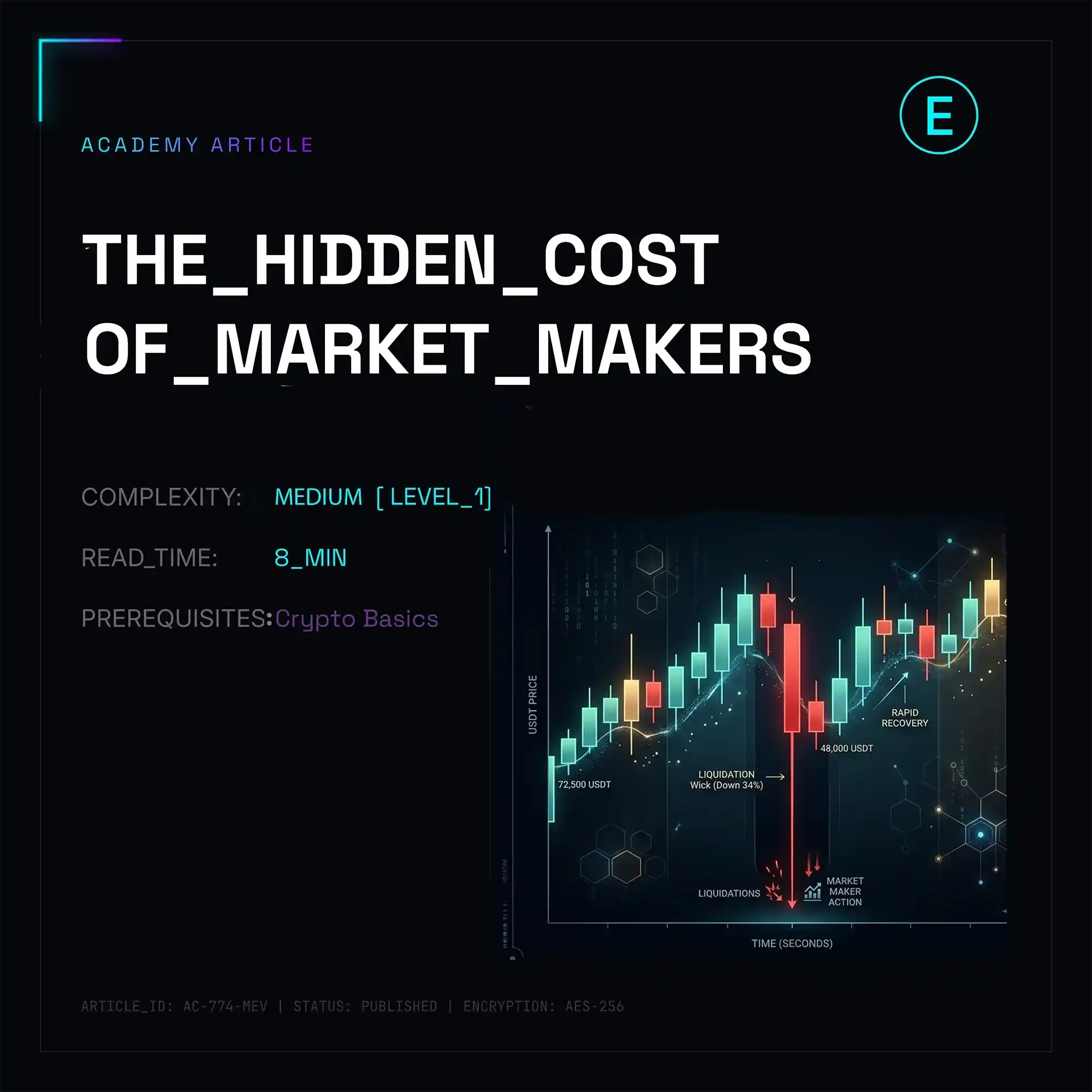
A textbook example of this is the volatile "wick"—those sudden spikes on the chart where the price on one specific exchange flash-crashes 5–10% below the global market average for a single second, sweeps the stop-losses of long positions, and instantly snaps back.
EXMON Analytics Brief:
The most high-profile incident of this kind went down in late 2025 on Binance. Due to aggressive moves by an affiliated market maker, a cascading squeeze in a USDT pair triggered liquidations for thousands of traders within a single one-minute candle—even though the index price on spot markets stayed perfectly flat. This is a classic example of third-party liquidity evaporating from the book exactly when the market needs it most.
3. Toxic Arbitrage
During periods of heavy macro volatility, third-party market makers simply pull the plug on their bots or widen their spreads to extreme levels to protect their own balance sheets. This leaves retail traders trapped in positions, unable to exit at a fair price.
The EXMON Architecture: Why We Don't Outsource Our Order Books
EXMON’s blockchain engineers and product team built our ecosystem on a completely different philosophy. We have completely banned the practice of onboarding external HFT firms with privileged data access.
| Feature | Exchanges with Third-Party MMs | The EXMON Ecosystem |
|---|---|---|
| Execution Priority | MM algorithms have the edge (ultra-low latency advantage) | Absolute equality for all orders in the engine queue |
| Order Flow Access | Exposed to partners (high risk of front-running) | Strictly confidential, end-to-end encrypted data |
| Order Book Depth | Artificial volume that vanishes during market dumps | Organic liquidity from P2P, native pools, and institutionals |
| Spreads During Volatility | Artificially widened by MM algorithms | Pure market-driven pricing with zero manipulative wicks |
Liquidity on EXMON is built on three independent, transparent pillars:
- Native Platform Liquidity Pools: Providing baseline depth without needing to turn a profit on slippage.
- Institutional Partners (No Front-Running): Compliance contracts strictly prohibit any access to internal order books.
- Organic Order Flow: Driven by deep, built-in integration across Spot, P2P, and Staking primitives within a unified clearinghouse.
The EXMON matching engine processes orders on a strict FIFO (First In, First Out) basis. No market participant, no matter how big, has the technical backdoor to cut the line ahead of your trade.
The Takeaway (Actionable Insight)
Trading on platforms backed by third-party market makers means playing a game with negative mathematical expectation. You aren't trading against the market—you're trading against an algorithm that can see your hand.
To stop losing money to manipulative squeezes and artificial slippage, it's time to move your capital to clean liquidity. Set up an account on EXMON, clear verification, and test out order execution across our trading pairs. See for yourself what a precise, fair, and truly organic spot order book feels like.