
Technical analysis is often dismissed as reading tea leaves. In reality, it is simply the mathematically grounded behavior of the crowd, packaged into visual formations. In a world where 80% of trades are executed by algorithms, the winner isn't the one hunting for a "secret indicator," but the one who understands the psychology of price levels.
Today, we’re breaking down three patterns that show an abnormally high statistical probability of playing out. We’re moving away from classic textbook definitions and adding "institutional filters" so you don’t end up as exit liquidity for the big players.
1. The Head and Shoulders Pattern (Gartley/Schabacker Edition)
This is the gold standard of trend reversals. However, the secret is that 90% of its success depends on volume and the slope of the neckline.
The Core Structure:
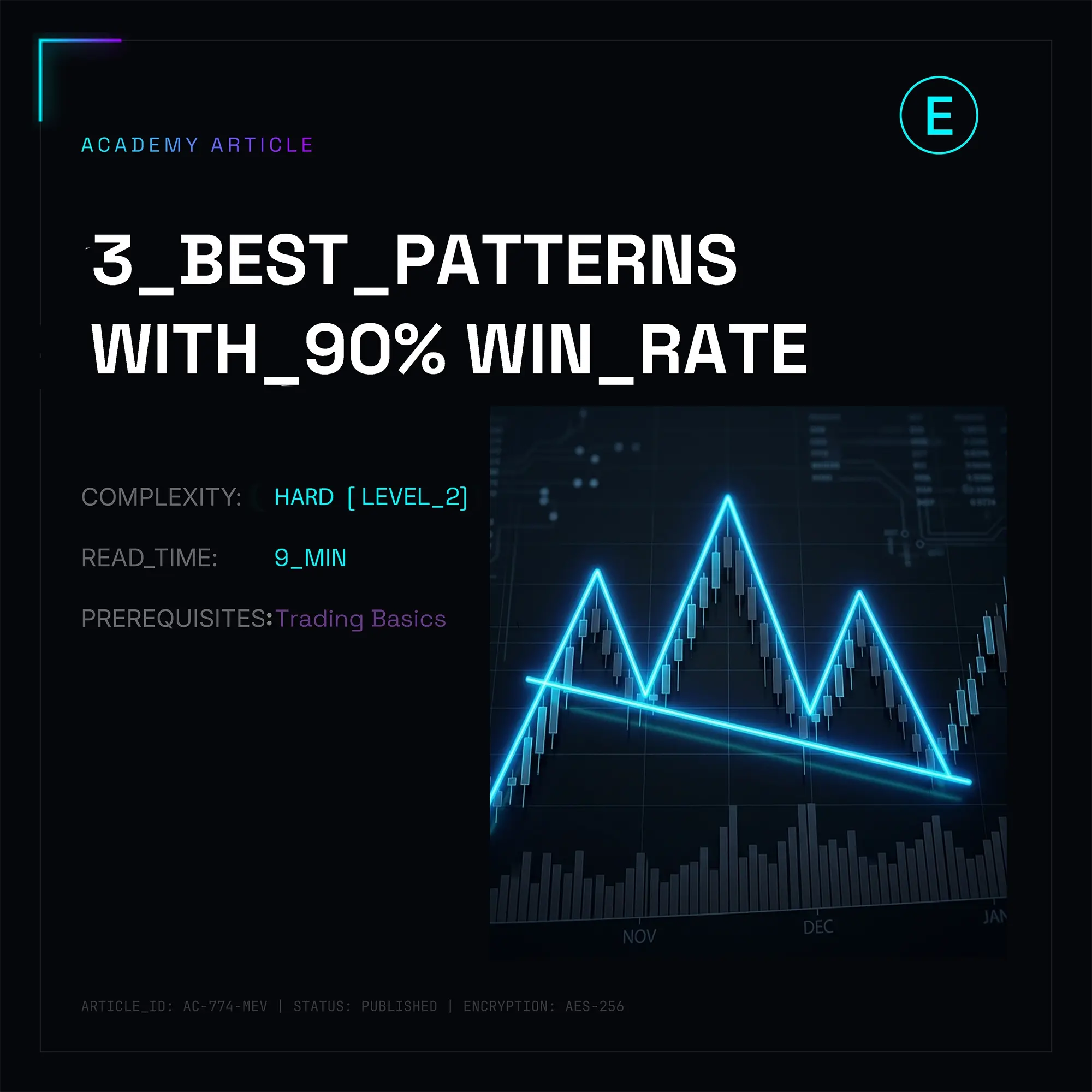
The pattern consists of three peaks: a left shoulder, the highest point (the head), and a right shoulder that sits lower than the head.
- Left Shoulder: Forms on a strong bullish impulse with high volume.
- The Head: Price hits a new high, but volume is often lower than the left shoulder (the first sign of buyer exhaustion).
- Right Shoulder: A final attempt by the bulls to regain control that ultimately falls flat.

The Secret Filter: "Neckline Slope"
If the neckline (the support connecting the lows) is sloping upward during a bullish trend, it’s a weak signal. If the neckline is already sloping downward, it confirms that sellers began dominating even before the pattern completed. The probability of this scenario playing out is significantly higher.
Table: Rating H&S Pattern Quality
| Parameter | Weak Signal (50/50) | High-Probability Signal (90%+) |
|---|---|---|
| Volume at Head | Higher than Left Shoulder | Lower than Left Shoulder |
| Right Shoulder | Higher than Left Shoulder | Lower or level with Left |
| Neckline | Sloping Up | Sloping Down |
| Reaction | Immediate entry on breakout | Breakout + Retest of the neckline |
2. Bull/Bear Flag (Trend Continuation)
If the H&S is about the reversal, the Flag is the best way to hop onto a moving train. Its stats are impressive because it represents a "breather" (accumulation) phase before the next leg up.
How it Works:
- Flagpole: A sharp, almost vertical price surge.
- The Flag: A tight descending channel (for a bull flag) with clear boundaries.
- The Exit: A break above the upper boundary of the channel on a volume spike.

The Pro Tip: The "50% Rule"
Institutional traders watch the depth of the flag's retracement. If the price drops below the 50% Fibonacci level of the flagpole, the pattern is considered broken. An ideal flag "breathes" within the 0.236 – 0.382 range.
3. Ascending Triangle (The "Squeeze")
This pattern is a nightmare for short sellers. It appears as a horizontal resistance level that price keeps hitting from below, while each subsequent low is higher than the last.
Why it Works:
A horizontal level is a wall of limit sell orders. Rising lows show that buyers are willing to scoop up the asset at increasingly higher prices without waiting for deep pullbacks. Pressure on the level builds until an "explosion" occurs.

Smart Money Advice:
Never enter a position on the mere "touch" of a level. Wait for the moment the price starts "sticking" to the resistance in a very tight range. This is known as volatility compression.
Code Filter (Pine Script for TradingView)
For those looking to automate the search for these zones, here is a Pine Script example that highlights "squeeze" zones (rising lows against a static high):
//@version=5
indicator("Squeeze Detector", overlay=true)
lookback = 20
highBarrier = ta.highest(high, lookback)
lowsRising = ta.low > ta.low[1] and ta.low[1] > ta.low[2]
// Condition: price near local high, but lows are trending up
isSqueeze = (high > highBarrier * 0.98) and lowsRising
plotshape(isSqueeze, title="Squeeze Alert", location=location.belowbar, color=color.green, style=shape.triangleup, size=size.small)
The "90% Success" Psychological Trap
It is crucial to understand: a pattern doesn't work because it’s a "magic shape," but because stop-losses of market participants are sitting right outside its borders.
- In a Head and Shoulders, stops from everyone who bought the rally sit below the neckline.
- In an Ascending Triangle, stops from everyone who opened a short position sit above the resistance.
Their forced liquidations (market buying or selling) create the very momentum we call a "pattern breakout."
Now that we’ve covered the basics, let’s dive into the nuances that separate the amateurs from the pros: handling fakeouts, risk management, and a "hidden" pattern that most traders mistake for simple market noise.
4. The Hidden Gem: The "Quasimodo" (Over-Under Pattern)

This pattern is considered an advanced version of the Head and Shoulders and is a favorite among Smart Money traders. Its main draw is a significantly better risk-to-reward ratio ($RR$).
How it Forms:
- Price hits a new high (High).
- A pullback follows (Low).
- Price rallies to a new, higher high (Higher High), flushing out short-sellers' stops.
- The Turning Point: Price drops sharply and breaks below the previous low, creating a Lower Low.
Why it Works:
In a classic H&S, we wait for the neckline break. With a "Quasimodo," we look for an entry at the Left Shoulder level immediately after the market structure breaks (the Lower Low). This allows you to catch a short at the very beginning of the reversal.
Golden Rule: When a Quasimodo forms at a major historical resistance level or within an institutional Supply Zone, the probability of a successful trade climbs toward that 90% mark.
Technical Table: Pattern Efficiency Comparison
| Pattern | Type | Optimal Timeframe | Primary Risk |
|---|---|---|---|
| H&S | Reversal | 4H and above | Neckline fakeout (choppy price action) |
| Bull Flag | Continuation | Any | Deep retracement (turns into a channel) |
| Ascending Triangle | Breakout | 1H, 4H | False breakout and return to range |
| Quasimodo | Reversal | 15m (Entry), 1D (Context) | No return to the left shoulder |
5. How to Avoid the "Fakeout" Trap
Even the most perfect pattern can fail. To minimize losses, pros use the Double Confirmation Method:
- Volume Filter: A breakout must be driven by a long-bodied candle with volume at least 1.5–2 times higher than the 20-period average. If price breaks out on low volume, there is an 80% chance it's a trap.
- The Retest: Instead of chasing the breakout, wait for the price to return to the broken level. Former resistance must flip into support.
Volume Filtering Example (Pine Script):
This snippet helps you visually identify breakouts confirmed by "smart money" on your chart.
//@version=5
indicator("Smart Breakout Volume", overlay=true)
avgVol = ta.sma(volume, 20)
isHighVolume = volume > avgVol * 1.5
// Highlight candle if it breaks local high on high volume
breakout = high > ta.highest(high[1], 10) and isHighVolume
plotshape(breakout, "Strong Breakout", style=shape.labeldown, location=location.abovebar, color=color.new(color.yellow, 0), text="VOL!", textcolor=color.black)
Practical Risk Management Tips
No pattern is a 100% guarantee. Your goal is positive expectancy.
- Stop-Loss Placement: In an Ascending Triangle, place your stop under the most recent higher low. In a Flag, place it below the lower boundary of the flag itself.
- Take-Profit: For a Flag, the target is usually the height of the flagpole. For H&S, it’s the distance from the head to the neckline, projected from the breakout point.
- Moving to Break-even: Once price covers 50% of the distance to your target, move your stop to the entry point.
Pro Tip: The Time Factor
If an ascending triangle takes too long to form (more than 40-50 candles on your chosen timeframe), it starts losing steam. The market "gets used" to the level, and buying pressure dries up. The most powerful breakouts typically occur between the 15th and 25th candle of the structure's formation.
Wrapping up our deep dive. We’ve covered structures and mechanics; now let’s move on to synthesis: how to tie it all together into a functional trading system and which overlooked details to watch for so you don't fall prey to market maker manipulation.
6. Three Drives Pattern
This is a pattern that often precedes a reversal after a strong trend. It’s rarely covered in basic courses, but it works in 90% of cases when the market is overbought or oversold.

Characteristics:
- Three consecutive symmetrical highs (or lows in a bearish case).
- The second and third drives must be confirmed by divergence on an indicator (like RSI or MACD). This signals that while price is moving on inertia, the actual buying pressure is fading.
7. Confluence: The Professional’s Secret
Pros never trade a pattern in a vacuum. High probability (90%+) is only achieved when a pattern aligns with other factors.
Confluence Checklist:
- Level: The pattern formed at a major horizontal level or a flip level (former resistance turned support).
- Fibonacci: The entry point coincides with the 0.618 or 0.786 retracement levels.
- Round Numbers: The price ends in .00 or .50 (psychological levels where orders cluster).
- Timing: The breakout occurs during the London or New York open, when market volatility peaks.
8. Table: Targets and Invalidation Levels for TOP-3 Patterns
To give you a quick reference, I’ve consolidated all the key trade management data into one table:
| Pattern | Entry Point | Stop Loss Placement | Take Profit Target |
|---|---|---|---|
| H&S (Head and Shoulders) | After candle close below the neckline | Above the right shoulder | Height of the "Head" from the neckline |
| Flag | On the breakout of the upper channel boundary | Below the most recent swing low within the flag | Length of the flagpole from the breakout point |
| Ascending Triangle (Squeeze) | On an impulsive level breakout | Below the nearest "Low" of the squeeze | Distance equal to the base of the triangle |
9. Automation: Divergence Scanner Script
As mentioned above, reversal patterns (like H&S or 3-Drives) work best with divergences. Here is a useful snippet of Pine Script to help you spot these moments.
//@version=5
indicator("Divergence Finder", overlay=false)
rsiSource = ta.rsi(close, 14)
plot(rsiSource, color=color.white)
// Divergence Logic: Price makes a Higher High, but RSI makes a Lower High
priceHH = high > ta.highest(high[1], 10)
rsiLH = rsiSource < ta.highest(rsiSource[1], 10)
isBearishDiv = priceHH and rsiLH
plotshape(isBearishDiv, "Bear Div", style=shape.labeldown, location=location.top, color=color.red, text="DIV")
Summary: Golden Rules of Discipline
- Don’t trade the 1-minute charts. The noise there swallows even the strongest patterns. Stick to the 1H and 4H timeframes for analysis.
- A pattern is just a hypothesis. Until the price breaks the confirmation level, the pattern doesn't exist. Don't try to front-run it.
- Context beats the chart. If you see a Bull Flag on an asset that’s been in a freefall for a year, it’s likely a trap. Only look for patterns that align with the global trend.
Technical analysis isn't about fortune-telling; it's a craft of risk management. Using these three (plus bonus) patterns will give you a statistical edge that translates into consistent profits over the long haul.
Summarize this blog post with: