
Web2 giants have turned compute rentals into an exclusive, corporate-only boys' club. If you need an 8x NVIDIA H100 cluster today to fine-tune a model, AWS or Google Cloud will force you into a one-year upfront contract. We are talking around $4.50 per GPU hour—and that is assuming you can even pass their compliance screening. Startups without Series A venture millions get rejected at the pre-screening phase, usually with a hand-waving excuse about node chip shortages. In reality, independent devs face outright censorship: cloud providers have the technical capability to scan in-memory context and kill generation pipelines if the content trips their internal safety guidelines.
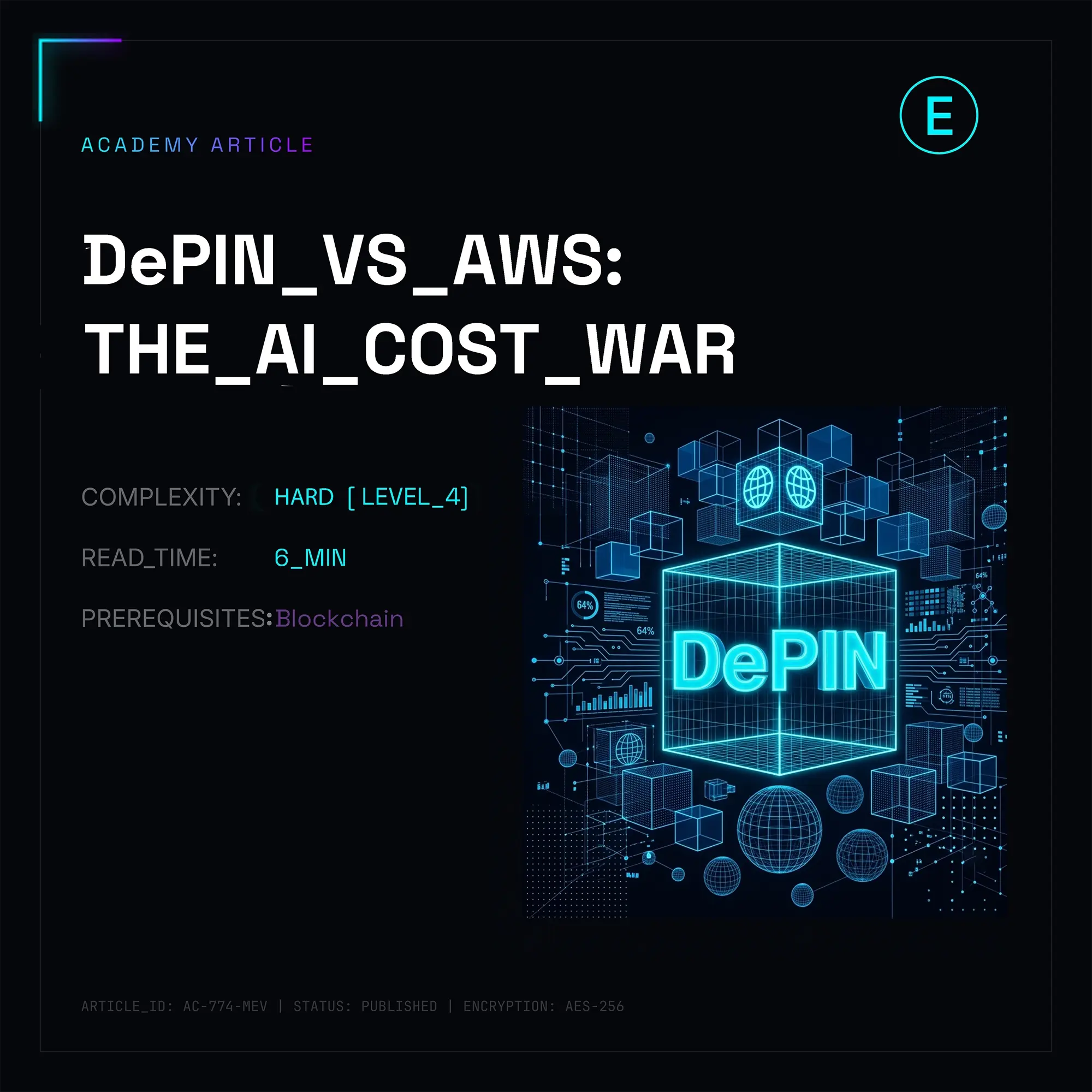
DePIN (Decentralized Physical Infrastructure Networks) is weaponizing aggressive price-cutting and underutilized hardware to completely hijack this market.
Pure Pragmatism vs. The Cloud Monopoly
Instead of dropping billions on massive data centers, decentralized networks aggregate computing power from independent miners, regional hosting providers, and high-end gaming rigs. The economic divide is stark once you break down the actual costs.
| Infrastructure Metric | Centralized Cloud (AWS / Azure) | DePIN Networks (Akash, Render, io.net) |
|---|---|---|
| Contract Terms | Rigid lock-in, strict compliance, 1-year minimum commitment | On-demand, per-minute billing, zero KYC |
| Avg. Cluster Cost (8x RTX 4090) | Unavailable directly (forced onto enterprise silicon at $30+/hr) | $4.50 – $6.20 per hour for the entire cluster |
| Escrow & Guarantees | Corporate credit lines, legal contracts | Native token staking by the provider to back SLAs |
| Data Privacy | Provider retains full root access to the VM | Hardware-level isolation via TEE enclaves |
Web2 legacy providers bake massive operational overhead into their pricing: army-sized middle management, real estate portfolios, and heavy marketing spend. Decentralized networks completely bypass these costs. A host operating out of Eastern Europe with access to cheap $0.06/kWh power is perfectly happy renting out RTX 3090s or 4090s practically at cost, making their margin on pure volume and tokenomics-driven network subsidies.
Trustless Verification: Keeping Untrusted Hardware Honest
The ultimate engineering bottleneck for distributed compute is verification. You are shipping data payloads to a random, anonymous node. How do you guarantee they actually ran your prompt through the model instead of just returning a stream of garbage bytes to save on their power bill? Standard cryptographic hashing fails here—AI inference is inherently non-deterministic.
This is solved via Proof-of-Useful-Work (PoUW) backed by hard cryptographic proofs. Providers are required to execute tasks inside a hardware-isolated Trusted Execution Environment (TEE). Silicon-level primitives like AMD SEV-SNP or Intel SGX create encrypted enclaves in real time. The server owner cannot scrape ram, tamper with model weights, or leak client data even with physical access to the machine.
To scale this, the protocol pairs TEEs with optimistic verification. Outputs are randomly sampled and mirrored to secondary nodes. If a single bit mismatch is flagged, a hard slashing protocol triggers via smart contract. The malicious host’s stake is instantly burned. It is a brutal mechanism, but it guarantees absolute integrity without a single central middleman.
Brutal engineering, but it ensures total honesty in a zero-trust environment.
Hands-On Case Study: Deploying Llama-3 Inference on a DePIN Node
To spin up compute workloads in a decentralized network, developers don't need to mess around with complex web UIs. Everything is managed directly via CLI or API. Below is a production-ready Python script that hooks into a provider via a decentralized network, verifies the hardware enclave (TEE) to keep model weights secure, and spins up a text generation task using the lightweight, open-source Llama-3 model.
import os
import requests
import sys
# Initialize config for connecting to the DePIN provider
# The auth token is minted by a smart contract after staking funds into the pool
DEPIN_API_KEY = os.getenv("EXMON_DEPIN_KEY")
PROVIDER_ENDPOINT = "https://node-771a.node.exmon-depin.network/v1"
if not DEPIN_API_KEY:
    print("[ERROR] Missing network API key. Please set the EXMON_DEPIN_KEY environment variable.")
    sys.exit(1)
headers = {
    "Authorization": f"Bearer {DEPIN_API_KEY}",
    "Content-Type": "application/json"
}
def verify_hardware_attestation():
    """
    Verifies the hardware enclave (TEE) on the remote provider side.
    Ensures that the compute is running inside isolated AMD SEV-SNP memory.
    """
    try:
        response = requests.get(f"{PROVIDER_ENDPOINT}/attestation", headers=headers, timeout=10)
        if response.status_code != 200:
            return False

        attestation_data = response.json()
        # Verify the processor's cryptographic signature and isolation status
        if attestation_data.get("tee_status") == "verified" and attestation_data.get("provider_stake_active"):
            return True
        return False
    except requests.exceptions.RequestException:
        return False
def run_inference(prompt_text):
    """Submits the prompt for execution to the decentralized GPU cluster."""
    payload = {
        "model": "meta-llama/Meta-Llama-3-8B-Instruct",
        "messages": [
            {"role": "system", "content": "You are a precise technical assistant."},
            {"role": "user", "content": prompt_text}
        ],
        "temperature": 0.2,
        "max_tokens": 150
    }
    try:
        response = requests.post(
            f"{PROVIDER_ENDPOINT}/chat/completions",
            json=payload,
            headers=headers,
            timeout=30
        )

        if response.status_code == 200:
            result = response.json()
            return result["choices"][0]["message"]["content"]
        else:
            return f"[ERROR] Node compute failed. Error code: {response.status_code}"

    except requests.exceptions.RequestException as e:
        return f"[ERROR] Network connection to provider failed: {str(e)}"
if __name__ == "__main__":
    print("[INFO] Auditing node security...")
    if not verify_hardware_attestation():
        print("[CRITICAL] Node failed TEE validation. Local memory is vulnerable. Aborting.")
        sys.exit(1)

    print("[SUCCESS] Hardware enclave verified. Node is secure.")
    query = "Explain gas optimization strategies in Solidity loops."

    print(f"[INFO] Dispatching inference task. Query: {query}")
    output = run_inference(query)
    print("\n[NODE RESPONSE]:\n", output)
Tokenomics vs. The Inflationary Bubble
Early DePIN projects made the classic mistake of handing out tokens just for hooking up hardware to the network. This triggered a brutal overproduction crisis: miners printed inflationary coins, immediately dumped them into the order books, and crushed the price to absolute zero because there was no actual organic demand for the compute.
Modern protocols have pivoted to the Burn-and-Mint Equilibrium (BME) model. In this setup, the token functions as utility fuel rather than a basic reward. The client buying compute always pays a fixed fiat rate, but behind the scenes, the protocol automatically sweeps native tokens off the market and burns them. Hardware providers still earn minted tokens, but the issuance rate is directly pegged to the volume of burned coins.
When the network is slammed with real-world AI training workloads, the burn rate outpaces inflation, triggering a supply shock. This drives up the token price, which naturally bootstraps more miners with high-end rigs. The speculative hype becomes secondary; it transforms into a pure arbitrage play between commercial GPU rental rates, local power costs, and the current capacity of the global AI market.
In this tech stack, blockchain isn't just a trendy buzzword—it's the only viable infrastructure for spinning up a trustless marketplace where idle silicon can be commoditized into a liquid digital asset.