

Many traders think that making money is just about "guessing" the market direction. But the crypto market is a graveyard of deposits from those who were right about the trend but wrong on position math. In this article, we'll break down the mechanics of leverage "blows" and explain why the liquidation price is not just a number but a dynamic trap.
1. Anatomy of Liquidation: Why 1% Is a Big Deal
Liquidation happens when your Margin Balance (your deposit + unrealized profit/loss) falls below the Maintenance Margin.
Important detail: exchanges don’t wait until your balance hits zero. They liquidate a bit earlier to have enough funds to close your position in the order book.
The Mathematical Trap of Leverage
With 100x leverage, the price only needs to move against you by 0.8%–1% (including fees and maintenance margin) for your position to be forcibly closed. During high volatility, such swings can happen in seconds.
Example:
- You open a long BTC position at $100,000 with 50x leverage.
- Your margin: $2,000.
- The liquidation price will be around $98,500.
- If the price dips to $98,400 and then jumps back to $105,000, you still lose everything. You were right about the trend, but volatility kicked you out.
2. The Hidden Enemy: Mark Price
A key factor beginners forget: liquidation triggers not on the last trade price in the order book (Last Price) but on the Mark Price.
Mark Price is a weighted average of the asset price across several major exchanges. It protects against "order book manipulation" on a single exchange.
Danger: If the price on your exchange stays put while another market crashes, your position can be liquidated based on the Mark Price even though your trading terminal never hit the stop.
3. Scam Wick: Mechanics of "Wicks" and Cascading Liquidations
On low-liquidity pairs or during news events, "scam wicks" (Scam Wicks) appear.
- A sharp impulse occurs.
- Stop-losses and the first liquidations trigger.
- These market sells/buys push the price even further.
- Domino effect starts — a cascade of liquidations sweeps out even 3x and 5x leverage.
4. Practical Calculation: Python Script to Monitor Distance
To avoid relying on the exchange interface, professionals use their own calculations. Here's an example of how to calculate the actual distance to liquidation for isolated margin.
def calculate_liquidation_distance(entry_price, leverage, side="long", maintenance_margin_rate=0.005):
    """
    entry_price: entry price
    leverage: leverage (e.g., 20)
    side: direction ("long" or "short")
    maintenance_margin_rate: maintenance margin rate (usually 0.5% - 1%)
    """
    if side == "long":
        # Formula for Long: Liq = Entry * (1 - (1/Leverage) + MMR)
        liq_price = entry_price * (1 - (1 / leverage) + maintenance_margin_rate)
    else:
        # Formula for Short: Liq = Entry * (1 + (1/Leverage) - MMR)
        liq_price = entry_price * (1 + (1 / leverage) - maintenance_margin_rate)

    distance_pct = abs(entry_price - liq_price) / entry_price * 100
    return round(liq_price, 2), round(distance_pct, 2)
# Example for 20x leverage
price, dist = calculate_liquidation_distance(95000, 20, "long")
print(f"Liquidation price: {price}, Distance: {dist}%")
5. Lesser-Known Influencing Factors
A. Funding Rate
If you hold a high-leverage position for a long time, Funding can "eat away" your margin. Every 8 hours, your balance decreases. If the price stands still, your liquidation price gradually moves closer to the current price as available margin melts.
B. ADL (Auto-Deleveraging)
Even if volatility hasn’t liquidated you, during extreme moves the exchange may forcibly close your profitable position to cover losses of liquidated traders whose orders didn’t get filled in time.
6. How to Survive: "Anti-Fragility" Rules
- Never use Cross Margin without a stop-loss. One wrong entry on cross margin can wipe out your entire account balance.
- Room to maneuver. For volatile assets (altcoins), the liquidation distance should be at least 15–20%, automatically limiting leverage to 5x.
- Use Liq maps. Study "liquidation heatmaps" (Liquidation Heatmaps). Big players often move the price toward where most leveraged positions are, so they can close their large orders on others' liquidations.
7. Slippage Mechanics During Liquidation
One of the most painful and least discussed topics is why your balance is always wiped after a liquidation, even if the price barely touched the liquidation level.
When the liquidation trigger hits, the exchange places your position into the order book as a Market Order.
- During periods of high volatility, the order book "empties out."
- Your position gets filled at prices much worse than the liquidation price.
- The difference between the execution price and the liquidation price goes to the Exchange Insurance Fund.
Little-known fact: if the exchange's insurance fund is full, it can afford to close you slightly softer, but in 99% of cases, a volatile spike eats everything due to lack of liquidity at that moment.
8. Mathematical Model of "Volatility Noise"
For professional trading, it's important to understand the concept of ATR (Average True Range). If the ATR of an asset on the 1H timeframe is 2%, and your distance to liquidation is 1.5% (with 50x–60x leverage), mathematically you are guaranteed to be liquidated by market noise, even if the price eventually moves in your favor.
Formula for "Safe Leverage":
$$Leverage_{safe} < \frac{100\%}{k \cdot ATR}$$
Where k is the safety factor (usually 2 or 3).
If BTC moves on average 3% per day, safe leverage for holding a position over 24 hours is no higher than x10–x15.
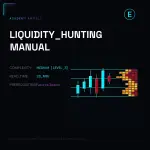
9. Advanced Tool: Liquidation Cascades and "Liquidity Hunting"
Market makers and big algorithms use liquidations as fuel.
- Under major support levels, stops and liquidation prices of longs accumulate.
- Price is pushed slightly below the level, either artificially or by a sudden impulse.
- The first wave of liquidations triggers → price drops further → the second wave triggers.
- The market maker buys this huge market sell volume with limit orders at very favorable prices.
Tip: Never set stop-loss exactly on "round numbers" or obvious levels. Place it significantly above/below, or use Time-based stops (closing the position if the price hasn’t moved into profit within N minutes).
10. Programmatic Strategy: Protection via API
If you trade via a bot, you can implement a "Dynamic Stop Relative to Liquidation" system.
# Logic to protect from liquidation spikes
def monitor_risk(current_mark_price, liq_price, threshold=0.02):
    """
    threshold: 2% buffer to liquidation
    """
    distance = abs(current_mark_price - liq_price) / current_mark_price

    if distance < threshold:
        print("WARNING: Dangerously close to liquidation! Exit the position or add margin.")
        # Here you should add code to close the position at market
        return True
    return False

# Usage: if Mark Price approaches liquidation by 2%,
# the bot automatically closes the position, preserving some margin without waiting for exchange clearing.
11. Specifics of Inverse Futures
This is the riskiest trap for those trading against BTC (or another asset) instead of USDT.
- In inverse futures, your margin is the asset itself.
- If the price drops, the dollar value of your margin also drops.
- This creates an accelerated liquidation effect: the price moves against you while your collateral devalues simultaneously.
- With a 33% price drop and 3x leverage on an inverse future, you will be liquidated, whereas on a linear (USDT) contract you would still have a buffer.
12. Survival Summary
- Isolated Margin — your best friend for high-risk trades. It limits loss to a single position.
- Funding rate — always check it before opening leverage above 20x. If it’s abnormally high (e.g., 0.1% per 8 hours), liquidation will "crawl" to you by itself.
- Watch the Mark Price, not the candles in the terminal. This is what actually triggers liquidation.