If you still think yield farming is just about throwing shitcoins into some random pool for 100% APR and praying the native token doesn't rug or wipe you out via impermanent loss (IL) by morning... Well, it’s time to grow up and look at the actual alpha used by hedge funds and institutional pros.
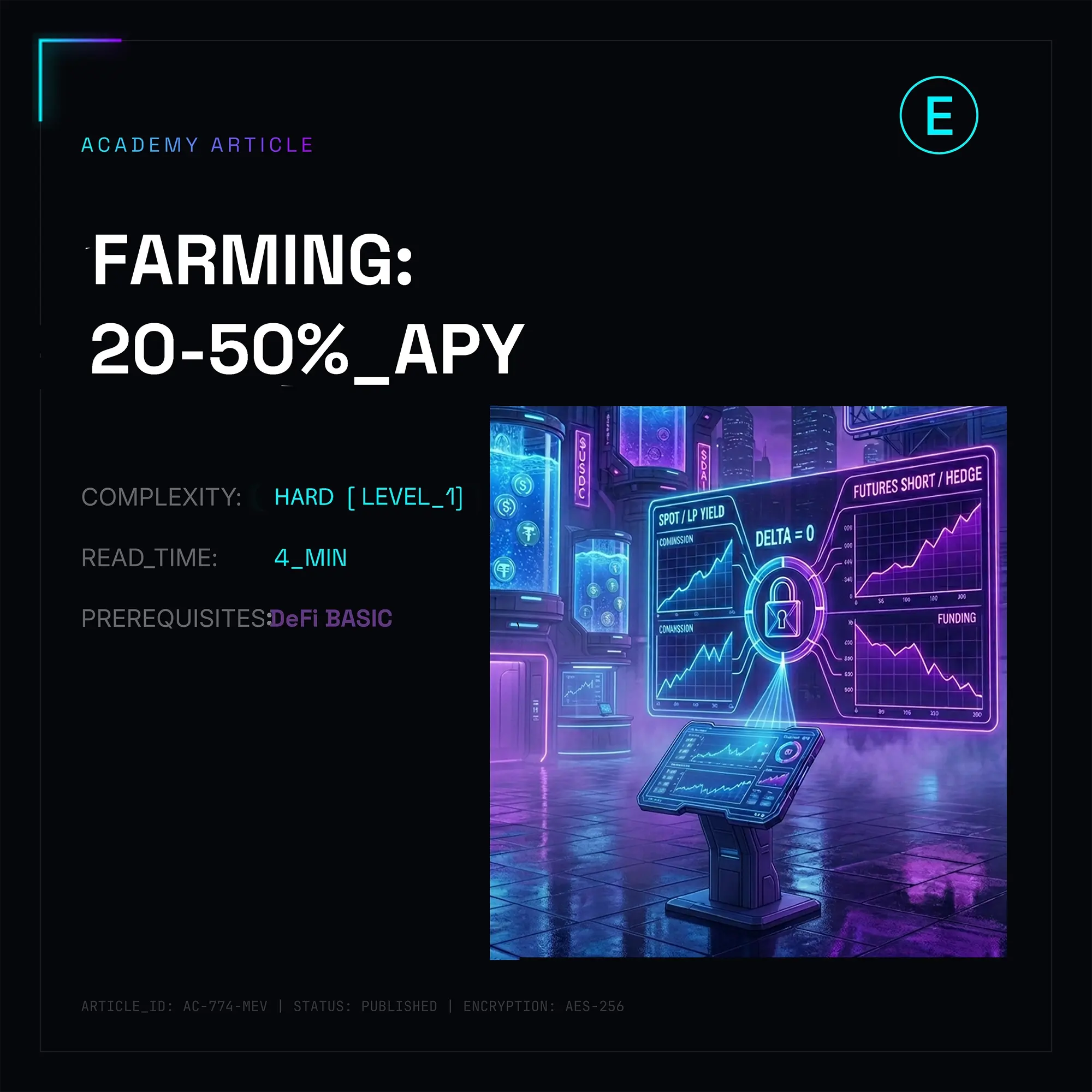
Today, we’re breaking down how to squeeze 20–50% APY in stables using Delta-Neutral Yield Farming. We are completely removing directional price risk from the equation. Just pure math, funding arbitrage, and automation.
Let’s dive in.
1. Deconstructing Delta Neutrality: The Core Mechanics
What is delta (Δ)? Simply put, it’s how sensitive your portfolio is to underlying price movements. If you hold 1 ETH spot, your delta is +1. If ETH pumps by $100, you make $100. If ETH dumps, you're underwater.
Our goal is to architect a setup where the total portfolio delta is strictly zero (Δ = 0$).
How do we execute this in crypto? Here is the classic blueprint:
- Spot (or LP Pool): Buy $1,000 worth of the asset. Your delta: +1.
- Futures (Perps): Open a $1,000 short on the same asset with 1x leverage. Your delta: -1.
Do the math: +1 + (-1) = 0. Price goes up? Your spot gains offset the perp losses. Price goes down? Your short prints while spot devalues. Either way, your total equity stays flat at $2,000.
Where is the yield coming from? You're capturing two revenue streams. First, the organic APR from the liquidity pool (swap fees + emissions). Second, the funding rate on the perp market. In a bullish market, long positions pay shorts every 8 hours just to keep their trades open. Since we are short, we collect that passive funding yield.
The Hidden Alpha: Arbitraged Deviances
Markets are inefficient, and that’s where off-chain oracle arbitrage comes into play. When funding rates on CEXs (like Binance) rocket to 0.1% per 8 hours (that's over 100% annualized just on the short leg!), perp DEXs like Hyperliquid or dYdX often lag behind by a few hours due to Pyth or Chainlink price update latency. Smart contracts exploit this exact gap—they lock in local delta-neutral positions on the DEX, extracting the premium before MEV and arbitrage bots can flatten the order book.
2. Execution Playbooks: From Lazy CEX to Hardcore DeFi
These strategies range from low-maintenance setups to high-yield, high-stress DeFi plays.
Playbook A: Spot + Perp (Classic Cash and Carry)
The safest route. Buy SOL on spot, move it to your futures margin account, and open a 1x SOL-PERP short.
- Pros: Zero smart contract risk (if using a tier-1 CEX). Liquidation is a non-issue because your short collateral scales linearly with the price of SOL.
- Cons: Yield is entirely at the mercy of market sentiment. If a crypto winter hits, funding flips negative, and you’ll end up paying to keep the position open.
Playbook B: Uniswap v3/v4 LP + Perp Short (Advanced DeFi)
This is where the real money is made. We take an ETH/USDC pair and deploy it into a tight, concentrated liquidity range on Uniswap v3. This generates massive fee APR (sometimes north of 100%). The catch? In a tight range, your position's delta is dynamic—it shifts constantly.
The Technical Pain Point: If ETH pumps, the pool automatically forces you into USDC, flattening your spot ETH delta to zero. Meanwhile, your perp short keeps bleeding money. This is called Gamma Risk. If you don't rebalance immediately, you get wiped. To survive here, you need to write custom bots that dynamically adjust your perp hedge size to mirror the real-time composition of your LP pool.
Strategy Comparison
| Strategy | Target APY (Stablecoin) | Key Risks | Capital Requirement | Management Frequency |
|---|---|---|---|---|
| CEX Cash & Carry | 12% — 25% | Exchange insolvency, negative funding rates. | From $100 | Weekly check-in (monitor funding) |
| DEX LP + CEX Short | 25% — 45% | Impermanent loss, liquidity desync. | From $5,000 | Daily / Automated via bot |
| GMX GLP / Pendle PT | 18% — 35% | Smart contract exploits, derivative depegs. | From $1,000 | Monthly check-in |
3. The Risks Twitter Influencers Never Mention
Remember: there is no such thing as a free lunch. Going delta-neutral kills directional risk but exposes you to structural landmines.
- Cascading Liquidations via Scam Wicks. Crypto is famous for barting and scam wicks—a sudden 15% spike up that gets completely retraced minutes later. If your short is leveraged past 2x, your perp leg gets liquidated before the spot/LP side can register the gains on-chain.
- Execution Risk. When it's time to unwind, your DeFi pool might require a multi-step transaction. If the network halts (classic Solana high-congestion era), your CEX short stays open while the market rips upward. You end up burning money every second your tx sits pending in the mempool.
- Funding Reversals. You enter a pool chasing 40% APY. Three days later, the hype dies, longs close out, and funding goes deeply negative. Now you're bleeding 15% APY just to hold the position. The strategy is dead, and gas fees have already eaten your early profits.
4. Automating the Playbook: Python Implementation (web3.py)
Enough theory. Let’s build a basic monitoring script that tracks the delta imbalance between your DeFi LP position and your CEX hedge. We'll focus on the heavy lifting: fetching real-time data from a Uniswap v3 pool to compute your live spot delta.
To calculate the delta of a Uni v3 LP position, we need to extract the current tick and liquidity directly from the pool contract state.
import math
from web3 import Web3
# Connect to RPC (use private endpoints; public nodes will 429 you)
RPC_URL = "https://eth-mainnet.g.alchemy.com/v2/YOUR_API_KEY"
w3 = Web3(Web3.HTTPProvider(RPC_URL))
# Minimal Uni v3 pool ABI for slot0 and liquidity reads
UNIV3_POOL_ABI = [
    {"inputs":[],"name":"slot0","outputs":[{"internalType":"uint160","name":"sqrtPriceX96","type":"uint160"},{"internalType":"int24","name":"tick","type":"int24"},{"internalType":"uint16","name":"observationIndex","type":"uint16"},{"internalType":"uint16","name":"observationCardinality","type":"uint16"},{"internalType":"uint16","name":"observationCardinalityNext","type":"uint16"},{"internalType":"uint8","name":"feeProtocol","type":"uint8"},{"internalType":"bool","name":"unlocked","type":"bool"}],"stateMutability":"view","type":"function"},
    {"inputs":[],"name":"liquidity","outputs":[{"internalType":"uint128","name":"balance","type":"uint128"}],"stateMutability":"view","type":"function"}
]
POOL_ADDRESS = "0x88e6A0c2dDD26FEEb64F039a2c41296FCB3f5640" # USDC/ETH 0.05%
def get_pool_delta(pool_address, tick_lower, tick_upper):
    contract = w3.eth.contract(address=w3.to_checksum_address(pool_address), abi=UNIV3_POOL_ABI)

    # Batch contract calls to minimize RPC roundtrips
    slot0 = contract.functions.slot0().call()
    liquidity = contract.functions.liquidity().call()

    current_tick = slot0[1]
    sqrtPriceX96 = slot0[0]

    # Calculate spot price adjusting for USDC (6 decimals) and ETH (18 decimals)
    price = (sqrtPriceX96 / (2**96)) ** 2 * (10**12)

    # Uniswap v3 math for tracking current asset exposure
    sqrtA = math.sqrt(1.0001 ** tick_lower)
    sqrtB = math.sqrt(1.0001 ** tick_upper)
    sqrtPrice = sqrtPriceX96 / (2**96)

    if current_tick < tick_lower:
        # Position is 100% ETH
        eth_amount = liquidity * (sqrtB - sqrtA) / (sqrtA * sqrtB)
    elif current_tick > tick_upper:
        # Position is 100% USDC, zero ETH delta exposure
        eth_amount = 0
    else:
        # Position is in-range; extract the current active ETH component
        eth_amount = liquidity * (sqrtB - sqrtPrice) / (sqrtPrice * sqrtB)

    # Convert from Wei to human-readable format
    eth_delta = eth_amount / (10**18)
    return eth_delta, price
# Define your LP range parameters (e.g., price boundaries at 3000-3500)
TICK_LOWER = 198000
TICK_UPPER = 202000
eth_delta, current_price = get_pool_delta(POOL_ADDRESS, TICK_LOWER, TICK_UPPER)
print(f"Current ETH Price: ${current_price:.2f}")
print(f"Live Spot Delta (Short size needed on CEX): {eth_delta:.4f}")
# TODO: Plug in ccxt.create_market_order() here to automate hedging
# If delta drift exceeds threshold, trigger rebalance transaction immediately.
Debugging common integration errors
If your script returns garbage numbers, always audit the token decimals. Uniswap dictates Price as token1/token0. In the USDC/ETH pair, token0 is USDC (6 decimals) and token1 is ETH (18 decimals). This requires the explicit 10^{12} scaling factor in the price derivation formula (10^{18-6} = 10^{12}). Mess up token ordering in a different pool, and your bot will miscalculate delta, ape into a massive over-leveraged short, and market-sell your portfolio into oblivion.
5. The Practical Checklist for Safe Deployment
A step-by-step operational framework to make sure you don't lose your shirt.
- Screen for Funding Anomalies. Hit Coinglass and filter for altcoins where short funding rates clear 0.05% per 8-hour epoch.
- Verify Spot Market Depth. The order book must be thick. If you suffer a 5% slippage on entry just buying the spot asset, it will take you two months of funding collection just to break even. Don't do it.
- Isolate Your Margin. On your futures sub-account, utilize STRICTLY isolated margin backed by stablecoins (USDT/USDC). Never use cross-margin, or a single rogue short squeeze on one asset will drain your entire account balance.
- Define Hard Exit Thresholds. Know your walk-away point. If the aggregate APY drops below 15%, close the entire position. Below that, transaction friction and smart contract tail-risks make the trade strictly EV negative.
6. Advanced Level: Delta-Neutral Farming via Lending Protocols (Lending Arbitrage)
If you're too lazy to mess with CEX futures, or if regulatory hurdles won't let you touch perps, you can lock your delta to zero completely within DeFi. We're talking money markets here—Aave v3, Morpho, Spark.
The core playbook is simple: levered yield farming with a bulletproof hedge.
Step-by-step position setup:
- You start with a bankroll of $10,000 in USDC.
- Head over to Aave and deposit your USDC as collateral. This banks you a baseline APR on stables (~3–5%).
- Borrow a volatile asset against your stables. Let's use SOL. Borrow exactly the amount you plan to deploy into the farm. Say you borrow 50 SOL (equivalent to $5,000). Right now, your SOL delta is -50 (you owe these tokens back to the protocol; if SOL pumps, your debt load in USD spikes, and you take a hit).
- Take those 50 SOL and swap half (25 SOL) back into USDC.
- LP those 25 SOL + USDC into a pool (like Raydium or Orca on Solana) to capture a juicy APR (say, 60% driven by native token emissions).
The balancing act: Your LP account is sitting on +25 SOL. Your Aave debt is -50 SOL. Net delta: -25 SOL. Wait, that's not zero. To hit a perfect delta-neutral state, you use the remaining $2,500 from your spot balance to buy another 25 SOL and just hold it in your wallet (or park it in a risk-free liquid staking token like JitoSOL). Now the math checks out: +25 (in LP) + 25 (spot in wallet) - 50 (Aave debt) = 0.
If SOL tanks, your Aave debt shrinks, perfectly offsetting the losses in your LP pool. If SOL rockets, your debt grows, but your spot SOL in the wallet and pool appreciates at the exact same rate.
The technical pain point: LTV (Loan-to-Value) Liquidation Risk
If the market pumps hard, your Aave debt swells in dollar terms while your USDC collateral stays dead flat. The moment the value of those 50 SOL hits the critical threshold (usually 80-85% of your collateral value), Aave liquidates you. They'll wipe out your USDC and hit you with a massive liquidation penalty (~5%).
To prevent getting reked, your hedging bot needs to track the healthFactor via smart contract. If it dips below 1.2, the bot must instantly pull some SOL from the pool or wallet and pay down a chunk of the debt.
7. Smart Contracts and Automators: One-Click Setups
If you don't want to build this infrastructure from scratch or manage your own bots on AWS, there are aggregator protocols that handle everything under the hood using smart contracts.
Delta-Neutral Vaults (on Arbitrum, Solana). Vaults like Kamino or Jones DAO offer plug-and-play strategies. You deposit USDC, and the contract handles the leverage, shorts the perps on DEXs (like Drift or GMX), and automatically rebalances the position as price moves.
- Pros: Set-and-forget. Click one button and clip a clean 25% APR. The contract recalculates delta every single minute.
- Cons: Composability risk. If GMX gets exploited where the vault holds its short, or if the aggregator itself gets drained, you go to zero. Plus, they skim a hefty performance fee (up to 20% of your net profits).
8. Hidden Alpha: Yield Stripping with Fixed Income Derivatives (Pendle Finance)
One of the most underrated ways to lock in fixed delta-neutral yields without sniffing a futures market is splitting assets into PT (Principal Token) and YT (Yield Token) via Pendle.
You take an asset—like a stablecoin or a liquid staking derivative like eETH (ether.fi)—and split it. The PT token guarantees the return of your principal plus a fixed interest rate at maturity. This often locks in a 15–20% fixed APR in stables, subsidized by degens buying the YT tokens to speculatively farm points and airdrops.
How to turn this into a high-yield delta-neutral setup:
- Buy PT eETH on Pendle at a discount. You've just locked in, say, an 18% fixed APR denominated in ETH.
- Your only remaining risk is the price of ETH itself. To kill that risk, you open a short for the equivalent amount of ETH on a futures exchange.
The Result: You clip a high fixed APR in ETH, but your short completely hedges your downside in USD. Your yield is effectively locked in stables, shielded from any market cycles.
9. Daily Position Audit Checklist
If you're managing these positions manually, every morning starts with a quick health check. Set up a spreadsheet or a Grafana dashboard to track these exact metrics:
- [ ] Total Net Equity (Spot + Margin) in USD. Did it drift? (Should be stable within +/- 0.5%).
- [ ] Current Funding Rate. If it flipped negative and stays there for more than two prints (16 hours), compute the bleed to see if the short is still viable.
- [ ] Lending Health Factor. Anything below 1.3 is the danger zone. Time to top up collateral.
- [ ] Divergence Loss (Impermanent Loss) in LP pools. How far has price drifted from your entry? Do you need to adjust and refit your range?
If even one box flashes red, you tear down and rebuild the position. Delta-neutral farming is never a "set-and-forget" play. It's a non-stop risk management grind, where your yield is the direct payout for your discipline and technical edge.