

Polymarket’s “BTC Up/Down” 5-minute markets have emerged as one of the most liquid and fast-paced sectors in the prediction market industry. However, they’ve also spawned countless myths about “easy money.” In reality, it’s a high-tech environment where only those who truly grasp the mechanics of the CTF Exchange and fee dynamics manage to survive.
Previously, we explored: Why has 2026 become the era of "event-driven risk hedging"? In this article, we’ll dive into the inner workings of these markets, the profit math, and the technical hurdles of bot implementation.
1. Mechanics and Settlement
Unlike traditional binary options, Polymarket’s markets are built on the Conditional Token Framework (CTF) on the Polygon network.
- Format: 288 windows per day (24/7). The identifier (slug) always follows the pattern: btc-updown-5m-{timestamp}.
- Data Source: They use Chainlink Data Streams. This is a game-changer because price update latency is minimal, making classic arbitrage against the oracle virtually impossible.
- Finalization: Settlement occurs approximately 128 seconds after the window closes. This buffer is required for L2 transaction confirmation and smart contract condition checks.
2. Fee Math: The Arbitrage Killer
The biggest shift occurred in January 2026 with the introduction of dynamic Taker Fees.
- Peak Fee: At a 50/50 probability (outcome price at $0.50), the fee hits 1.56%.
- Dynamics: As the price approaches extremes ($0.05 or $0.95), the fee drops, trending toward 0%.
- Makers: They pay 0% fees and receive a 25% rebate on the fees paid by takers.
The Takeaway: Attempting to “snipe” the price direction in the final 10 seconds (Latency Arb) when the price is near $0.50 is now mathematically underwater. The taker ends up paying more than their mathematical expected value.
3. Strategies: What Works vs. What’s Myth
Strategy #1: Latency Arbitrage (Taker Sniping)
The Concept: Monitoring BTC prices on Binance (via WebSocket) and buying the winning side on Polymarket 5–10 seconds before the close.
- Status: Effectively dead for small-scale players.
- Profitability Condition: Only viable when the outcome price is > $0.85, where fees are negligible. You’ll need a bankroll of $5,000–$10,000 just to cover operational costs and slippage.
Strategy #2: Two-Sided Quoting (Market Making)
Placing resting limit orders for both YES and NO simultaneously.
- The Upside: You capture the spread plus the 25% maker rebate.
- Risk (Adverse Selection): This is the main trap. When the market moves sharply, "smart" takers will clear your orders on one side, leaving you with a "naked exposure" that devalues faster than your spread earnings.
Strategy #3: Straddle Arbitrage
Trying to buy both sides so that the total cost is < $1.00.
Reality: Analysis of 9,191 windows shows this opportunity only pops up in about 0.9% of cases. You can code a bot for this, but it’ll be sitting idle 99% of the time.
4. Technical Barriers and Pitfalls
If you’re planning to build a bot in Python using the official py-clob-client library, be ready for these headaches:
- Library Bugs: There are at least 14 known critical issues, ranging from float precision errors (causing rounding failures during order submission) to WebSocket hangs and tick cache memory leaks.
- Heartbeat API: To keep your limit orders live, you must hit the /heartbeats endpoint with a POST request every 5 seconds. Miss one, and the system auto-cancels all your orders (Liveness Check).
- Processing Speed: The time from signing a transaction to matching in the CLOB (Central Limit Order Book) and finalization on Polygon is between 5 to 12 seconds. This "vulnerability window" must be factored into your bot's logic.
5. Practical Example: Order Structure
Operating on the Polymarket CLOB requires EIP-712 signatures. Here’s what a maker order object looks like (Solidity/Python logic):
# Example parameters for creating a limit order (pseudocode)
order_params = {
    "price": 0.51,             # Your bid price
    "size": 100.0,             # Number of contracts
    "side": "BUY",             # Order direction
    "token_id": "...",         # Token ID (YES or NO for the specific window)
    "expiration": timestamp,    # End of the 5-minute window
    "maker_address": "0x...",  # Your wallet address
    "post_only": True          # Critical: ensures the order only executes as a maker
}
Little-known fact: There’s a "Ghost Fill" vulnerability (incrementNonce attack). An attacker can watch the mempool for your cancellation and front-run it with a higher gas fee to fill your order right before it becomes invalid.
6. How Do the Pros Scale?
Analysis of top-tier maker wallets (like 0x8dxd) shows a clear operational pattern:
- Frequency: 40,000+ trades per day.
- Size: Tiny lots ($3–$5 per trade).
- The Secret: They don't try to predict the market. They manage inventory. If a bot gets too heavy on YES tokens, it automatically shifts its quotes to entice NO buyers, balancing the position before expiry.
7. Trading Bot Architecture: A Low-Latency Approach
To truly compete in 5-minute markets, a standard Python script usually falls short due to the Global Interpreter Lock (GIL) and sluggish JSON processing. Professional makers are migrating toward hybrid setups or pure Rust/Go implementations.
Critical system components include:
- WebSocket Manager: This must handle three independent, high-speed streams:
- Binance/Coinbase: A raw BTC Mark Price feed.
- Polymarket CLOB Orderbook: A real-time L2 data stream for order book updates.
- User Orders: An execution event stream (Fills) for your own positions.
- Inventory Controller: A module that calculates your "exposure" in real time. If you’ve accumulated 500 YES and 0 NO, the controller must aggressively lower your YES bid price to stop filling that side of the book.
- Signer Service: Offloading transaction signing (EIP-712) to a dedicated, isolated service written in a high-performance language (like Rust using the ethers-rs library) can shave 100-300ms off your latency.
8. Practical Logic: Inventory Skew
Instead of simply placing orders at a "fair" price, makers use a skew function to manage risk.
The Mathematical Model:
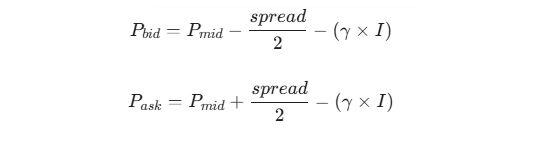
Where:
- Pmid: The current market mid-price (e.g., 0.50).
- Y: The risk coefficient (how much you fear position accumulation).
- I: Current inventory (the number of tokens held).
If your inventory (I) is positive (you're heavy on YES), you shift your quotes downward. This makes your buy orders less attractive to the market while making your sells more appealing to buyers, naturally rebalancing your book.
9. Insider Details and Exploits
The Nonce Attack (incrementNonce)
On the CTF Exchange (the backbone of Polymarket), order cancellations can occur via a nonce increment in the smart contract. Sophisticated players monitor "hanging" cancellation transactions in the mempool and push their own buy transactions with higher gas fees to fill against your order before it becomes invalid.
The py-clob-client Tick Cache Issue
The official library caches the minimum price increment (tick size). If Polymarket changes market parameters on the fly (e.g., moving from a $0.01 tick to $0.001), your bot will start throwing INVALID_PRICE errors as it attempts to submit orders based on outdated rounding rules.
The "Account Flipping" Reality Check
Stories of turning $300 into $400,000 in these markets are usually marketing hype or survivor bias. With an average maker yield of 0.1% to 0.2% on turnover, achieving those numbers requires:
- Massive leverage (which Polymarket doesn't natively offer).
- Colossal trading volume (tens of millions in daily turnover).
- Flawless spread management during periods of minimal volatility.
10. Mainnet Launch Checklist
- Liquidity Check: Never enter a market with a 24-hour volume below $100,000. You won't be able to exit your position without devastating slippage.
- Heartbeat Stress Test: Run your script for 24 hours without real capital. Monitor logs for "Order Cancelled by System." If you see them, your connection or heartbeat logic is unstable.
- Dust Management: Configure your bot to ignore token balances worth less than $0.01; otherwise, your wallet will quickly fill up with un-sellable "trash" balances.
- Chainlink Monitoring: Subscribe to alerts for Chainlink Data Stream delays. If the oracle hangs, your maker bot will keep quoting at stale prices and get instantly wiped out by arbitrageurs.
Conclusion
The BTC 5m markets on Polymarket are an elimination game. The real money isn't made by predicting Bitcoin’s price, but by efficiently selling liquidity to speculators and maintaining technical perfection. If you're building a system, focus on maker strategies with the 25% rebate—it’s the only sustainable source of alpha in this niche right now.
Summarize this blog post with: