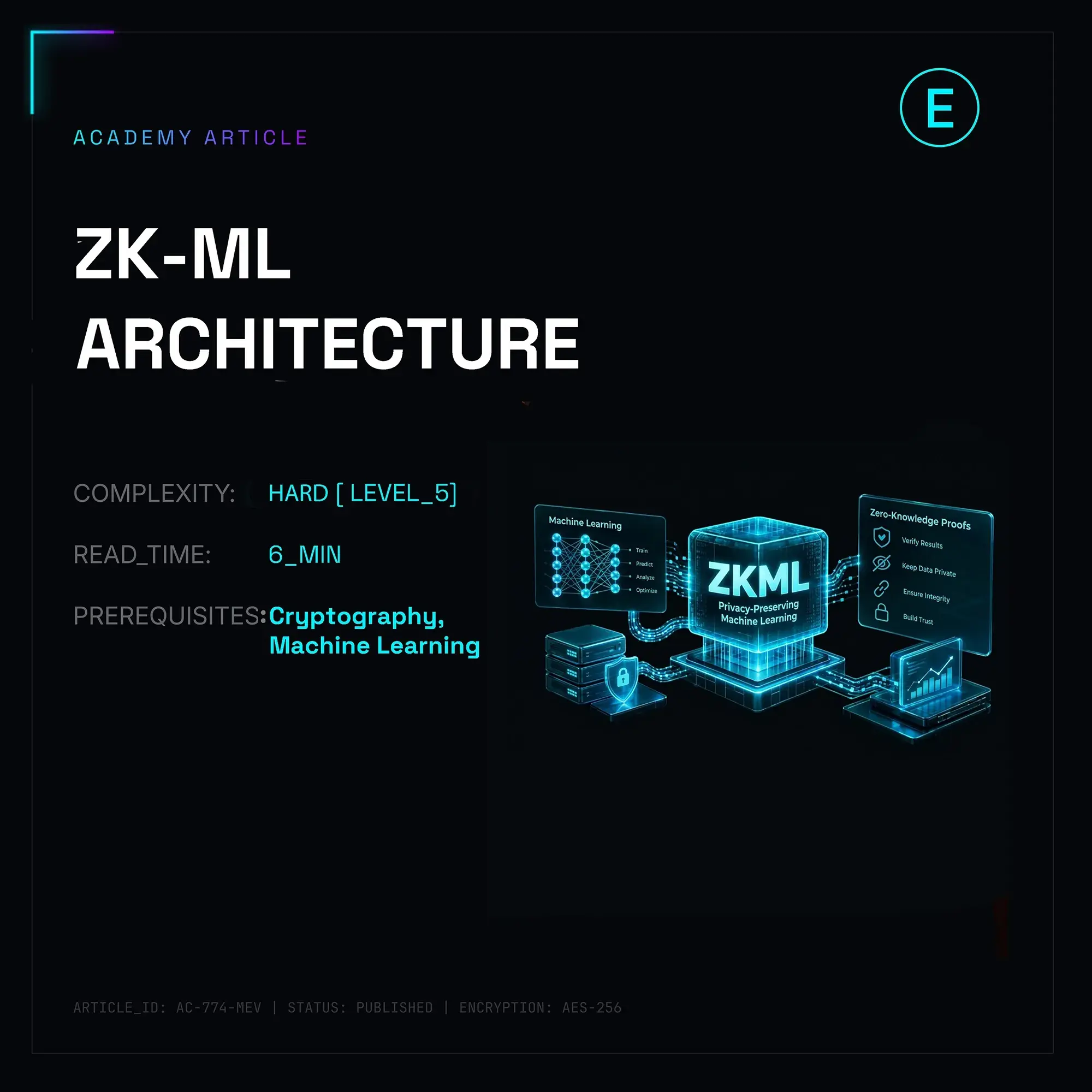
TL;DR: ZK-ML (Zero-Knowledge Machine Learning) compiles neural net inference down into arithmetic circuits over finite fields. This lets you cryptographically prove inside the EVM that a specific output y is genuinely the result of running model M(x) on input x, all while keeping model weights W, private data x, or both completely under wraps.
The AI Trust Deficit in Decentralized Systems
The deterministic nature of the Ethereum Virtual Machine isn't built to digest floating-point math, 1024 × 1024 matrix multiplications, or non-linearities. Any attempt to run native inference directly in the EVM instantly slams into the block gas limit (30M gas) and forces validators to waste time re-executing heavy computations, utterly tanking scalability.
Why Legacy Web3 AI Suffers from Black-Box Syndrome
Integrating AI into smart contracts without cryptographic proofs forces two sketchy compromises: centralized off-chain oracles or Trusted Execution Environments (TEEs like Intel SGX or TDX). In both cases, the smart contract essentially has to trust a third-party service on blind faith.
Oracle setups collapse the second real money is on the line: bribing a node operator or intercepting a backend API request is orders of magnitude cheaper than exploiting the smart contract itself. Meanwhile, TEE enclaves are routinely plagued by side-channel attacks (Spectre, Meltdown, Foreshadow), where an attacker siphons private keys straight out of CPU registers via microarchitectural leaks. The end result? Web3 protocols end up with a fragile crutch holding user funds hostage instead of truly decentralized AI.
The Role of Cryptographic Proofs (zk-SNARKs/zk-STARKs) in Verifying Inference
Zero-knowledge cryptography erects a trustless barrier: the heavy lifting of running the model is offloaded to beefy GPU/NPU servers off-chain, while a compact cryptographic attestation is shipped on-chain.
The smart contract stops doing compute entirely and becomes an impartial judge. It doesn't need to store gigabytes of weights; it just needs the verifier bytecode and the trusted setup constants (proving and verifying keys).
Once the asymmetric math of a zk-SNARK (like Groth16, PlonKy2, or UltraPLONK) validates the proof in a few milliseconds, the contract locks in a "True" status. A malicious operator can't fake the argument: the odds of generating a bogus proof without knowing the correct intermediate wire values are mathematically negligible (soundness error on the order of 1/2128).
ZK-ML: Anatomy of the Pipeline
Translating a deep learning model from PyTorch into a smart contract isn't just an ONNX export job—it's major surgery on the neural net's mathematical framework.
+------------------------+
| PyTorch / ONNX Model   |
| (FP32 Tensors)         |
+------------------------+
            |
            v
+------------------------+
| Quantization Engine    |
| (Fixed-Point / INT8)   |
+------------------------+
            |
            v
+------------------------+
| Circuit Compilation    |
| (R1CS / Plonkish)      |
+------------------------+
            |
            v
+------------------------+
| Prover (Halo2 / EZKL)  | ----> Generates ZK Proof (π)
+------------------------+
            |
            v
+------------------------+
| EVM Verifier Contract  | ----> Validates Proof via Pairing Check
+------------------------+
Model Preparation (Quantization & Circuit Compilation)
Weight matrices in PyTorch use FP32 (32-bit floating-point) data types. ZK crypto fields, however, operate strictly on integers modulo a large prime p (например, p = 21888242871839275222246405745257275088548364400416034343698204186575808495617 for the BN254 elliptic curve).
Engineers have to apply quantization. Fractional values get mapped to integers using a designated scale factor:
xquant = ⌊x · 2S⌋
where S is the scale factor. Some precision loss is inevitable here, which is why models are typically fine-tuned using Quantization-Aware Training (QAT).
Next, the computational graph is compiled down into an arithmetic circuit. Every basic operation (addition, multiplication) turns into an R1CS (Rank-1 Constraint System) gate looking like this:
(A · Z) ∘ (B · Z) = C · Z
Non-linear activation functions (ReLU, GELU, Sigmoid) are an absolute nightmare for ZK circuits. ReLU (f(x) = max(0, x)) demands bit decomposition or lookup arguments in Plonkish-style provers, which blows up circuit sizes by orders of magnitude instantly.
The Prover Phase (Prover Mechanics)
The prover takes the compiled circuit, public inputs/outputs, and private witness data (model weights or user inputs). Crunching the proof involves heavy high-degree polynomial arithmetic and running Fast Fourier Transforms (FFTs) over finite field polynomials.
The compute load on CPUs and GPUs here is staggering. For a ResNet-50 model, generating a proof on a top-tier GPU (like an Nvidia A100) can take anywhere from tens of seconds to a few minutes, chewing through up to 128 GB of RAM just to hold the witness vectors.
EVM Smart Contract Verification (Verifier Contract Gas Costs)
On Ethereum, verification boils down to an elliptic curve pairing check. The EVM provides native precompiles for BN254: ecAdd (0x06), ecMul (0x07), and ecPairing (0x08).
Gas expenditure and proof parameter breakdown for deployed verifier contracts:
| Scheme / Backend | Curve / Field | Proof Size (Bytes) | Verification Gas (EVM Gas) | Trusted Setup Requirement |
|---|---|---|---|---|
| Groth16 (EZKL) | BN254 | ~256-384 | ~190,000 – 230,000 | Yes (Per-circuit Ceremony) |
| UltraPLONK (Halo2) | BN254 / KZG | ~512-1024 | ~300,000 – 450,000 | Yes (Universal SRS) |
| STARK (Fri / Winterfell) | None (Hash-based) | ~80,000 – 200,000 | > 1,500,000 (Impractical in EVM) | No (Transparent) |
| Nova (Folding Scheme) | BN254 / Grumpkin | ~1024 (Recursive) | ~280,000 | Yes (Universal) |
Groth16 wins the gas battle by a landslide, but it demands a custom trusted setup ceremony for every single unique neural net topology. Change even one layer, and you have to run a brand-new setup.
Core Technical Challenges and Bottlenecks
ZK-ML is the ultimate playground of engineering tradeoffs, where you pay for cryptographic guarantees with raw compute power.
Proving overhead remains the industry's biggest speed bump. The ratio of prover time to native model inference time sits roughly around 105 - 106. Running a simple classification model inference takes 2 milliseconds on a CPU, whereas building the ZK proof for it will melt your server for 30 seconds.
Memory consumption is another beast. Multi-dimensional tensors expanded into R1CS constraints devour RAM faster than a resource-heavy AAA game. Try compiling a 7-billion-parameter LLM into a ZK circuit—you'll need a data center packed with petabytes of RAM and specialized ASIC accelerators that don't even exist in mass production yet.
Real-World Use Cases in DeFi and Security
Private credit scoring without leaking personal data takes Web3 lending to the next level. A borrower aggregates bank statements, real estate records, on-chain transaction history, and tax filings. The scoring model runs locally in the browser or on a mobile device via an EZKL WebAssembly module. A clean result—"Credit Score = 780"—along with a ZK proof is shipped straight to an Aave or Compound smart contract, which then grants a loan at a lower collateral ratio. Zero personal data leakage, zero risk to a centralized provider's database.
Autonomous trading agents with verifiable strategy integrity wipe out trust issues in crypto hedge funds. Imagine a quant fund managing $50M in DeFi running on a proprietary, closed-source ML model strategy. Investors want absolute proof that the fund manager isn't draining the treasury via MEV bots or sketchy wash trades. The fund generates a ZK proof for every portfolio rebalance, and the contract verifies that the trade was genuinely executed based on the model's mathematical output rather than a trader's personal whim.
Conclusion and the Future of Decentralized AI
ZK-ML shifts trust out of the social and legal realms entirely and into pure mathematics. The moment proof overhead drops another 100x thanks to advances in folding schemes and native hardware accelerators, smart contracts will stop acting like glorified calculators and evolve into autonomous, verifiable agents of a brand-new financial order.