
A bull run is the time when even the biggest fools make bank. You buy some dog-themed memecoin, go to sleep, and wake up to a 3x. Your group chats are flooded with PnL screenshots, everyone's planning to quit their day jobs, and Uber drivers are starting to give tips on which altcoin to bag on spot.
And that's the exact moment the market prepares to wipe you out.
Why does this happen? It’s simple: for a major player to lock in hundreds of millions in profits, they need massive buy-side liquidity to absorb their sells. Large capital can't just smash the "market sell" button at the bottom—they'd literally dump the price on themselves to zero. They need you—happy, confident, FOMO-fueled buyers who believe the line only goes up.
The higher the euphoria, the more exit liquidity there is for the whales to dump into.
How the Mechanics Actually Work
Forget the fairy tales about "shadowy market makers out to get you." It's way more cynical than that. It’s pure math and crowd psychology.
Every market cycle follows the exact same script:
- The Accumulation Phase. The market is dead, volume is nonexistent, and the media is either completely silent or spreading pure panic. Large wallets quietly vacuum up spot supply over weeks using limit orders. No hype, no noise.
- The Markup. Prices start ticking up, breaking local resistance levels. Mid-tier speculators FOMO in. Open Interest on futures begins to climb.
- Euphoria (Distribution). Price goes vertical, going full parabolic. Every mainstream outlet is screaming about a "new paradigm" and Bitcoin hitting a million bucks. Retail traders ape in with everything they’ve got, usually maxing out their leverage.
And this is where the magic happens. Whales start scaling out of their positions. They aren't shorting—they're just closing their longs directly into your buy orders.
Price stalls out, forming a local distribution range. And then, a single massive market sell order hits the books.
The Chain Reaction: Why the Dump is Always Violent
It takes months to climb the stairs, but only seconds to take the elevator down.
When the market is overextended, 90% of the crowd is sitting in longs with massive leverage. Say you're running 20x leverage. That means if the price drops a mere 5%, the exchange will forcefully liquidate your position.
A long liquidation is just an automatic market sell order triggered on your assets.
The anatomy of a cascade looks like this:
- A whale takes profit using a massive market order.
- The price dips 1% to 2%.
- This instantly triggers stops and liquidations for the degenerates running 50x to 100x leverage.
- These forced liquidations dump more market sell orders into the order book, pushing the price down even faster.
- We drop another 3%—and now the 20x leverage crowd gets liquidated.
Boom—you get a liquidation cascade. The order book gets hollowed out, and there's zero spot bid to support it. Within a few hours, the market wipes out billions of dollars in collateral. Euphoria turns to pure panic in a heartbeat.
The Metrics to Watch so You Don't Become Exit Liquidity
Stop reading the news. The media is designed to either lure you in at the top or shake you out at the bottom. Watch these three on-chain and derivative metrics instead.
| Metric | What to Look For | What It Actually Means |
|---|---|---|
| Funding Rate | Rates > 0.05% every 8 hours | Longs are heavily overleveraged. Traders are paying hand over fist just to keep their positions open. A flush is imminent. |
| MVRV Z-Score | Values above 6.0 | The asset is highly overvalued relative to its actual realized purchase price. The historical top is very close. |
| Open Interest (OI) | Vertical spike in OI while price goes sideways | An insane amount of leveraged degenerate money is flooding the market. Expect a massive, volatile sweep in either direction. |
A Simple Script to Check Futures Overheating
Below is a straightforward, no-nonsense Python script. No bloated console outputs or flashy dashboards—it just queries Binance via CCXT and prints out current funding rates for the major players. Run it before you even think about opening your next trade.
import ccxt
from statistics import mean
def funding_status(rate: float) -> str:
    """
    Classify the funding rate.
    rate is passed as a percentage.
    """
    if rate >= 0.10:
        return "EXTREME"
    elif rate >= 0.05:
        return "OVERHEATED"
    elif rate >= 0.03:
        return "BULLISH"
    elif rate <= -0.10:
        return "EXTREME SHORTS"
    elif rate <= -0.05:
        return "OVERSOLD"
    elif rate <= -0.03:
        return "BEARISH"
    else:
        return "NORMAL"
def check_funding():
    exchange = ccxt.binance({
        "enableRateLimit": True,
        "options": {
            "defaultType": "future"
        }
    })
    tickers = [
        "BTC/USDT",
        "ETH/USDT",
        "SOL/USDT"
    ]
    print("=" * 65)
    print("FUNDING RATE ANALYSIS (BINANCE FUTURES)")
    print("=" * 65)
    results = []
    for symbol in tickers:
        try:
            data = exchange.fetch_funding_rate(symbol)
            rate = float(data["fundingRate"]) * 100
            results.append({
                "symbol": symbol,
                "rate": rate
            })
        except Exception as e:
            print(f"Error fetching {symbol}: {e}")
    if not results:
        print("\nFailed to fetch data for any tickers.")
        return
    print("\nCURRENT RATES:")
    print("-" * 65)
    for item in sorted(results, key=lambda x: x["rate"], reverse=True):
        status = funding_status(item["rate"])
        print(
            f"{item['symbol']:<10} | "
            f"{item['rate']:>8.4f}% | "
            f"{status}"
        )
    rates = [x["rate"] for x in results]
    avg_rate = mean(rates)
    max_rate = max(rates)
    min_rate = min(rates)
    print("\n" + "=" * 65)
    print("STATS")
    print("=" * 65)
    print(f"Tickers checked       : {len(results)}")
    print(f"Average funding       : {avg_rate:.4f}%")
    print(f"Max funding           : {max_rate:.4f}%")
    print(f"Min funding           : {min_rate:.4f}%")
    overheated = [x for x in rates if x >= 0.05]
    extreme = [x for x in rates if x >= 0.10]
    print("\n" + "=" * 65)
    print("VERDICT")
    print("=" * 65)
    if len(extreme) > 0:
        print(
            "Extreme funding rates detected. "
            "The market is heavily skewed towards leveraged longs."
        )
    elif len(overheated) >= len(results) / 2:
        print(
            "A significant portion of tickers show "
            "elevated funding. Trade with caution."
        )
    elif avg_rate >= 0.03:
        print(
            "Moderate long bias observed, "
            "but no signs of extreme overheating yet."
        )
    elif avg_rate <= -0.03:
        print(
            "Heavy short bias observed."
        )
    else:
        print(
            "Funding is sitting comfortably within normal parameters."
        )
    print("\nImportant:")
    print(
        "Funding rate is not a standalone trading signal. "
        "For a proper analysis, combine this with "
        "Open Interest, volume, and price action."
    )
if __name__ == "__main__":
    check_funding()
The golden rule of surviving a bull market: know how to take profits. It’s far better to leave some money on the table and exit to cash early, than to sit at the absolute peak holding a bag of shitcoins down 90% hoping for another cycle to save you.
So, how do big funds actually dump their multi-million dollar positions without tipping off the market?
If a major fund tried to market-sell $200 million worth of Bitcoin at spot price, they'd instantly obliterate the order book and execute half their volume at a massive loss due to slippage. That's why they rely on stealth distribution strategies. Our job as traders is to spot these footprints on the charts and in the order book.
Stealth Execution Algorithms: TWAP and VWAP
Institutions don't trade manually through a standard terminal. They use execution algorithms. Here are the two most popular setups:
- TWAP (Time-Weighted Average Price). The algorithm chops a massive order into thousands of tiny slices and feeds them to the market at regular intervals (e.g., selling 0.1 BTC every 15 seconds). On the chart, this shows up as constant, relentless selling pressure that caps any upward move without triggering panic candles to the downside.
- VWAP (Volume-Weighted Average Price). The order executes in proportion to the volume in the order book. When buyer activity spikes (like when retail FOMOs into a breakout), the algorithm immediately ramps up its selling pressure, absorbing all that incoming buy liquidity.
For us, the biggest tell that these algos are running is abnormally high volume on the hourly candles while price action remains completely flat. If volume is through the roof but the price can't break local highs, it means someone is actively distributing a massive position right into that resistance.
The Local High Bull Trap
The dirtiest trick market makers pull before a major trend reversal is the fakeout breakout.
The price consolidates under a key resistance level for a while. The herd looks at this, assumes the market is "building strength for a breakout," sets their stop-losses just above local highs, and jumps in with breakout long orders.
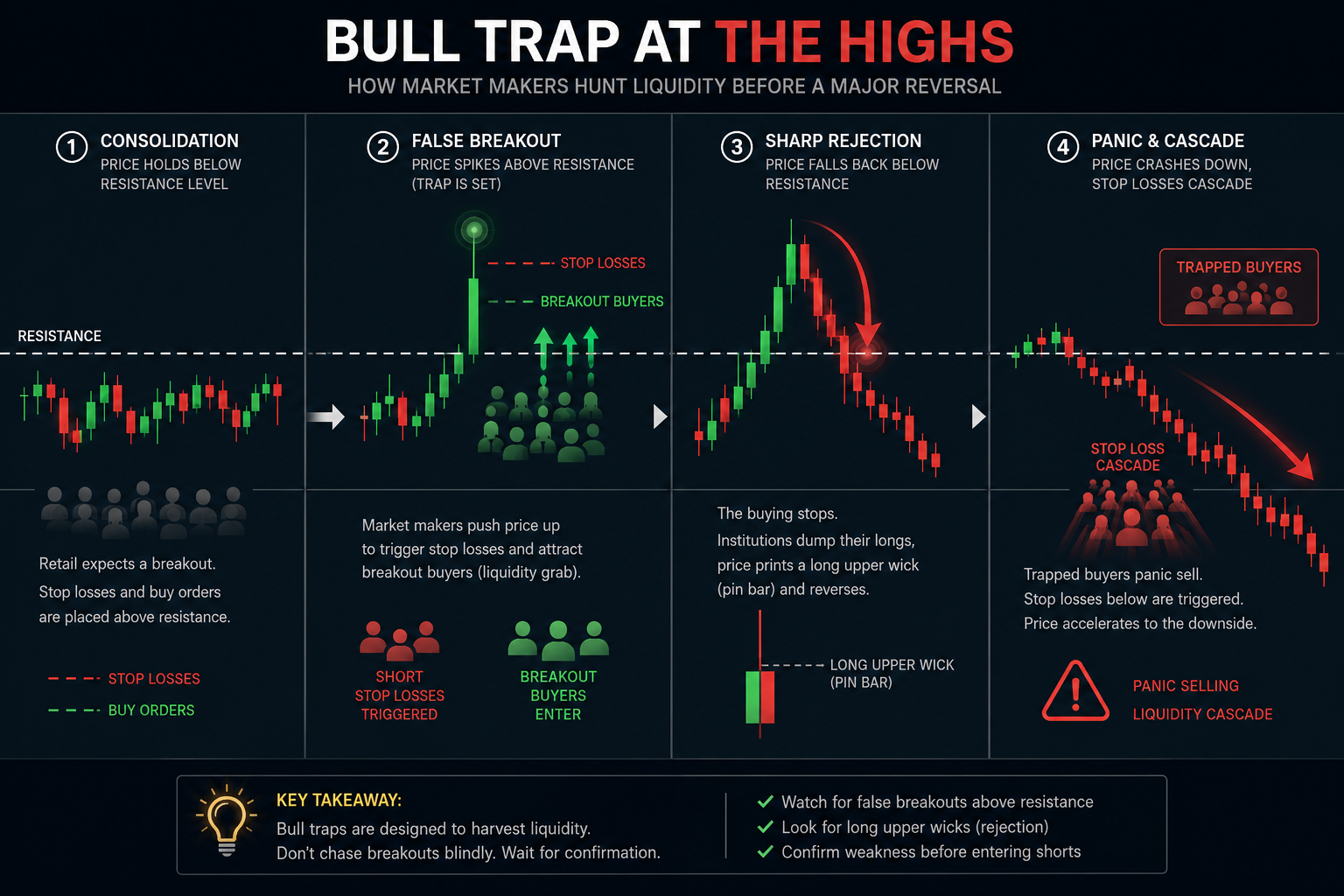
Then comes the sharp spike upward. Retail traders FOMO in, thinking they're catching the train as it leaves the station. But this pump is completely artificial: a whale or market maker intentionally buys up the remaining sell wall to trigger a wave of retail buying.
The second the order book fills up with buy orders, the fund dumps its entire position directly into them. The daily candle ends up printing a massive upper wick (a pin bar) and price plummets. Everyone who bought the breakout is instantly trapped.
The Survival Checklist: How to Spot the Top and Move to Cash
If you can check off at least three items on this list, take profit on your spot positions. Don't fight the market—just secure the bag.
- Memecoins dominate the charts. Utility-less junk tokens pump hard on nothing but a funny picture. This is a clear sign that rational investment ideas have dried up, and the market is running on pure, unadulterated gambling.
- Bitcoin dominance drops while trash altcoins pump 50% a day. The classic finale of "altseason." Capital is rotating out of safe-haven BTC and cascading down into hyper-risky assets for one final cash grab before a full exit into fiat.
- You start feeling like a financial genius. If trading feels like free money and you think you've cracked the code to life, you're in a state of pure euphoria. This is the single most reliable psychological indicator of a market top.
- Insane APY staking programs pop up. Projects start offering 50–100% APY to lock up your tokens for 3 to 6 months. Their goal is simple: lock up your liquidity so you can't sell while the devs and venture funds dump their tokens directly onto the market.
That's it! Keep a cool head, and keep your stop-losses tight.