
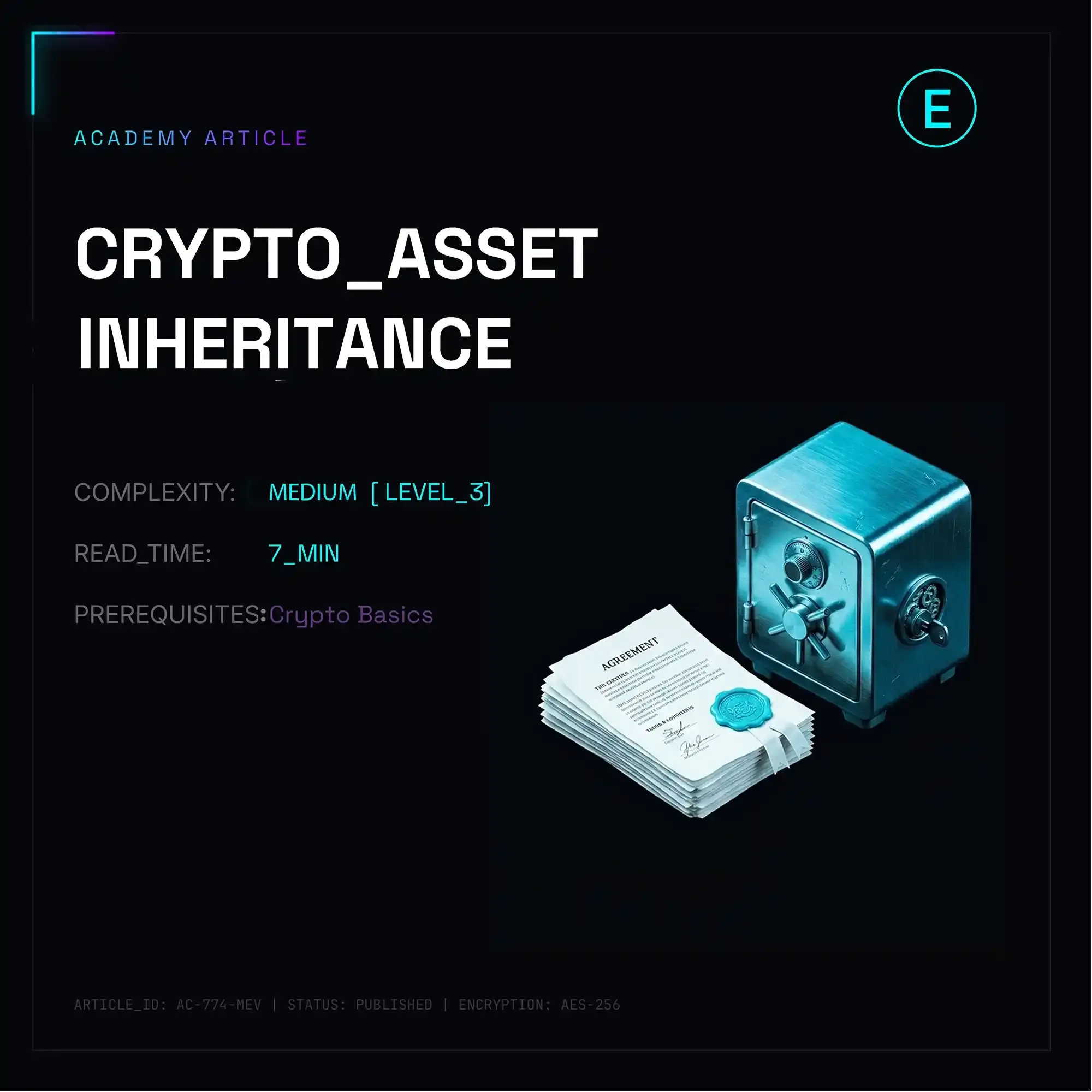
Inheriting digital assets is the "Achilles' heel" of the modern crypto economy. The main paradox is that full security (when only you hold the keys) directly conflicts with the ability to pass on assets. If you hand over the keys now, you lose control of your assets. If you don’t and something happens to you, the assets will be lost forever on the blockchain.
In this article, we'll explore how to build a Dead Man's Switch system, leverage the capabilities of 2026 smart contracts, and legally document your intentions without compromising your seed phrase while you’re alive.
1. The "Glass Vault" Problem
Cryptocurrency is like a vault with glass walls: everyone can see what's inside, but without the key, nothing can be taken out. By 2026, courts widely recognize crypto as property, but a bailiff cannot just enter the blockchain and "hack" a wallet.
Your task: create a mechanism that triggers automatically under a certain condition (such as your prolonged absence from the network).
2. Technical Solution #1: Smart Contracts and Dead Man's Switch
This is the most reliable method for networks supporting smart contracts (Ethereum, L2 networks, Solana, etc.). The idea is that you create a contract that transfers funds to a beneficiary if you haven’t pressed the “I’m alive” button for, say, six months.
Practical Example: Sarcophagus (SARCO)
By 2026, decentralized inheritance protocols have become standard.
- How it works: You upload an encrypted file (containing keys, instructions, or access) to a decentralized storage network.
- Arbiter: A network of nodes monitors your "heartbeat."
- Trigger: If you fail to update the signature in the contract, the decryption key is automatically passed to your beneficiary.
Solidity Logic Example (Simplified)
If you’re a developer or want to understand how it works under the hood, here’s a simple inheritance contract example:
pragma solidity ^0.8.0;
contract CryptoInheritance {
    address public owner;
    address public beneficiary;
    uint256 public lastSeen;
    uint256 public timeout = 180 days; // Waiting period
    constructor(address _beneficiary) {
        owner = msg.sender;
        beneficiary = _beneficiary;
        lastSeen = block.timestamp;
    }
    // Owner must call this function every six months
    function iamAlive() public {
        require(msg.sender == owner, "Only owner");
        lastSeen = block.timestamp;
    }
    // Beneficiary can claim funds only after the timeout
    function claimInheritance() public {
        require(block.timestamp > lastSeen + timeout, "Owner is still active");
        require(msg.sender == beneficiary, "Only beneficiary");
        payable(beneficiary).transfer(address(this).balance);
    }
    receive() external payable {}
}
3. Technical Solution #2: Social Recovery
Thanks to the Account Abstraction upgrade (ERC-4337), which became mainstream by 2026, wallets can now have "Guardians."
- Concept: Your wallet is managed not just by a seed phrase but by a logic layer.
- Implementation: You assign 3-5 trusted people (friends, lawyers, or your own other wallets). To change the wallet owner or withdraw funds, a majority approval is required (e.g., 3 out of 5).
- Benefit: While alive, you use the wallet yourself. If access is lost or you’re unavailable, your Guardians can collectively vote to transfer control to your beneficiary.
4. Legal Layer: Wills in the Digital Age
Even if you’ve technically set up a transfer, your heirs may face tax issues (where did millions in USDT come from?).
Little-known hack: "Letter of Wishes"
Instead of writing private keys directly in the will (which becomes a public document in some jurisdictions after your death!), use this scheme:
- In the will: State that you have digital assets, with access described in a confidential instruction.
- Instruction: Kept with a notary or in a safe deposit box. It does NOT contain the key. Instead, it says: "Download app X, enter this login, and get the second part of the password from my favorite book on page 42."
5. Practical "Inheritance 2026" Algorithm
- Secret Sharing (Shamir’s Scheme): Split your seed phrase into 3 parts. Give one to your beneficiary, one to a lawyer, and hide the third in a safe deposit box. Any 2 parts are enough for recovery. This way, no one can steal funds while you’re alive, but together they can access them.
- Use hardware wallets with PINs: By 2026, Ledger and Trezor support "passphrase layers." You can give your beneficiary the main PIN containing "dust" while hiding the main funds under a passphrase that they’ll only get via the will.
- Centralized Exchanges (CEX): If you hold assets on Binance or Coinbase, set up their Inheritance Tool. By 2026, many exchanges offer official forms for submitting death-related documents.
6. Multisig Wallets as a "Family Council"
For large family fortunes, using a single wallet with one seed phrase is a huge risk. The 2026 solution is to use Safe (formerly Gnosis Safe) or similar solutions on other blockchains.
"M of N" Mechanics:
You create a wallet where a transaction requires, for example, 2 signatures out of 3.
- Signature #1: Yours (primary access).
- Signature #2: Your spouse.
- Signature #3: A trusted lawyer or a bank safety deposit box (on a hardware wallet).
Why it works:
While alive, you and your partner can operate jointly. In the event of your death, your partner takes the second signature from the lawyer or safety deposit box and gains full control of the assets without needing to know your personal password.
7. Inheriting NFTs and Metaverses
In 2026, NFTs are not just images—they can be property documents, game characters generating income, and intellectual property rights.
The Problem: Many NFT marketplaces are tied to a specific address. If the address is lost, the "digital home" in the metaverse is locked forever.
Solution:
- Wrapped Assets: There are protocols that allow you to "wrap" your valuable NFTs into an inheritance smart contract.
- ENS (Ethereum Name Service): Don’t forget to transfer rights to your domain (for example, ivanov.eth). This is the "face" of your digital wealth. In ENS settings, you can pre-set a Controller—the inheritor’s address that can renew the domain even without access to the main wallet.
8. Little-Known Detail: "Dust" and Gas
The most common mistake when setting up inheritance is sending tokens (USDT, WBTC) but forgetting to leave the native network coin (ETH, SOL, BNB) for paying fees (gas).
Critical Advice: If the inheritor's wallet contains millions in tokens but zero native coins, they won’t be able to take any action. Always include a small amount for gas in the "inheritance package," or use wallets that support Paymasters (services that allow gas to be paid with the transferred tokens themselves).
9. Advanced Scheme: "Shamir's Secret Sharing"
This is a mathematical method that in 2026 is built into many crypto vaults, but it can also be implemented manually.
How it works in practice:
Your 24-word seed phrase is split into 5 different codes (shards).
To restore the wallet, any 3 out of 5 codes must be collected.
You distribute the codes: Inheritor #1, Inheritor #2, lawyer, hide one in a safe in another country, and keep one for yourself.
Security: If one inheritor is dishonest and steals their code—they can’t do anything. They would need to collude with two more people.
10. Digital Will Checklist
To make your system work, check it point by point:
| Element | Check |
|---|---|
| Instructions | Are they written in plain language for someone who doesn’t know what a blockchain is? |
| Device | Does the inheritor know where the hardware wallet/phone/laptop is physically located? |
| 2FA (Two-Factor) | Has access to Google Authenticator or the SIM card been transferred? (This is the most common reason for account lockouts on exchanges.) |
| Test | Have you conducted a "drill"? Try simulating your unavailability and see if the inheritor can access a test wallet. |
11. Cloud Inheritance Specifics
If you store some data in the cloud (iCloud/Google), use the built-in features:
- Apple: Digital Legacy.
- Google: Inactive Account Manager.
This allows your loved ones to access your emails and files, which may contain clues to your "treasure," legally and without hacking.
Summarize this blog post with: