

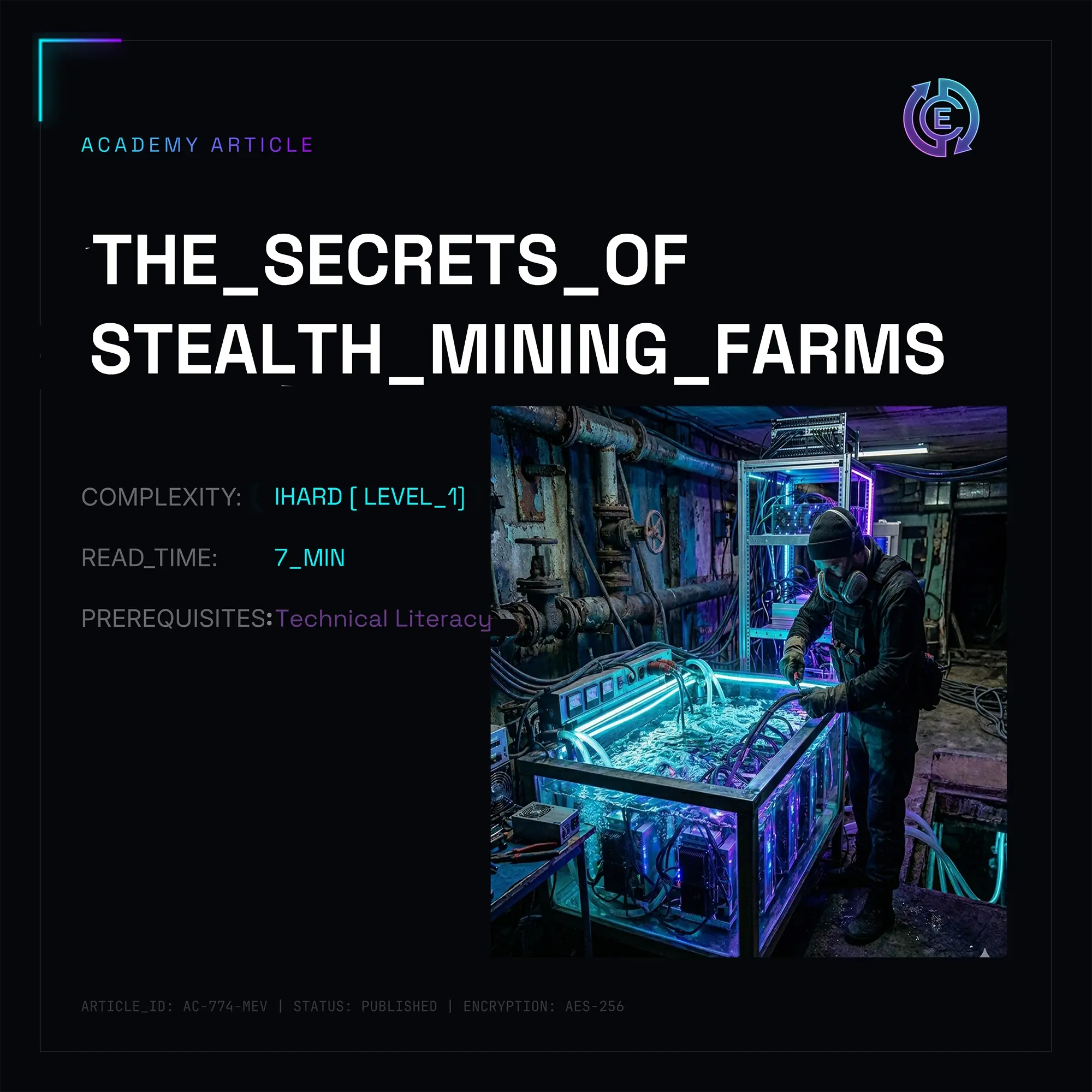
The modern crypto industry has entered the era of "guerrilla marketing." As regulations tighten and power grid monitoring systems get smarter, miners are going into full stealth mode. Today, we’re breaking down how "digital ghosts" operate farms that are impossible to find using thermal imaging or standard traffic analysis.
Our expert guide for this investigation is Specter - a white-hat hacker and cyber-intelligence specialist who has spent years hunting down hidden infrastructures.
Part 1. The Physical Layer: Heat Inversion and Radio Noise
The first problem for any large-scale farm is thermodynamics. A massive amount of energy is converted into heat. The amateur approach high-powered exhaust fans makes a site a sitting duck for drones equipped with thermal cameras. Professionals do things differently.
In Their Own Words: Specter on Thermal Myths
Question: Specter, everyone says it’s easy to find a farm with a thermal camera. Is that a fact, or just a myth for the general public?
Answer: It’s true for amateurs. Pros have been using phase transitions for a long time. They don't heat the air. They use immersion cooling tanks with dielectric fluid and heat exchangers hooked up to old cast-iron radiators in abandoned buildings or, even more elegantly, flooded basements. Standing water in a basement is a perfect radiator. From the outside, the building looks freezing, while underwater, it’s "teeming" with life. To find a farm like that, we have to use more than just thermal imagers—we use radiometers that pick up microwave radiation from poorly shielded circuit boards, which can even penetrate concrete.
Technical Breakdown: Gravity Pipes
Beyond immersion, miners utilize "thermal footprint inversion." Hot coolant is dumped into abandoned storm drains or buried underground through a system of heat exchangers.
How to find it: The only way is to look for physical anomalies. Search for patches of ground where snow doesn't settle in winter, or where puddles dry up in minutes during the summer. That is the "thermal signature" of an underground farm.
Part 2. Energy Mimicry: Simulating a Factory’s "Breathing"
The second issue is the electrical footprint. Modern systems (like the Russian "Pyramida" or Western Smart Grids) use AI to analyze load profiles. A flat consumption line (a "shelf") is an immediate red flag for an audit.
In Their Own Words: Specter on Deceiving Dispatchers
Question: How do miners manage to pull megawatts in abandoned zones without raising suspicion from grid dispatchers?
Answer: They use "industrial profile simulation." If you just switch on a farm, the load graph in the monitoring system looks like a flat "shelf"—that’s an instant trigger for an inspection. Professionals install controllers that dynamically vary the load, mimicking the operation of, say, a cold storage warehouse or a pumping station. Consumption is higher during the day and lower at night, with spikes that look like "compressors" kicking in. To the grid's automation, it looks like a legitimate sub-tenant. We only catch them by looking for 13th and 15th-order harmonic distortions—a specific "ringing" from switching power supplies that no refrigerator can replicate.
APF (Active Harmonic Filter) Technology
To neutralize this "ringing," active harmonic filters are used. Since ASIC power supplies consume current non-sinusoidally, an APF module analyzes the network and injects current in anti-phase to cancel it out.
Investigative Marker: The presence of brand-new cabinets labeled "PFC" (Power Factor Correction) in a dilapidated building. This is standard industrial equipment that miners use as legal cover to filter out their "digital noise."
Part 3. Network Stealth: Satellite Hops and Stratum V2
Once physical and energy traces are hidden, only the traffic remains. A standard VPN is easily detected by DPI (Deep Packet Inspection) systems, and the Stratum V1 mining protocol is plain as day to any ISP.
In Their Own Words: Specter on the Digital Shadow
Question: Is there a way to completely hide a farm's internet traffic from state surveillance or Western monitoring systems?
Answer: Yes. The current trend is the "satellite hop" via tunneling. A miner sets up a dish 2 kilometers away from the farm in the woods and throws a radio-relay bridge to the site. The traffic is packed into the Stratum V2 protocol with TLS encryption. To any DPI, it looks like standard encrypted messenger traffic. To prove mining is happening, we have to perform timing analysis: measuring micro-delays in packets that correlate with the discovery of blocks on the Bitcoin network. That’s top-tier cyber-intelligence work.
The "Stealth Communications" Layer
- Stratum V2: Unlike V1, this protocol fully encrypts data. The stream becomes indistinguishable from a video call.
- Satellite Backend: Using Starlink terminals or similar providers. Antennas are camouflaged under radio-transparent covers (plastic sheets mimicking old roofing), removing the local ISP from the investigative chain entirely.
Part 4. Institutional Loopholes: Hunting in Industrial Labyrinths
When a miner hits the megawatt scale, they stop hiding in residential basements. Professionals look for locations where colossal energy consumption can be "dissolved" into someone else's reports.
First-hand Account: Spectre on Insane Locations
Question: What’s the craziest location for a "shadow" farm you’ve encountered in your practice?
Answer: An abandoned fallout shelter beneath an active factory. The miners tapped into the factory's busway before the main utility meter. The plant paid for its own operations, while the "leak" was written off as aging equipment and poor insulation of underground cables. The farm ran for three years. It was only discovered when humidity caused a short circuit in one of the racks, blowing a phase for half the workshop. There was 1.5 million dollars worth of gear inside, and the entrance was camouflaged as a regular rusty hatch buried under trash.
Leeching off Railways and Research Institutes
Today, the most secure setups are moving into institutional grids that operate by their own rules.
- Railway Traction Substations: This is a "gold mine" with massive power limits. Miners strike deals with low-level staff and set up containers in sidings or abandoned depots. Railways have their own security services, but they often use outdated protocols that fail to recognize modern digital anomalies.
- Analysis of "Technical Losses": Spectre emphasizes that the primary investigative tool today isn't inspecting buildings, but auditing documentation. In corrupt schemes, mining is written off as "grid wear and tear." If energy losses in a specific district jump from 5% to 15% without any visible physical cause, you can bet there’s a high-capacity facility operating there.
Part 5. Expert Conclusions: Tech vs. Intuition
The fight against "grey" mining in 2026 isn't about police raids; it’s a battle of algorithms.
Why is it so hard to win?
The Stratum V2 protocol and satellite backends practically eliminate the possibility of remote detection through an ISP. When data is encrypted and transmitted via microwave links in the woods, digital surveillance hits a dead end.
The only effective method remains field reconnaissance and combined technical audits:
- Spectral Analysis: Searching for 13th-15th order harmonics at connection points.
- Radiometry: Detecting electromagnetic "noise" in abandoned zones.
- Thermal Inversion: Monitoring soil and storm drain temperatures during winter.
Conclusion
Spectre’s story shows that modern miners are no longer just enthusiasts, but high-tier engineers utilizing electronic warfare and industrial espionage tactics. For the average user, this information is a reminder of how deeply "digital" can penetrate the physical world while remaining completely invisible.
The hunt for these "ghosts" continues. And as Spectre says: In this race, the winner isn't the one with the most powerful chips, but the one who best understands how to hide their physical presence in reality.
Summarize this blog post with: