
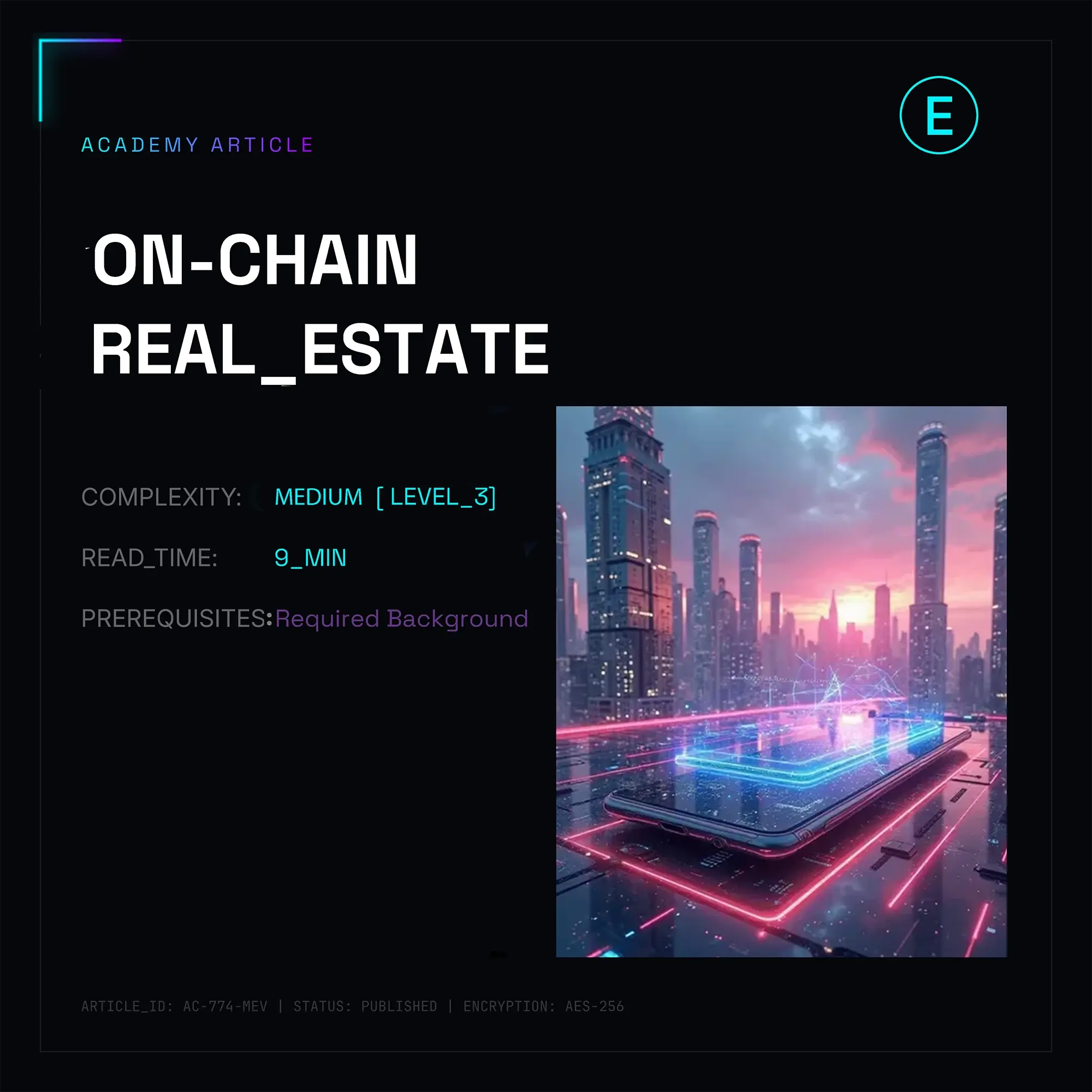
The beginning of 2026 marked RWA (Real World Assets) finally graduating from the “experimental” bucket into core infrastructure for the global financial system. Commercial real estate — long seen as one of the most conservative and least accessible asset classes — is now available as fractional tokens on the blockchain.
Below is a practical, professional deep dive that brings together the current tech stack, legal nuances, and financial strategies shaping this market.
Traditionally, acquiring a business center meant years of legal paperwork, multi-million dollar entry thresholds, and capital tied up for decades. Tokenization flips that model on its head, turning bricks and glass into a liquid digital asset.
1. Solution Architecture: How It Works in 2026
On-chain real estate is built around a structured link between the physical property and a digital ledger. It’s not just about minting tokens — it requires a layered legal and technical framework:
- SPV (Special Purpose Vehicle): A separate legal entity is set up for each property (most commonly an LLC in Wyoming or Delaware, or an AG in Switzerland). That entity holds title to the building.
- Asset-Backed Tokens (Security Tokens): The tokens represent an equity stake in the SPV. By 2026, ERC-3643 (the T-REX protocol) has become the industry standard, allowing compliance rules (KYC/AML) to be embedded directly into the smart contract.
- Oracle Integration: Decentralized oracles (such as Chainlink) feed property appraisals and rental cash-flow data into the blockchain in near real time.
2. Key Advantages for Investors
A. Micro-Investing (Fractional Ownership)
Fractionalization has lowered the entry point for premium assets (Amazon warehouses, data centers, hotels) to roughly $50–$100. Retail investors can now build a diversified cross-border property portfolio without leaving their living room.
B. Programmable Yield (On-chain Yield)
Rental income is distributed automatically via smart contracts.
Lesser-known fact: In 2026, leading platforms use “streaming payouts.” Instead of receiving rent once a month, investors accrue their share continuously — second by second (via protocols like Superfluid) — enabling instant reinvestment into DeFi strategies for compounded returns.
C. Liquidity and Collateralization
Unlike a traditional private LLC stake, a token can be sold on secondary markets (ATS — Alternative Trading Systems) within minutes. Moreover, tokenized real estate is increasingly accepted as collateral in lending protocols (such as Aave or MakerDAO), allowing investors to borrow at competitive rates without liquidating their underlying asset.
3. Legal Risks and Structural Pitfalls
Despite technological maturity, the legal layer remains a high-stakes domain.
- Registry Conflict: The primary risk is a mismatch between the blockchain ledger and the official government land registry. If wallet A is recorded on-chain as the owner, but the state registry lists a bankrupt entity, the government registry will prevail.
- Regulatory Status (Securities Law): Most fractional real estate tokens qualify as securities (e.g., under the U.S. Howey Test). This typically limits U.S. investors to offerings under Regulation D (accredited investors) or Regulation S (non-U.S. persons).
- Jurisdictional Risk: Tokenization frameworks in the UAE (VARA) or the EU (MiCA) differ significantly from Asian markets. Choosing the wrong SPV jurisdiction can result in asset freezes or adverse tax treatment.
4. Practical Example: Technical Implementation (Solidity)
For those interested in what’s happening under the hood, below is a simplified smart contract illustrating how rental income could be distributed to fractional property holders.
// SPDX-License-Identifier: MIT
pragma solidity ^0.8.20;
import "@openzeppelin/contracts/token/ERC20/ERC20.sol";
import "@openzeppelin/contracts/access/Ownable.sol";
contract RealEstateToken is ERC20, Ownable {
    uint256 public totalRentalIncome;
    mapping(address => uint256) public lastClaimedIncome;
    constructor(string memory name, string memory symbol, uint256 initialSupply)
        ERC20(name, symbol)
        Ownable(msg.sender)
    {
        _mint(msg.sender, initialSupply);
    }
    // Function to deposit rental income into the contract (in stablecoins)
    function depositRentalIncome(uint256 amount) external onlyOwner {
        totalRentalIncome += amount;
    }
    // Calculate and claim the investor’s share of income
    function claimDividends() external {
        uint256 share = balanceOf(msg.sender);
        require(share > 0, "No tokens owned");

        // Simplified logic: income = (total income * share) / total token supply
        uint256 payment = (totalRentalIncome * share) / totalSupply();
        uint256 amountToPay = payment - lastClaimedIncome[msg.sender];

        require(amountToPay > 0, "No new dividends");

        lastClaimedIncome[msg.sender] = payment;
        // Stablecoin transfer should occur here (USDC/USDT)
        // IERC20(USDC_ADDRESS).transfer(msg.sender, amountToPay);
    }
}
Note: In production environments, projects typically rely on the ERC-3643 standard with mandatory Identity Registry verification.
5. How to Invest Today: Practical Guidance
- Verify the Legal Wrapper: Always request documentation for the SPV. If the platform cannot clearly demonstrate the link between the token and the official property registry entry, treat it as a red flag.
- Assess the Exit Strategy: Confirm where the token is traded on secondary markets. Partnerships with platforms like Uniswap (via licensed gateways) or tZERO are generally positive signals.
- Monitor the Oracles: Ensure property valuations are updated regularly by independent firms (e.g., CBRE or JLL), and that the data feed to the blockchain is transparent and verifiable.
6. Legal Wrappers: Comparing Jurisdictions
In 2026, choosing a jurisdiction for an SPV affects not only tax obligations but also which institutional investors can buy your token.
| Parameter | UAE (Dubai / ADGM) | Switzerland (Zug / AG) | USA (Wyoming / Delaware) |
|---|---|---|---|
| Regulator | VARA / ADGM FSRA | FINMA | SEC (Reg D/S) |
| Structure Type | SPV (Foundations or LLC) | AG (Public Limited Company) | DAO LLC / Series LLC |
| Corporate Tax | 9% (over 375k AED), often 0% in free zones | ~12–14% (cantonal) | 21% (federal) + state |
| Withholding Tax (WHT) | 0% | 35% (can be reduced to 0–5%) | 30% (for non-residents) |
| Key Features | Best base for RWA in 2026. Sandbox regime for startups. | Maximum reliability. Token recognized as a share (Dlt Act). | Complex compliance, but access to the largest capital pool. |
Case Study: Warehouse Complex in Dubai (2025)
In mid-2025, a major logistics operator tokenized a warehouse through an ADGM (Abu Dhabi Global Market) structure.
- Execution: 1,000,000 tokens issued at $100 each.
- Smart Contract: Used ERC-3643 standard, which blocked transfers to wallets that hadn’t passed KYC via a licensed provider (Identity Registry).
- Outcome: The project raised $100M in 48 hours, with 40% of liquidity coming from DeFi protocols where tokens were used as collateral.
7. Taxation and Reporting: 2026 Realities
The world has moved beyond the "gray area." As of January 1, 2026, most developed countries have implemented CARF (Crypto-Asset Reporting Framework) standards.
- Tax Automation: Advanced platforms (for example, in Switzerland) now integrate tax modules. When paying dividends, the smart contract automatically withholds tax (Withholding Tax) if the investor hasn’t provided a tax residency certificate.
- Token as a Security: If your token grants a share of profits, tax authorities (e.g., the IRS in the USA or FTA in Switzerland) will treat the income as dividends rather than crypto capital gains.
- Real Estate Reporting (IRS 2026): In the US, from 2026, blockchain brokers must file Form 1099-DA for real estate transactions. This means anonymity in On-chain Real Estate is effectively dead on legal platforms.
8. Advanced Technical Details: Cross-chain and Oracle 2.0
In 2026, real estate doesn’t "live" on just one network.
- CCIP (Cross-Chain Interoperability Protocol): An investor can buy a London property token using liquidity from the Polygon network, while the token itself is issued on Ethereum Mainnet.
- Dynamic NFTs (dNFTs): To represent ownership rights, not only ERC-20 (fungible shares) are used anymore, but ERC-721/1155, where metadata (asset price, tenant occupancy) is dynamically updated via oracles.
Code Example: Updating Asset Price via Oracle
// Example function to update the valuation of a tokenized property
function updateAssetValuation(uint256 _newValuation) external onlyAuthorizedOracle {
    assetValuation = _newValuation;
    // Automatic recalculation of token Net Asset Value (NAV)
    tokenPrice = assetValuation / totalSupply();
    emit PriceUpdated(_newValuation, block.timestamp);
}
9. Lesser-Known Risks: Oracle Manipulation and Legal Fork
- Oracle Manipulation: If the redemption price comes from a single source, an attacker could try to hack the oracle to lower the price and buy shares cheaply. Solution: use a weighted average price from multiple appraisers (Chainlink + independent auditors).
- Legal Fork: Situation where the property is sold off-chain, but the smart contract "doesn’t know" due to a governance error. In 2026, this is addressed with an Admin Multisig, where one key is held by a government registrar or trusted custodian.
10. Investor Checklist (Professional Grade)
Before sending USDT to a project, check:
- VARA/FINMA License: Does the platform have a license to issue virtual assets (VASP)?
- Asset Custody: Who physically holds the ownership documents? (Ideally: independent trust or bank).
- Identity Registry: Does the smart contract require KYC for secondary sales? If not, that’s a major regulatory risk.
- Audit: Has the smart contract been audited (CertiK, OpenZeppelin) and the physical asset audited (Big Four)?
11. Liquidity and Exit Strategies: How to "Sell Bricks" Instantly
The main challenge of real estate — low liquidity — is addressed in the On-chain environment of 2026 through three innovative methods:
- AMM Pools (Automated Market Makers): Instead of waiting for a buyer, you swap your real estate tokens for stablecoins in a liquidity pool (for example, Uniswap V4). The issuer locks a portion of tokens and liquidity, enabling instant exit with minimal slippage.
- Buy-back Protocols (Buy-back Vaults): A smart contract reserves 5–10% of monthly rental income in a special fund to buy back tokens from investors, maintaining price stability.
- Secondary Markets (ATS): Licensed platforms (tZERO, Archax) allow trading tokenized shares within a legal framework, similar to the stock market.
12. Composability: Using Real Estate in DeFi ("Money Legos")
In 2026, your real estate tokens ($RWA) can operate across multiple protocols simultaneously:
- Lending: You can use property tokens as collateral in protocols like Centrifuge or Aave RWA, receiving a loan for 50-70% of the asset’s value without selling your share.
- Yield Boosting: Automatically directing dividend flows into yield aggregators to earn compound interest.
- Index Tokens: Holding an index token (for example, $EU-LOGISTICS) that includes stakes in 50 different warehouses, minimizing the risk of one building being idle.
Conclusion: How to Enter the Market Today
On-chain commercial real estate is no longer the future — it’s a functioning infrastructure. Successful investing in 2026 requires a hybrid skill set: analyzing both the physical asset (Cap Rate, location) and the digital layer (smart contract audit, pool liquidity).
- Start by reviewing the platform’s licenses (VARA/FINMA).
- Always verify the presence of an independent custodian for documents.
- Leverage DeFi opportunities to enhance the efficiency of your capital.