


If you still think executing a trade on an exchange is just hitting a "Buy" button and watching magic happen behind the scenes, I hate to break it to you. Down at the microsecond and millisecond level, the market is a brutal battlefield. Liquidity shifts constantly between regimes, where execution speed and pool architecture dictate who captures alpha and who gets wrecked by slippage and toxic flow.
Centralized trading (TradFi and CEXs) is dominated by the Central Limit Order Book (CLOB). In DeFi, Automated Market Makers (AMMs) became the default primitives. But when you zoom into high-frequency trading (HFT), the distinction isn't just about different tech stacks—it fundamentally alters price discovery, arbitrage mechanics, and order routing.
Let's dive under the hood of both architectures, unpack their hidden friction points, and see how to leverage these mechanics in production.
1. L2/L3 Order Book Anatomy: How Liquidity Actually Works
Most retail traders stare at L2 depth: aggregated volume sitting at static price ticks. HFT algos and institutional desks work with L3 feeds (Order-by-Order)—the raw event stream where every single action retains a distinct identifier (order_id), precise nanosecond-level timestamp, and queue position.
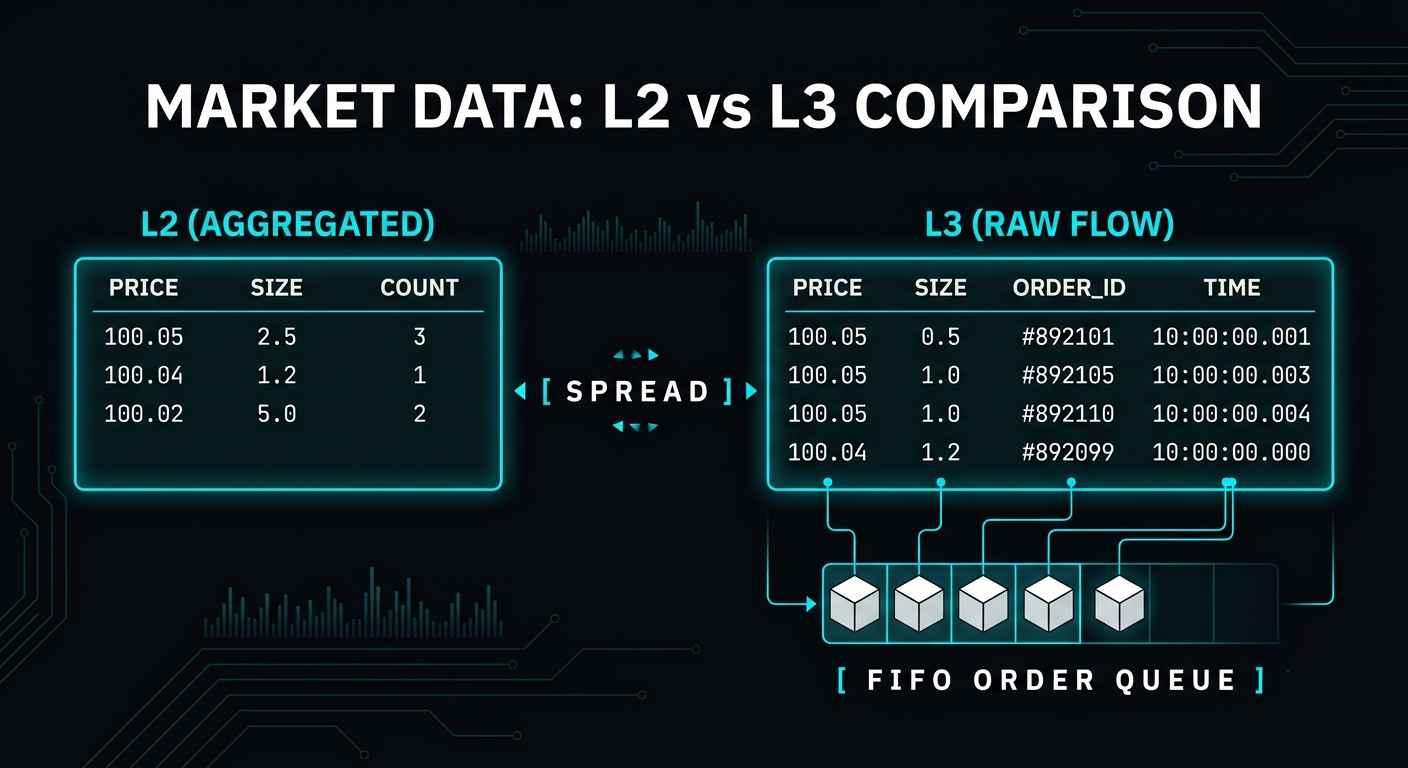
The Price-Time Priority Rule (FIFO)
In a standard matching engine, orders fill strictly by priority:
- Price (the best bid/ask gets priority).
- Time (at the same price level, early birds get filled first).
This time-based queue priority gives rise to two critical market microstructure dynamics:
Adverse Selection: If your resting limit buy order gets filled instantly, chances are aggressive institutional sell flow (toxic flow) just hit the market—and price is about to keep dumping right through your bid.
Queue Position Value: Sitting at the front of a price level carries tangible economic value. HFT bots constantly cancel and replace limit orders (spoofing/layering strategies or adaptive liquidity management) to defend queue priority without taking on unhedged inventory risk.
2. AMM Mechanics: From Constant Product to Concentrated Liquidity
AMMs operate on entirely different principles than order books: there is no order queue. Instead, pricing is enforced by an invariant mathematical curve.
Constant Product (v2): x · y = k
In legacy Uniswap v2 pools, liquidity is stretched endlessly from zero to infinity.
When routing a trade of size Δx, the trader swaps into the pool to pull out Δy, calculated against the swap fee factor γ = (1 - fee):
Δy = (y · Δx · γ) / (x + Δx · γ)
The fill price isn't static—it moves continuously along the invariant curve as execution occurs.
Concentrated Liquidity (v3 / Tick-based)
Uniswap v3 refactored AMMs to mimic order book density by letting Liquidity Providers (LPs) deploy capital into explicit price ranges [Pa, Pb].
Price space is discretized into ticks, where every single tick step represents a 0.01% (1 bps) price movement:
P(i) = 1.0001i
Active liquidity L within a tick acts like a localized invariant, but crossing a tick boundary causes active liquidity to step-function violently. For HFT arbitrageurs, this means AMM v3 depth is discrete, stepped, and discontinuous across price levels.
3. Microstructure Comparison Matrix
| Parameter | Order Book (CEX/TradFi) | AMM (Uniswap v2) | Concentrated AMM (v3) |
|---|---|---|---|
| Execution Priority | Price-Time (FIFO) / Pro-Rata | Gas Price / MEV (Priority Fee) | Gas Price / MEV (Priority Fee) |
| Latency Profile | Microseconds / Nanoseconds | Block time (or slotted latency) | Block time / P2P Mempool |
| Price Discovery | Continuous Double Auction (CDA) | Dynamic via trade size (x · y = k) | Dynamic within current active tick |
| Liquidity Overhead | No Impermanent Loss (Inventory Risk only) | Impermanent Loss (IL) | Loss-Versus-Rebalancing (LVR) |
| Order Flow Visibility | L3 Data Feeds (Pitch, ITCH, FIX) | Mempool (pre-block) / On-chain (post-block) | Mempool (pre-block) / On-chain (post-block) |
4. Hidden Microstructure Dynamics: MEV, LVR, and Toxic Flow
On centralized order books, HFT firms compete on physical network propagation latency—co-locating servers in exchange data centers, deploying custom FPGA setups, and leasing dedicated fiber lines.
In DeFi, the physical concept of time gets warped: block construction and transaction sequencing dictate execution.
MEV (Maximal Extractable Value)
Order ordering inside an AMM block is determined by searchers and block builders. This setup fuels specialized HFT strategies:
- Front-running / Back-running: Sniping target transactions out of the mempool by bidding higher priority fees.
- Sandwich Attacks: Front-running a large swap to pump the price, letting the target trade execute, and instantly back-running to dump back into the inflated price.
LVR (Loss-Versus-Rebalancing)
Retail traders usually measure LP drag via Impermanent Loss (IL). But at the high-frequency level, LVR—introduced by researchers at Columbia and Paradigm—is the true metric that matters.
LVR (Loss-Versus-Rebalancing) quantifies the systematic loss an AMM LP incurs compared to an identical rebalanced portfolio hedged against external reference prices on CEXs.
LVR is fundamentally caused by volatility arbitrage. When CEX prices move, AMM pools lag behind, leaving stale quotes exposed. HFT arbitrageurs spot the spread, drain cheap liquidity out of the AMM, and unload it back onto CEXs. Consequently, AMM LPs consistently get filled at off-market prices against informed, toxic flow.
LVR ≈ (σ² / 8) · ∫0T St · Lt dt
Where σ represents asset volatility, St is spot price, and Lt is active liquidity. The takeaway: The higher market volatility goes, the more LP value gets extracted by HFT arbs.
5. Hands-On Implementation: Python Trade Execution Simulator (AMM v2 vs. L2 Depth)
Let's translate this to code. Here is a Python script designed to simulate true execution price (taking slippage into account) for a target market order by comparing L2 order book depth against a Constant Product AMM pool.
Built in pure Python with zero heavy external dependencies.
from __future__ import annotations
from dataclasses import dataclass
from enum import Enum
from typing import List
class FeeMode(Enum):
    QUOTE = "quote"  # fee deducted from incoming USDT
    BASE = "base"    # fee deducted from received ETH
@dataclass
class AskLevel:
    price: float
    volume: float
class OrderBookL2:
    """
    L2 Order Book (Ask side).
    ETH/USDT pair setup:
        price  = USDT per 1 ETH
        volume = ETH
    """
    def __init__(
        self,
        asks: List[tuple[float, float]],
        taker_fee: float = 0.001,
    ) -> None:
        if not (0 <= taker_fee < 1):
            raise ValueError("taker_fee must be in range [0, 1)")
        self.taker_fee = float(taker_fee)
        self.asks: List[AskLevel] = []
        for price, volume in asks:
            if price <= 0:
                raise ValueError("Price must be > 0")
            if volume <= 0:
                raise ValueError("Volume must be > 0")
            self.asks.append(
                AskLevel(
                    price=float(price),
                    volume=float(volume),
                )
            )
        self.asks.sort(key=lambda x: x.price)
    def best_ask(self) -> float:
        if not self.asks:
            raise ValueError("Order book is empty")
        return self.asks[0].price
    def spot_price(self) -> float:
        return self.best_ask()
    def total_liquidity_quote(self) -> float:
        return sum(
            level.price * level.volume
            for level in self.asks
        )
    def total_liquidity_base(self) -> float:
        return sum(
            level.volume
            for level in self.asks
        )
    def simulate_buy(
        self,
        amount_in_quote: float,
        mutate: bool = True,
        fee_mode: FeeMode = FeeMode.QUOTE,
    ) -> tuple[float, float]:
        """
        Buy base asset using amount_in_quote.
        Returns:
            (
                base_asset_received,
                average_effective_price
            )
        """
        if amount_in_quote <= 0:
            raise ValueError(
                "amount_in_quote must be > 0"
            )
        if fee_mode == FeeMode.QUOTE:
            quote_for_trade = (
                amount_in_quote *
                (1.0 - self.taker_fee)
            )
        else:
            quote_for_trade = amount_in_quote
        remaining_quote = quote_for_trade
        total_base_bought = 0.0
        new_levels: List[AskLevel] = []
        for level in self.asks:
            if remaining_quote <= 0:
                new_levels.append(level)
                continue
            level_cost = (
                level.price *
                level.volume
            )
            if remaining_quote >= level_cost:
                total_base_bought += level.volume
                remaining_quote -= level_cost
            else:
                base_from_level = (
                    remaining_quote /
                    level.price
                )
                total_base_bought += base_from_level
                remaining_volume = (
                    level.volume -
                    base_from_level
                )
                if remaining_volume > 1e-12:
                    new_levels.append(
                        AskLevel(
                            level.price,
                            remaining_volume,
                        )
                    )
                remaining_quote = 0.0
        if remaining_quote > 1e-9:
            raise ValueError(
                "Insufficient liquidity in order book"
            )
        if fee_mode == FeeMode.BASE:
            total_base_bought *= (
                1.0 - self.taker_fee
            )
        if total_base_bought <= 0:
            raise ValueError(
                "Received zero volume"
            )
        avg_price = (
            amount_in_quote /
            total_base_bought
        )
        if mutate:
            self.asks = new_levels
        return total_base_bought, avg_price
class ConstantProductAMM:
    """
    Uniswap V2 style AMM
    x = ETH
    y = USDT
    spot = y / x
    """
    def __init__(
        self,
        reserve_x: float,
        reserve_y: float,
        fee: float = 0.003,
    ) -> None:
        if reserve_x <= 0:
            raise ValueError(
                "reserve_x must be > 0"
            )
        if reserve_y <= 0:
            raise ValueError(
                "reserve_y must be > 0"
            )
        if not (0 <= fee < 1):
            raise ValueError(
                "fee must be in range [0, 1)"
            )
        self.x = float(reserve_x)
        self.y = float(reserve_y)
        self.fee = float(fee)
    def spot_price(self) -> float:
        return self.y / self.x
    def invariant(self) -> float:
        return self.x * self.y
    def simulate_buy(
        self,
        amount_y_in: float,
        mutate: bool = True,
    ) -> tuple[float, float]:
        """
        Buy ETH using USDT.
        Returns:
            (
                eth_received,
                average_price
            )
        """
        if amount_y_in <= 0:
            raise ValueError(
                "amount_y_in must be > 0"
            )
        y_effective = (
            amount_y_in *
            (1.0 - self.fee)
        )
        x_out = (
            self.x *
            y_effective
        ) / (
            self.y +
            y_effective
        )
        if x_out <= 0:
            raise ValueError(
                "Received zero volume"
            )
        if x_out >= self.x:
            raise ValueError(
                "Insufficient pool liquidity"
            )
        avg_price = (
            amount_y_in /
            x_out
        )
        if mutate:
            self.x -= x_out
            self.y += amount_y_in
        return x_out, avg_price
def print_trade_result(
    title: str,
    received: float,
    avg_price: float,
    spot_price: float,
) -> None:
    slippage = (
        (avg_price - spot_price)
        / spot_price
    ) * 100
    print(
        f"{title:<12}"
        f" Received: {received:.6f}"
        f" | Avg Price: {avg_price:,.4f}"
        f" | Slippage: {slippage:.4f}%"
    )
def main() -> None:
    asks = [
        (3000.0, 1.5),
        (3001.0, 2.0),
        (3002.5, 5.0),
        (3005.0, 10.0),
        (3010.0, 25.0),
    ]
    orderbook = OrderBookL2(
        asks=asks,
        taker_fee=0.001,
    )
    amm = ConstantProductAMM(
        reserve_x=1000.0,
        reserve_y=3_000_000.0,
        fee=0.003,
    )
    trade_size = 15_000.0
    ob_spot = orderbook.spot_price()
    amm_spot = amm.spot_price()
    ob_received, ob_avg = orderbook.simulate_buy(
        amount_in_quote=trade_size,
        mutate=True,
        fee_mode=FeeMode.QUOTE,
    )
    amm_received, amm_avg = amm.simulate_buy(
        amount_y_in=trade_size,
        mutate=True,
    )
    print(
        f"\n=== Order Execution Comparison "
        f"for {trade_size:,.2f} USDT ===\n"
    )
    print_trade_result(
        "ORDERBOOK",
        ob_received,
        ob_avg,
        ob_spot,
    )
    print_trade_result(
        "AMM V2",
        amm_received,
        amm_avg,
        amm_spot,
    )
    print("\n=== Post-Trade State ===\n")
    if orderbook.asks:
        print(
            f"Best Ask: "
            f"{orderbook.best_ask():,.4f}"
        )
    else:
        print("Order book completely cleared")
    print(
        f"AMM Spot: "
        f"{amm.spot_price():,.4f}"
    )
    print(
        f"AMM Reserves: "
        f"{amm.x:.6f} ETH | "
        f"{amm.y:.2f} USDT"
    )
if __name__ == "__main__":
    main()
Interpreting the Output
In deep AMM pools, small orders fill with minimal slippage. However, as trade size scales, execution prices on an AMM follow a convex curve. Order books, on the other hand, depend entirely on liquidity walls. If the book is thin, larger orders will sweep multiple levels, causing price impact that far exceeds AMM slippage.
6. Hybrid Models: How DEXs Are Adopting Order Books and Why CEXs Are Eyeing AMMs
The line between order books and AMMs is rapidly blurring. High-frequency traders and institutions quickly hit a wall with classic Uniswap v2 models: poor capital efficiency and the inability to set complex limit orders (Stop-loss, Take-profit, Iceberg) made DEXs a nightmare for active market making.
This triggered an evolutionary leap toward hybrid architectures.
1. On-Chain and L2 Order Books (dYdX, Hyperliquid, Vertex)
With the rise of high-throughput L1/L2 networks (Aptos, Sui, Arbitrum) and dedicated AppChains, running a fully-fledged order book directly on-chain became a reality.
Off-chain matching + On-chain settlement: Order matching modules run on ultra-fast off-chain engines (achieving sub-10ms latency), while trade execution and margin requirements are settled via smart contracts.
Fully On-chain (Hyperliquid, Serum/Ellipsis): The order book lives entirely within the chain's consensus layer. The biggest hurdle here is handling insane throughput: order modifications and cancellations (Cancel/Replace) account for up to 95–98% of all incoming HFT traffic.
2. Intent-Based Architectures and RFQs (Request for Quote)
The "Intents" paradigm (UniswapX, 1inch Fusion, CoW Protocol) essentially brings institutional-grade execution mechanics to Web3.
Instead of submitting a transaction to interact with a specific liquidity pool, the trader signs an intent (e.g., "Swap 100 ETH for at least 300,000 USDC"). A network of third-party actors (Fillers / Solvers) then competes to execute the order using any liquidity route available—CEXs, private market maker inventory, or DEXs.
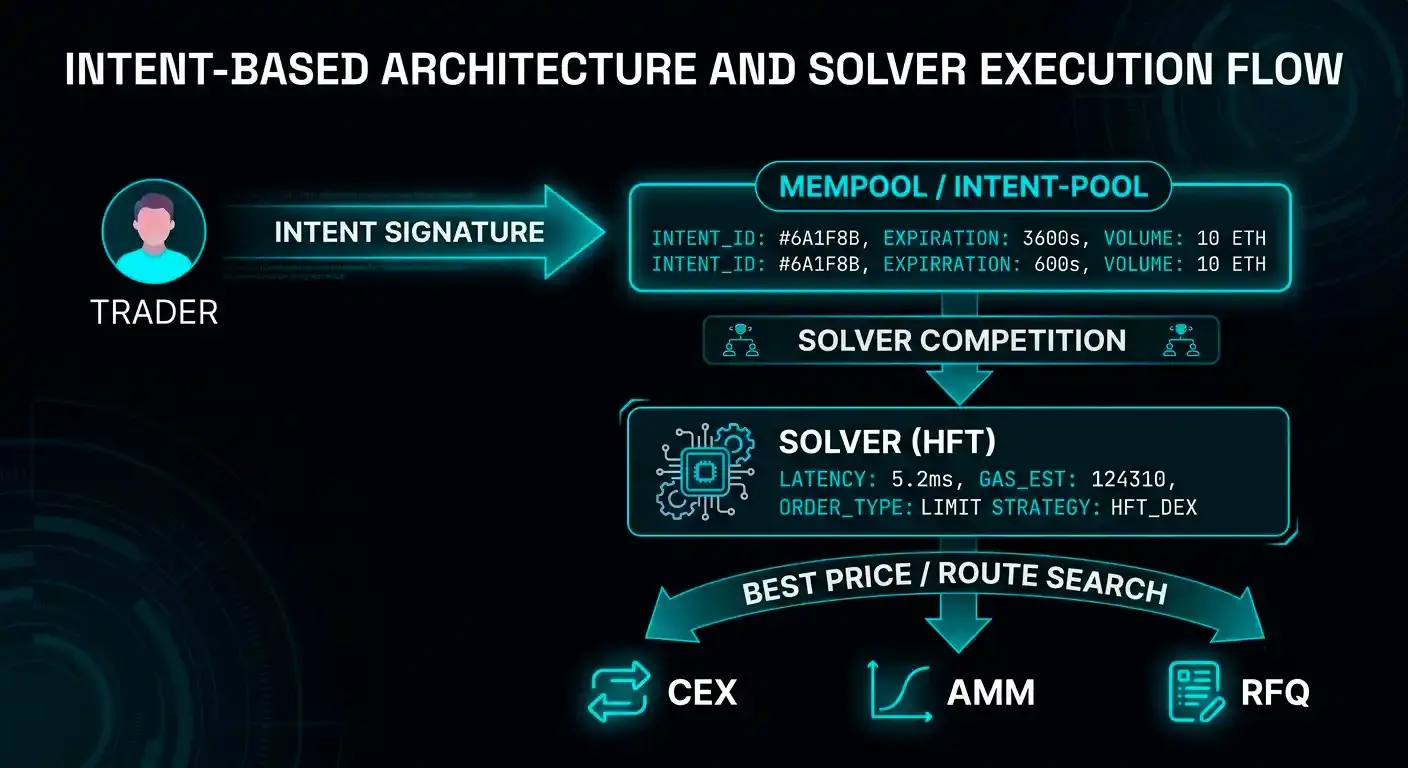
For active traders, this means zero slippage and built-in MEV sandwich protection: all slippage and execution risks fall squarely on the Solver, who profits via cross-venue arbitrage.
7. Hands-On: Advanced Arbitrage Script Between CEX L2 Order Book and AMM v2
In the wild, HFT bots are constantly hunting for price discrepancies between CEXs and AMMs. When a massive market buy causes a price spike on a CEX, the AMM pool stays "stale" for a brief window. Arbitrageurs step in, buying from the AMM to push its price up to CEX levels while offloading that inventory right back onto the CEX.
Here’s a battle-tested Python script that calculates the optimal arbitrage trade size (dx) in real time, accounting for AMM pool fees, CEX order book depth, and maker/taker fee structures.
from __future__ import annotations
from dataclasses import dataclass
from typing import List, Dict, Any
@dataclass
class BidLevel:
    price: float
    volume: float
class OrderBookSide:
    """
    Bid side of the order book.
    price  = buy price
    volume = base asset volume
    """
    def __init__(self, bids: List[tuple[float, float]]):
        self.bids: List[BidLevel] = []
        for price, volume in bids:
            if price <= 0:
                raise ValueError("Price must be > 0")
            if volume <= 0:
                raise ValueError("Volume must be > 0")
            self.bids.append(
                BidLevel(
                    float(price),
                    float(volume)
                )
            )
        self.bids.sort(
            key=lambda x: x.price,
            reverse=True
        )
    def is_empty(self) -> bool:
        return len(self.bids) == 0
    def best_bid(self) -> float:
        if self.is_empty():
            raise ValueError("Order book is empty")
        return self.bids[0].price
    def cumulative_levels(self) -> List[tuple[float, float]]:
        """
        Returns liquidity step points.
        [
            (2 ETH, VWAP up to 2 ETH),
            (7 ETH, VWAP up to 7 ETH),
            ...
        ]
        """
        result = []
        cumulative_x = 0.0
        cumulative_y = 0.0
        for level in self.bids:
            cumulative_x += level.volume
            cumulative_y += level.volume * level.price
            result.append(
                (
                    cumulative_x,
                    cumulative_y
                )
            )
        return result
    def execute_sell(
        self,
        amount_x: float
    ) -> tuple[float, float]:
        """
        Sell amount_x into the order book.
        Returns:
        (
            usdt_received,
            VWAP
        )
        """
        if amount_x <= 0:
            raise ValueError(
                "amount_x must be > 0"
            )
        remaining_x = amount_x
        received_y = 0.0
        for level in self.bids:
            if remaining_x <= 0:
                break
            executed = min(
                remaining_x,
                level.volume
            )
            received_y += (
                executed *
                level.price
            )
            remaining_x -= executed
        if remaining_x > 1e-9:
            raise ValueError(
                "Insufficient order book liquidity"
            )
        vwap = received_y / amount_x
        return received_y, vwap
class AMMPool:
    """
    Constant Product AMM
    x = ETH
    y = USDT
    """
    def __init__(
        self,
        reserve_x: float,
        reserve_y: float,
        fee: float = 0.003
    ):
        if reserve_x <= 0:
            raise ValueError(
                "reserve_x must be > 0"
            )
        if reserve_y <= 0:
            raise ValueError(
                "reserve_y must be > 0"
            )
        if not (0 <= fee < 1):
            raise ValueError(
                "fee must be in range [0,1)"
            )
        self.x = float(reserve_x)
        self.y = float(reserve_y)
        self.fee = float(fee)
    def spot_price(self) -> float:
        return self.y / self.x
    def calculate_out_x(
        self,
        amount_y_in: float
    ) -> float:
        if amount_y_in <= 0:
            raise ValueError(
                "amount_y_in must be > 0"
            )
        y_effective = (
            amount_y_in *
            (1.0 - self.fee)
        )
        x_out = (
            self.x *
            y_effective
        ) / (
            self.y +
            y_effective
        )
        return x_out
    def calculate_required_y_for_x(
        self,
        target_x_out: float
    ) -> float:
        """
        Inverted AMM formula.
        How much USDT needs to be deposited
        to receive target_x_out.
        """
        if target_x_out <= 0:
            raise ValueError(
                "target_x_out must be > 0"
            )
        if target_x_out >= self.x:
            raise ValueError(
                "Cannot drain total reserves"
            )
        y_effective = (
            target_x_out *
            self.y
        ) / (
            self.x -
            target_x_out
        )
        amount_y_in = (
            y_effective /
            (1.0 - self.fee)
        )
        return amount_y_in
def find_optimal_arbitrage(
    amm: AMMPool,
    cex_bids: OrderBookSide,
    cex_fee: float = 0.001
) -> Dict[str, Any]:
    if not (0 <= cex_fee < 1):
        raise ValueError(
            "cex_fee must be in range [0,1)"
        )
    if cex_bids.is_empty():
        return {
            "opportunity": False,
            "reason": "Empty CEX order book"
        }
    best_bid = cex_bids.best_bid()
    if (
        best_bid *
        (1.0 - cex_fee)
        <=
        amm.spot_price()
    ):
        return {
            "opportunity": False,
            "reason": "No spread available"
        }
    best_result = None
    best_profit = float("-inf")
    cumulative = cex_bids.cumulative_levels()
    for cumulative_x, cumulative_y in cumulative:
        try:
            required_usdt = (
                amm.calculate_required_y_for_x(
                    cumulative_x
                )
            )
            gross_usdt = cumulative_y
            net_usdt = (
                gross_usdt *
                (1.0 - cex_fee)
            )
            profit = (
                net_usdt -
                required_usdt
            )
            if profit > best_profit:
                avg_buy_price = (
                    required_usdt /
                    cumulative_x
                )
                avg_sell_price = (
                    gross_usdt /
                    cumulative_x
                )
                amm_spot = (
                    amm.spot_price()
                )
                impact_pct = (
                    (
                        avg_buy_price -
                        amm_spot
                    )
                    /
                    amm_spot
                ) * 100
                roi_pct = (
                    profit /
                    required_usdt
                ) * 100
                best_profit = profit
                best_result = {
                    "opportunity": True,
                    "input_usdt_amm": required_usdt,
                    "bought_x": cumulative_x,
                    "gross_usdt_cex": gross_usdt,
                    "net_usdt_cex": net_usdt,
                    "net_profit_usdt": profit,
                    "roi_pct": roi_pct,
                    "amm_spot_price": amm_spot,
                    "amm_avg_buy_price": avg_buy_price,
                    "amm_price_impact_pct": impact_pct,
                    "cex_vwap": avg_sell_price,
                }
        except ValueError:
            continue
    if best_result is None:
        return {
            "opportunity": False,
            "reason": "Liquidity is insufficient"
        }
    if best_result["net_profit_usdt"] <= 0:
        return {
            "opportunity": False,
            "reason": "Slippage wipes out profit"
        }
    return best_result
def main():
    amm = AMMPool(
        reserve_x=1000.0,
        reserve_y=3_000_000.0,
        fee=0.003
    )
    cex = OrderBookSide([
        (3050.0, 2.0),
        (3048.0, 5.0),
        (3045.0, 10.0),
        (3040.0, 20.0),
        (3030.0, 50.0),
    ])
    result = find_optimal_arbitrage(
        amm,
        cex,
        cex_fee=0.0005
    )
    print(
        "\n=== Arbitrage Search Results ===\n"
    )
    if not result["opportunity"]:
        print(
            f"Status: ABORTED\n"
            f"Reason: {result['reason']}"
        )
        return
    print("Status: ARBITRAGE OPPORTUNITY FOUND")
    print()
    print(
        f"AMM Input: "
        f"${result['input_usdt_amm']:,.2f}"
    )
    print(
        f"ETH Bought: "
        f"{result['bought_x']:.6f}"
    )
    print(
        f"CEX Gross Revenue: "
        f"${result['gross_usdt_cex']:,.2f}"
    )
    print(
        f"CEX Net Revenue: "
        f"${result['net_usdt_cex']:,.2f}"
    )
    print(
        f"Net Profit: "
        f"${result['net_profit_usdt']:,.2f}"
    )
    print(
        f"ROI: "
        f"{result['roi_pct']:.4f}%"
    )
    print(
        f"AMM Spot: "
        f"{result['amm_spot_price']:.4f}"
    )
    print(
        f"AMM Avg Buy: "
        f"{result['amm_avg_buy_price']:.4f}"
    )
    print(
        f"AMM Impact: "
        f"{result['amm_price_impact_pct']:.4f}%"
    )
    print(
        f"CEX VWAP: "
        f"{result['cex_vwap']:.4f}"
    )
if __name__ == "__main__":
    main()
8. Practical Takeaways for Traders: How to Stop Paying the "Ignorance Tax"
Understanding market microstructure isn't just academic fluff. It’s a core survival skill to keep your bankroll from bleeding out to hidden friction.
- Match order types to current market conditions: Slamming a massive Market Order into a CEX order book guarantees you'll sweep multiple levels, causing horrible negative slippage. If execution speed is non-negotiable, use Immediate-or-Cancel (IOC) or Fill-or-Kill (FOK) orders with explicit limit price bounds.
- Calculate effective depth, not just top-of-book spread: A razor-thin $0.01 spread on L2 is often an illusion. If the best Bid/Ask only holds $100 in size, your $50k market order is going to tear through the book to levels with vastly worse pricing.
- Beware toxic flow in AMMs: If you're providing concentrated liquidity on Uniswap v3 during high-volatility news events, you're free real estate for HFT arbitrageurs. LVR (Loss-Versus-Rebalancing) will wipe out your fee yields in a matter of minutes.
- Protect yourself from MEV on DEXs: When trading on AMMs, always tighten your Slippage Tolerance (cap it at 0.1–0.3%) or route through private RPC endpoints (like Flashbots Protect or MEV-Blocker) to keep your txs out of public mempools where sandwich bots lurk.
Drop a comment below: What kind of slippage are you seeing on your larger orders, and do you lean more on CEX Order Books or DEX AMMs for your day-to-day trading?