
The RWA sector has officially graduated from the "pilot proof-of-concept" phase: total value locked in tokenized assets—excluding stablecoins—has crossed $15 billion. Institutional capital isn't deploying here for "blockchain hype"; they're chasing raw cost reduction and instant settlement. The gap between real-world yield and hyper-inflated, leveraged DeFi yield is now impossible to ignore.
Let's tear down the financial engineering, legal frameworks, and technical pitfalls across four core verticals: Treasury bills, private credit, tokenized equities, and physical commodities.
On-Chain T-Bills: Treasuries and Sovereign Debt
Tokenizing US Treasury Bills (T-Bills) is currently the most liquid and legally battle-tested RWA sector. The thesis is simple: port the risk-free Fed Funds Rate directly on-chain, bypassing trad-fi brokers, their bloated fee structures, and banking holidays.
Architecture & Collateral Mechanics
There are two primary deployment models:
- Direct Ownership (SPV-based): An asset manager spins up a Special Purpose Vehicle (SPV) in a crypto-friendly jurisdiction like the Caymans, Delaware, or BVI. The SPV buys short-dated T-Bills (typically 0–3 months) or enters into Reverse Repo agreements. The token directly represents equity shares in this SPV. Key examples: BlackRock BUIDL, Franklin Templeton (FOBXX).
- Re-staking / Collateralized Vaults: Users deposit stablecoins (USDC/USDT), and the protocol routes those funds through a licensed custodian (e.g., BNY Mellon or BitGo) to off-ramp into fiat and purchase the underlying Treasuries.
The biggest blind spot for investors is the Redemption Mechanics. While blockchains run 24/7/365, Fedwire and TradFi clearinghouses (DTCC) only settle during standard business hours and strictly observe bank holidays.
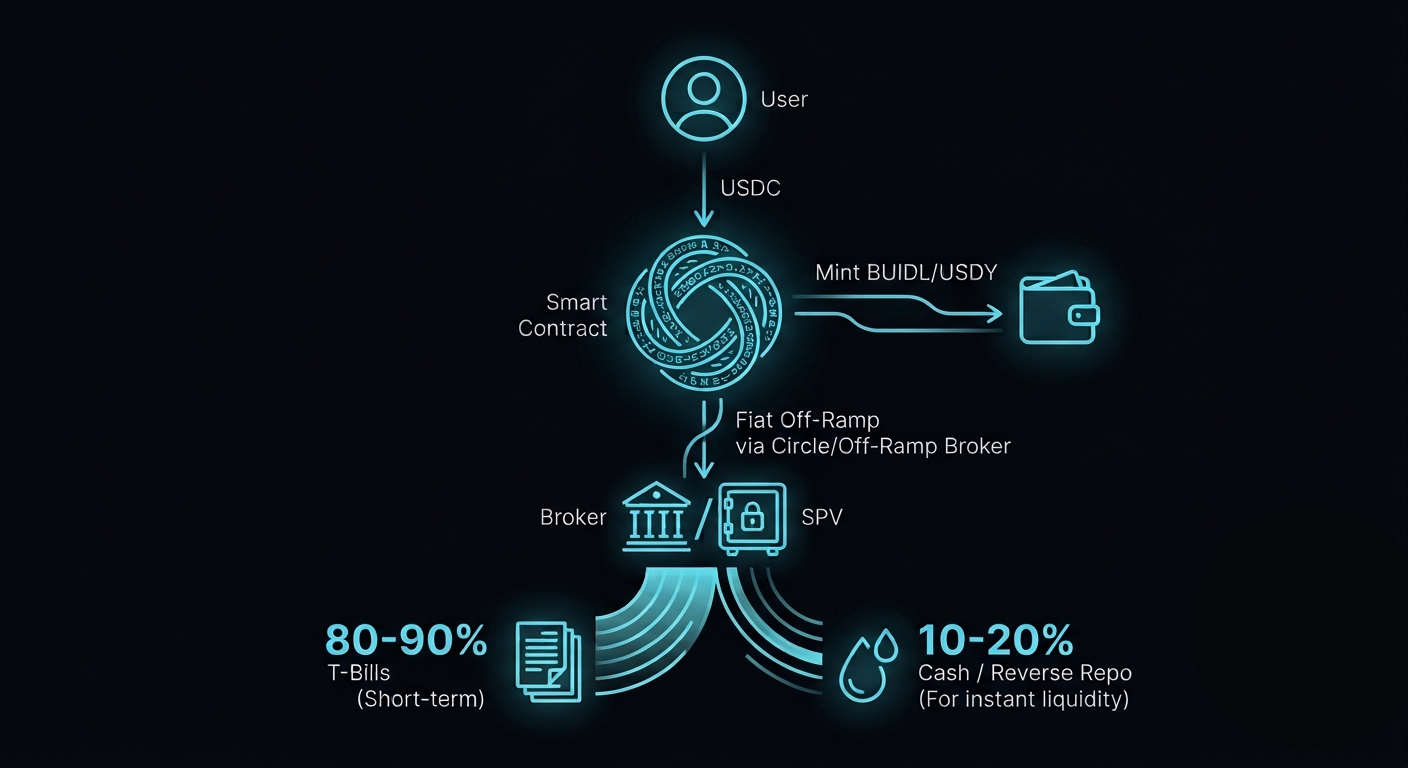
If a protocol promises instant mints and redemptions, it means they are maintaining an internal liquidity buffer in USDC/USDT (usually 10–15% of TVL). The moment a bank run drains this buffer, the protocol is forced to halt redemptions until US markets open for settlement (T+1 or T+2).
| Product / Protocol | Collateral Structure | Redemption Window | Min. Ticket Size | SPV Jurisdiction |
|---|---|---|---|---|
| BlackRock (BUIDL) | 100% Cash, US T-Bills, Rev Repo | T+0 (via Circle pool) / T+1 | $5,000,000 | BVI / US |
| Ondo Finance (USDY) | Short-term US T-Bills, Bank Deposits | T+2..T+3 business days | $500 | BVI |
| Ondo (OUSG) | BlackRock BUIDL + ETF (SHV) | Instant (subject to liquidity buffer) | $100,000 | Delaware, US |
| Centrifuge (Anemoy) | US Treasury Bills | Monthly / Daily batches | $5,000 | BVI |
Private Credit
While T-Bills yield a conservative 4–5% APY, on-chain Private Credit protocols (Centrifuge, Goldfinch, Maple Finance) target 10–18%. But make no mistake—these aren't risk-free government bonds. This is uncollateralized or partially collateralized debt issued to real-world businesses: emerging market fintechs, auto lenders, real estate developers, and microfinance institutions.
Risk Tranching: Senior vs. Junior (First-Loss)
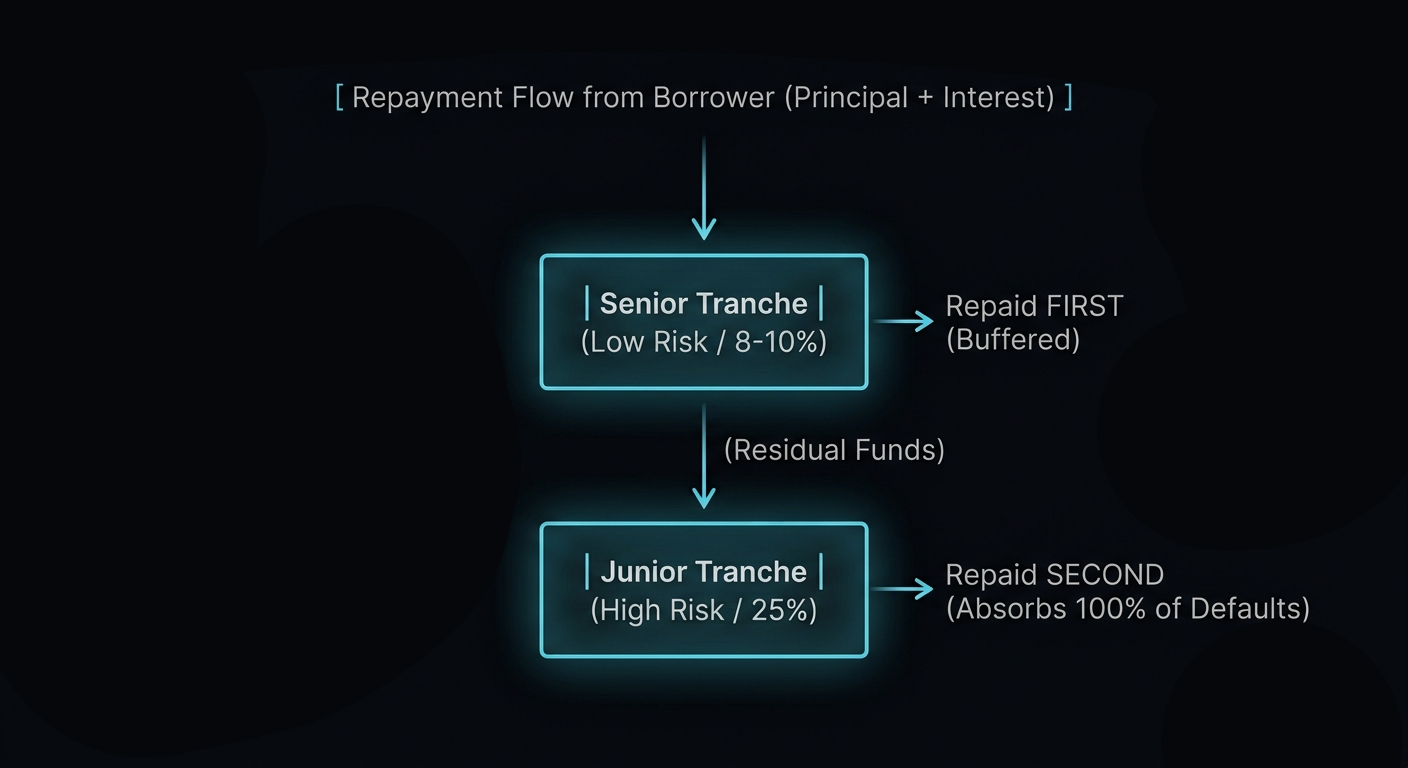
Because real-world defaults are inevitable, credit pools are structured around a classic Waterfall mechanism. The protocol splits capital providers into two core tranches:
- Junior Tranche (First-Loss Capital / Equity): LP deposits in this tranche absorb the first hit during a default. If a borrower fails to pay, loss is written off against Junior capital first. To compensate for taking the brunt of the risk, yields here are juicy (20–30%+). Underwriters or protocols often seed this tranche themselves to show market makers they have skin in the game.
- Senior Tranche: Capital is protected by the Junior tranche cushion. Yields are lower (8–12%), but Senior LPs sit at the top of the waterfall for payouts. As long as pool defaults don't exceed total Junior capital, Senior investors walk away whole.
The APY for the Senior tranche factors in the leverage provided over the Junior layer:
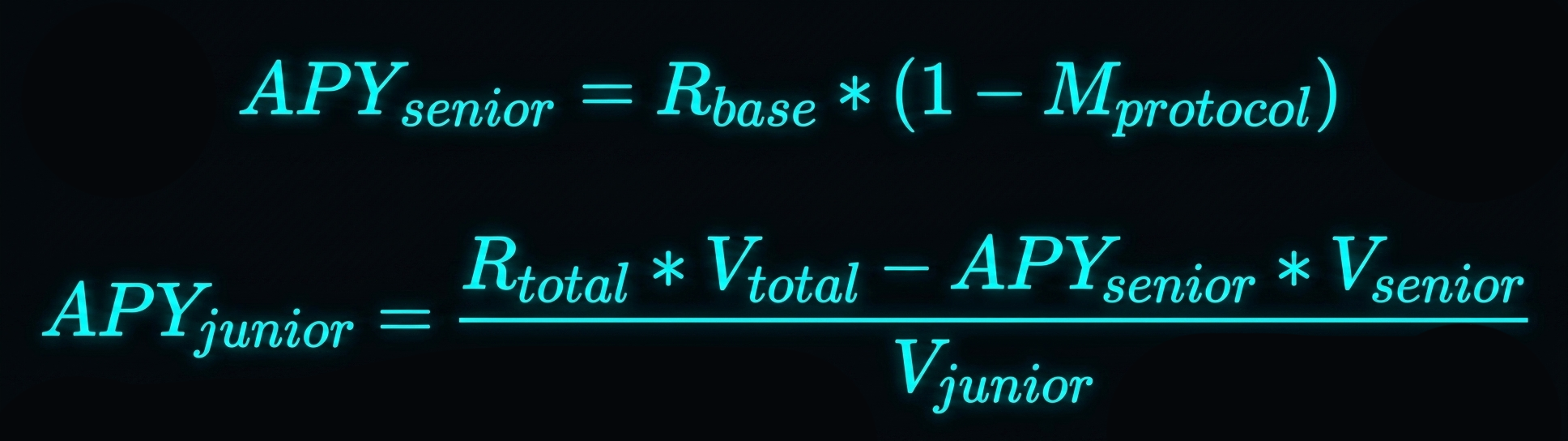
Where V is the TVL of the respective tranche, and R is the weighted average rate of the loan portfolio. When a borrower defaults, loss calculation for the Junior tranche is a simple write-down: min(Losses, Vjunior).
Programmable Waterfall Logic in Solidity
Here is a complete, self-contained smart contract implementing Senior/Junior repayment mechanics via a waterfall model. Built without external dependencies to keep the underlying math crystal clear.
// SPDX-License-Identifier: MIT
pragma solidity 0.8.24;
/// @title WaterfallDistribution - Waterfall payout engine for Senior/Junior RWA credit pools
/// @notice Implements sequential debt repayment mechanics without external dependencies
contract WaterfallDistribution {
    address public immutable owner;
    uint256 public seniorPrincipal;
    uint256 public juniorPrincipal;

    uint256 public seniorInterestDebt;
    uint256 public juniorInterestDebt;
    uint256 public constant SENIOR_RATE_BPS = 800;  // 8.00% APY
    uint256 public constant JUNIOR_RATE_BPS = 2000; // 20.00% APY
    uint256 public constant BPS_DENOMINATOR = 10000;
    event Deposited(address indexed investor, uint8 tranche, uint256 amount);
    event RepaymentProcessed(uint256 interestPaid, uint256 principalPaid);
    modifier onlyOwner() {
        require(msg.sender == owner, "NOT_OWNER");
        _;
    }
    constructor() {
        owner = msg.sender;
    }
    // # deposit liquidity into target tranche
    function deposit(uint8 tranche) external payable {
        require(msg.value > 0, "ZERO_AMOUNT");
        if (tranche == 0) {
            seniorPrincipal += msg.value;
            emit Deposited(msg.sender, 0, msg.value);
        } else if (tranche == 1) {
            juniorPrincipal += msg.value;
            emit Deposited(msg.sender, 1, msg.value);
        } else {
            revert("INVALID_TRANCHE");
        }
    }
    // # accrue interest debt for time period (simple interest calculation)
    function accrueInterest(uint256 periodInDays) external onlyOwner {
        seniorInterestDebt += (seniorPrincipal * SENIOR_RATE_BPS * periodInDays) / (365 * BPS_DENOMINATOR);
        juniorInterestDebt += (juniorPrincipal * JUNIOR_RATE_BPS * periodInDays) / (365 * BPS_DENOMINATOR);
    }
    // # strict waterfall execution for incoming fiat/stablecoin repayments
    function processRepayment() external payable onlyOwner {
        uint256 remaining = msg.value;
        // 1. Pay Senior interest first
        if (remaining > 0 && seniorInterestDebt > 0) {
            uint256 paySeniorInt = remaining > seniorInterestDebt ? seniorInterestDebt : remaining;
            seniorInterestDebt -= paySeniorInt;
            remaining -= paySeniorInt;
        }
        // 2. Pay Junior interest second
        if (remaining > 0 && juniorInterestDebt > 0) {
            uint256 payJuniorInt = remaining > juniorInterestDebt ? juniorInterestDebt : remaining;
            juniorInterestDebt -= payJuniorInt;
            remaining -= payJuniorInt;
        }
        // 3. Pay Senior principal
        if (remaining > 0 && seniorPrincipal > 0) {
            uint256 paySeniorPrn = remaining > seniorPrincipal ? seniorPrincipal : remaining;
            seniorPrincipal -= paySeniorPrn;
            remaining -= paySeniorPrn;
        }
        // 4. Pay Junior principal (First-Loss absorbs shortfall if remaining == 0)
        if (remaining > 0 && juniorPrincipal > 0) {
            uint256 payJuniorPrn = remaining > juniorPrincipal ? juniorPrincipal : remaining;
            juniorPrincipal -= payJuniorPrn;
            remaining -= payJuniorPrn;
        }
        emit RepaymentProcessed(msg.value - remaining, remaining);
    }
}
Tokenized Stocks and Commodities
Equities in traditional powerhouses (think Apple or Tesla) alongside hard assets (gold, oil, real estate) offer direct access to global capital markets—yet they constantly hit a brick wall when it comes to infrastructure compatibility.
Synthetics vs. 100% Asset-Backed
When you pop open the hood, there’s a fundamental architectural split in how tokenized equities and commodities are built:
- Synthetic Assets (Synthetics): Over-collateralized crypto derivatives (like Synthetix's snxUSD). These carry zero direct legal claim on the underlying stocks or physical gold. Instead, oracles track the spot price while positions are backed by ETH, USDC, or native protocol tokens. The upsides? 24/7 permissionless liquidity with no KYC friction. The catch? Massive liquidation risk during violent collateral dumps and zero rights to the underlying physical assets or dividend payouts.
- 100% Asset-Backed (Legal & Physical Backing): Here, each token is hard-pegged to a depository receipt, share, or physical gold bullion held in a custodial vault (e.g., PAXG, Tether Gold XAUt, or Backed Finance bIB01). Every minted token maps 1:1 to a real-world asset. If the issuer goes belly up, the SPV (Special Purpose Vehicle) legal structure lets token holders file direct claims on the collateral through designated arbitration.
The Weekend Market-Making Dilemma
Legacy TradFi venues (NYSE, NASDAQ, LME) stick to standard banker hours and shut down completely on weekends and holidays. Crypto order books, on the other hand, run 24/7/365.
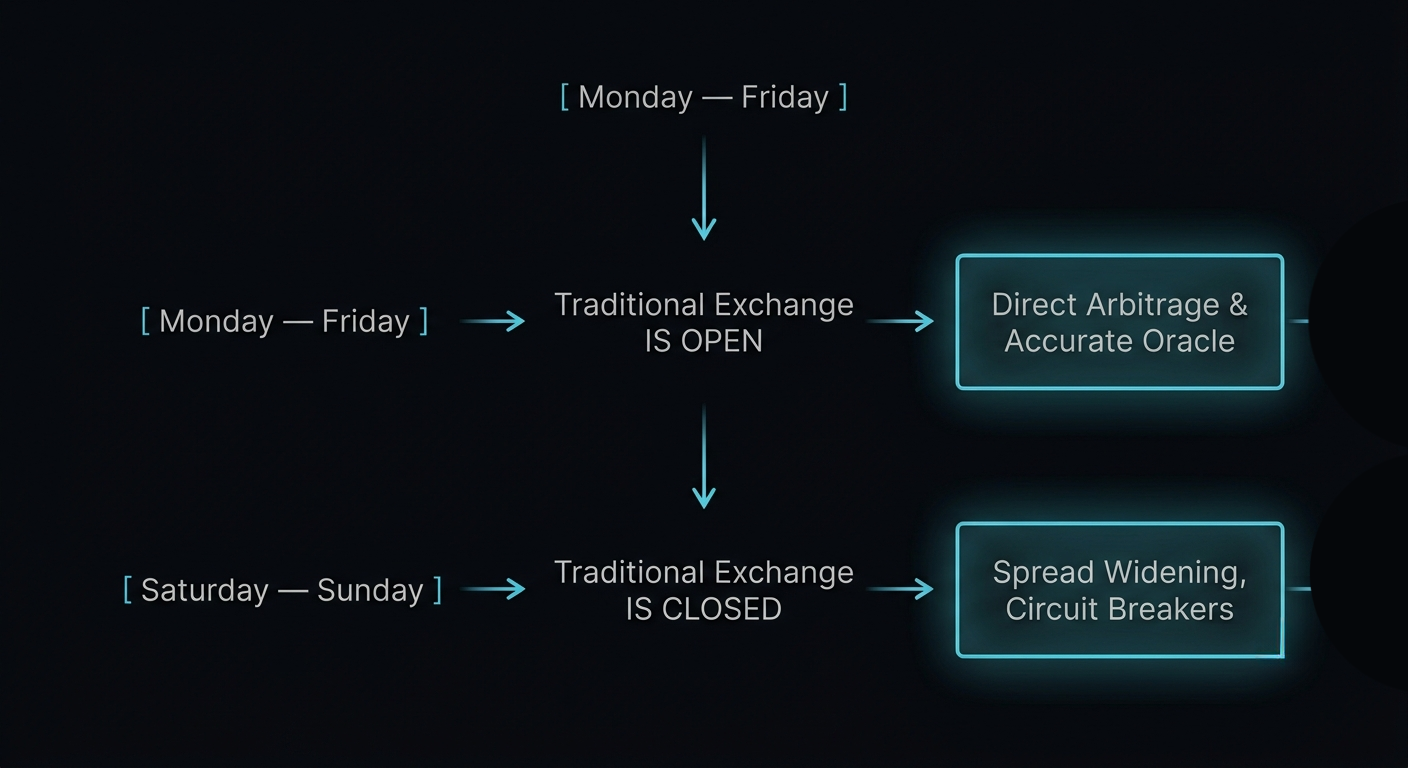
This gap creates a dangerous price vacuum on weekends. If a macro shock hits crypto markets while TradFi is closed, market makers backing tokenized stocks can't hedge their inventory on traditional venues.
To prevent toxic arbitrage attacks and liquidity drain, protocols lean on a few key mechanisms:
- Dynamic Spread Scaling: AMM algorithms and CLOB venues automatically blow out bid/ask spreads from a tight baseline (~0.05%) up to 1.5–3.0% the second the bell rings at NYSE or LME.
- Smart Contract Circuit Breakers: Pinning the price feed to the Friday Close Price via Chainlink. Any large swaps or trades drifting past a set tolerance threshold (say, 2%) get instantly frozen until TradFi markets reopen.
- Chainlink Proof of Reserve (PoR): Real-time automated verification of custodial accounts (like BNY Mellon or Brink's) prior to minting. If the underlying gold bar or stock certificate hasn't cleared into the vault, the smart contract reverts the transaction.
Oracle Validation and Stale Price Protection
To execute RWA trades safely, your backend and smart contracts need rock-solid checks on Chainlink price feed timestamps to catch stale data before it bites you.
Here’s a production-ready Python script using Web3.py that monitors a Chainlink Gold (XAU/USD) oracle with built-in stale price validation.
import sys
from web3 import Web3
# # Connect to Ethereum Mainnet RPC node
RPC_URL = "https://eth.merkle.io"
w3 = Web3(Web3.HTTPProvider(RPC_URL))
if not w3.is_connected():
    sys.exit("CRITICAL: RPC node connection failed")
# # Chainlink XAU/USD Feed Contract (Ethereum Mainnet)
FEED_ADDRESS = "0x214eD128B890A985B66282E2e66A7D9D3eAf39dA"
CHAINLINK_ABI = [
    {
        "inputs": [],
        "name": "latestRoundData",
        "outputs": [
            {"name": "roundId", "type": "uint80"},
            {"name": "answer", "type": "int256"},
            {"name": "startedAt", "type": "uint256"},
            {"name": "updatedAt", "type": "uint256"},
            {"name": "answeredInRound", "type": "uint80"}
        ],
        "stateMutability": "view",
        "type": "function"
    },
    {
        "inputs": [],
        "name": "decimals",
        "outputs": [{"name": "", "type": "uint8"}],
        "stateMutability": "view",
        "type": "function"
    }
]
feed_contract = w3.eth.contract(address=w3.to_checksum_address(FEED_ADDRESS), abi=CHAINLINK_ABI)
def verify_oracle_price(max_stale_time_seconds=86400):
    try:
        round_id, price, started_at, updated_at, answered_in_round = feed_contract.functions.latestRoundData().call()
        decimals = feed_contract.functions.decimals().call()

        current_block_time = w3.eth.get_block('latest')['timestamp']

        # # Calculate human-readable price adjusted for decimals
        human_price = price / (10 ** decimals)
        time_delta = current_block_time - updated_at
        # # Strict round integrity and freshness validation
        if price <= 0:
            raise ValueError("Oracle returned an invalid price (zero or negative)")

        if answered_in_round < round_id:
            raise ValueError("Stale round detected (answeredInRound lower than roundId)")

        if time_delta > max_stale_time_seconds:
            print(f"WARN: Stale price feed! Heartbeat delay: {time_delta}s (TradFi markets likely closed)")
            return human_price, False
        return human_price, True
    except Exception as e:
        print(f"ERROR: Smart contract call failed: {e}")
        return None, False
if __name__ == "__main__":
    price, is_valid = verify_oracle_price()
    if price:
        print(f"Current XAU/USD Price: ${price:.2f} | Status: {'OK' if is_valid else 'STALE'}")
EXMON Core Framework for RWA Protocol Audits
When evaluating RWA primitives, our engineering team relies on five critical metrics to score protocol health and structural risk:
| Metric | Formula / Source | Target Baseline / Critical Risk | Analytical Insight |
|---|---|---|---|
| Default Rate (Private Credit) | Written-off Principal / Total Active Capital | < 2.5% | Reflects the true quality of credit underwriting and borrower risk controls. |
| First-Loss Capital Buffer | Vjunior / Vtotal | ≥ 15% | First-loss tranche protection shielding Senior LP tranches when defaults occur. |
| Liquidity Buffer Ratio (T-Bills) | USDC / Cash Reserve / TVL | 10% - 20% | The protocol’s capacity to handle same-day redemptions without friction. |
| PoR Update Frequency | Chainlink PoR Feeds | Real-time / Daily | On-chain visibility verifying physical assets sit securely in off-chain custody accounts. |
| Legal Claim Enforceability | SPV / Legal Opinion | Direct Collateral Assignment | Legal recourse strength to seize underlying collateral in court if the issuer defaults. |
Institutional money isn't flocking to RWAs for privacy—they're here for deterministic smart contract execution backed by ironclad property rights.