
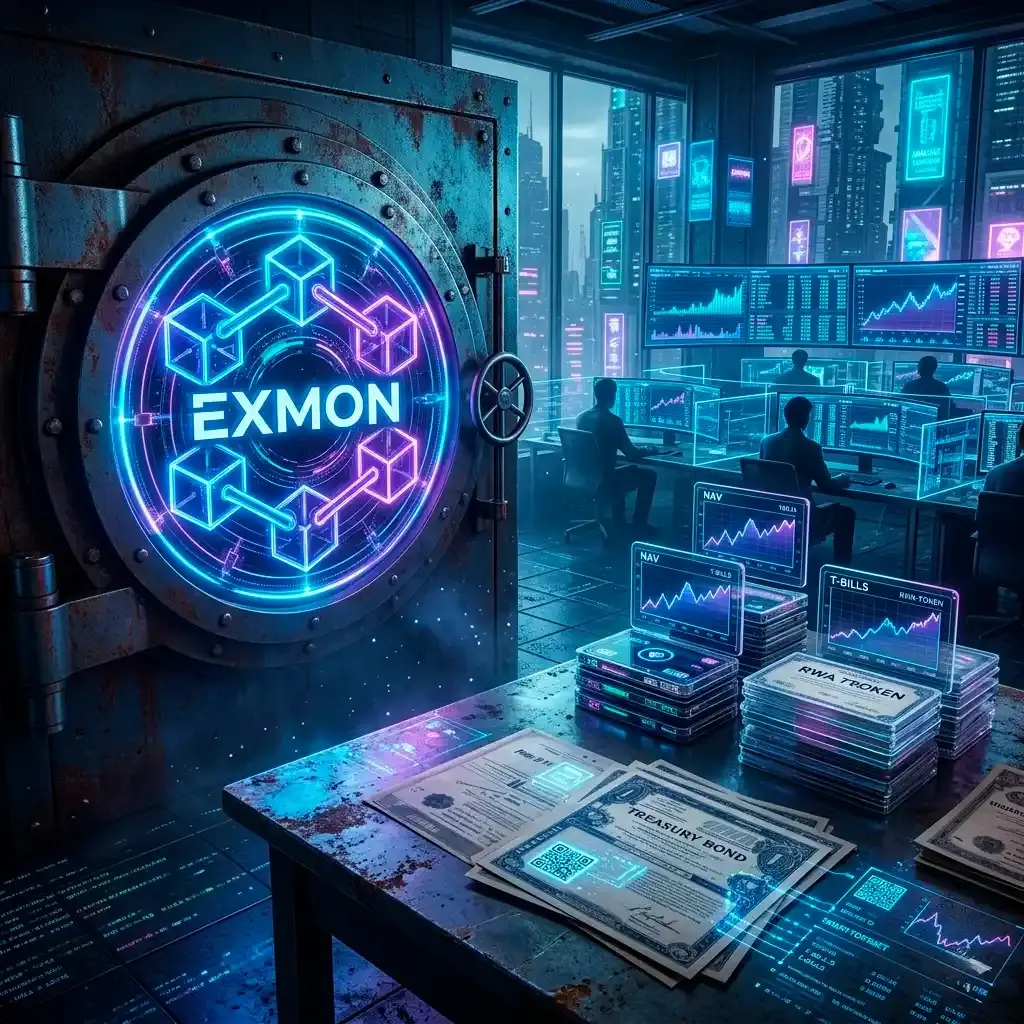
It’s 2026, and the world of finance has finally crossed the line between “traditional” and “digital.” Not long ago, buying U.S. Treasury bills (T-Bills) was something mostly reserved for institutions — or it required opening an account with a foreign broker and dealing with stacks of paperwork. Today, Real World Assets (RWA) — the tokenization of real-world financial instruments — have turned government debt into a liquid asset you can hold right in your crypto wallet.
In this article, we’ll break down how this “magic” actually works, where the yield comes from, and how to execute a trade step by step.
1. Why did T-Bills “move” to the blockchain?
U.S. Treasury bills are widely considered a risk-free asset (the Risk-Free Rate). With crypto markets remaining volatile, traders have been looking for ways to park liquidity not just in stablecoins that earn nothing, but in instruments generating 4–5% annual yield in dollars.
Advantages of tokenization:
- Fractionalization: You don’t need $1,000 to buy a bond — you can invest as little as $10.
- 24/7 Liquidity: Blockchains don’t close for weekends. You can sell a “tokenized bond” in a liquidity pool at 3 a.m. on a Sunday.
- Composability: Tokenized debt can be used as collateral in DeFi protocols, improving capital efficiency.
2. Key players and platforms in 2026
As of now, the market has consolidated around a handful of major players. It’s important to understand the different levels of access:
| Platform | Main Token | Access Type | Key Features |
|---|---|---|---|
| Ondo Finance | OUSG / USDY | Retail / Accredited | USDY is a yield-bearing stablecoin available to most users. |
| Franklin Templeton | BENJI | Retail (via app) | An official fund operating on Polygon and Stellar. |
| BlackRock (BUIDL) | BUIDL | Institutional | A base asset used across many other protocols. |
| Backed Finance | bIB01 | Retail (outside the U.S.) | Tokenized ETFs tracking short-term Treasuries. |
Little-known fact: By 2026, integration has advanced to the point where MetaMask lets you buy Ondo tokens directly through its built-in “Portfolio” interface, aggregating liquidity across multiple networks.
3. Practical walkthrough: How to buy
For retail traders, the simplest route is purchasing USDY (Ondo Yield Cash) or similar instruments from Backed or Swarm.
Step 1: Prepare your wallet
You’ll need a wallet that supports Ethereum, Polygon, or Solana. Make sure you hold stablecoins (USDC or USDT) and a small amount of the network’s native token to cover gas fees.
Step 2: Complete KYC (Know Your Customer)
Even though this is crypto, we’re still dealing with securities. Most compliant platforms (Ondo, Backed) will require identity verification.
Pro tip: If you don’t want to complete KYC on every platform, you can use decentralized exchanges (DEXs) like Unisat or aggregators (such as Jupiter on Solana). There you may find “wrapped” versions of bonds trading on the secondary market — just be careful about liquidity and always verify the original smart contract.
Step 3: Buy on a DEX
If you’re buying bIB01 (a Backed token tracking 1–3 month T-Bills), for example:
- Find the official contract address on RWA.xyz.
- Go to Uniswap (Ethereum) or CowSwap (for MEV protection).
- Swap USDC for the bond token.
4. Technical part: Interacting via code (Python)
For professional traders looking to automate government bond portfolio management, the web3.py library can be used. Below is an example of how to check your tokenized bond balance and its current yield (illustrated through a contract function call).
from web3 import Web3
# Connect to RPC (e.g., Polygon or Ethereum)
rpc_url = "https://polygon-mainnet.infura.io/v3/YOUR_PROJECT_ID"
w3 = Web3(Web3.HTTPProvider(rpc_url))
# Tokenized bond contract address (example for USDY)
contract_address = "0x963031366006400c69873907771e1ef6700831b8"
# Simplified ABI for reading balance and price only
abi = [
    {"constant": True, "inputs": [{"name": "_owner", "type": "address"}], "name": "balanceOf", "outputs": [{"name": "balance", "type": "uint256"}], "type": "function"},
    {"constant": True, "inputs": [], "name": "getPrice", "outputs": [{"name": "", "type": "uint256"}], "type": "function"}
]
contract = w3.eth.contract(address=w3.to_checksum_address(contract_address), abi=abi)
def get_portfolio_data(user_address):
    balance = contract.functions.balanceOf(user_address).call()
    price = contract.functions.getPrice().call() # Token price in USDC

    # Convert from wei (18 decimals)
    human_balance = balance / 10**18
    human_price = price / 10**6

    print(f"Your balance: {human_balance:.4f} T-Tokens")
    print(f"Current value: ${human_balance * human_price:.2d}")
# Call function
get_portfolio_data("0xYourWalletAddress")
5. Risks no one talks about
- Smart contract risk: Even if Uncle Sam guarantees bond payments, bugs in the Ondo or Backed protocol code are still very real.
- Regulatory risk: In 2026, the GENIUS Act came into force, imposing strict regulation on stablecoins and RWAs. Tokens can be frozen at a regulator’s request if your address ends up on a “gray list.”
- De-peg risk: The token’s market price may temporarily diverge from the value of the underlying bond due to market panic.
6. Yield Strategies: Getting the Most Out of “Digital Treasuries”
For a professional trader, simply “holding” the token is just the tip of the iceberg. In 2026, the maturity of the DeFi infrastructure allows you to use T-Bills in sophisticated strategies.
Strategy A: Carry Trade 2.0 (Leveraged Yield)
Many lending protocols (e.g., Morpho or Aave) let you use tokenized bonds (like OUSG) as collateral.
- You put $10,000 into OUSG (yield ~5%).
- Borrow against that collateral in stablecoins (e.g., LUSD or USDC) at 3–3.5%.
- Use the borrowed funds to buy more OUSG.
Result: Thanks to leverage, your net return on equity (ROE) can reach 8–10% per year with minimal liquidation risk (since the correlation between the collateral and the loan is nearly perfect).
Strategy B: Delta-Neutral Arbitrage
Sometimes on decentralized exchanges (DEX), large sell-offs push a bond token below its NAV (Net Asset Value).
- Action: Buy the token at a discount on a DEX and redeem it directly with the issuer at par.
- Note: Requires KYC and processing time (usually T+1 or T+2).
7. Tax and Legal Nuances
This used to be a “grey area,” but it’s become clearer in 2026.
- Classification: In most jurisdictions, a tokenized bond is treated as a security token. Income is usually classified as interest income rather than capital gains.
- W-8BEN: If you’re not a U.S. resident, registering officially on a platform (e.g., Franklin Templeton) will require submitting a W-8BEN to avoid double taxation.
- Stablecoins vs RWA: Unlike USDT, which pays nothing, RWA tokens accrue yield in their price (like auto-compounding tokens). This is more convenient for long-term holding since the taxable event happens only on sale.
8. Lesser-Known Details: “Sleeping” Protocols and Yield Bridges
Few realize that in 2026, Cross-Chain Yield Aggregators are gaining traction. For example, you can hold bonds on the Base network (Coinbase L2) but use their liquidity as collateral for margin on decentralized futures exchanges on Arbitrum via protocols like LayerZero. This lets your “safe” capital work in two ways: earning a fixed return and serving as collateral for speculation.
Sample Code: Price Deviation Monitoring (Peg Tracking)
Professional traders use bots to track discrepancies between a token’s DEX price and the bond’s real price.
import requests

def check_arbitrage_opportunity():
    # Simulate fetching NAV from the issuer (via Oracle or API)
    real_nav = 105.42

    # Get the price from the DEX (e.g., via DexScreener API or directly from the pool)
    dex_price_api = "https://api.dexscreener.com/latest/dex/pairs/ethereum/PAIR_ADDRESS"
    response = requests.get(dex_price_api).json()
    current_dex_price = float(response['pair']['priceUsd'])

    threshold = 0.005  # 0.5% difference

    if real_nav - current_dex_price > (real_nav * threshold):
        print(f"SIGNAL: Token trading at a discount! NAV: {real_nav}, DEX: {current_dex_price}")
        # Trigger buy function here
    else:
        print("No arbitrage opportunities.")

check_arbitrage_opportunity()
9. The Future: Tokenizing the Long End of the Curve
While T-Bills (up to 1 year) are popular now, the 2026 trend is tokenizing 10- and 30-year bonds. Traders can play Fed rate moves directly on-chain. Expecting rates to drop? Buy tokenized 20-year bonds (TLT ETF in tokens) — their price rises as rates fall.
Trader Takeaway:
Tokenized treasuries aren’t just a boring conservative tool. They’re the foundation for building a “smart” portfolio where your cash isn’t idle but actively generating yield backed by U.S. Treasury strength and blockchain transparency.
Summarize this blog post with: