
Building your own trading strategy is the bridge between gambling and running a systematic business. Backtesting—using historical data—lets you make every possible mistake on paper before you trust an algorithm with your hard-earned cash.
In this deep dive, we’ll walk through the whole process: from hunting for an idea to stress-testing it using a modern tech stack.
1. The Foundation: From Idea to Algorithm
Every strategy kicks off with a hypothesis. This is a clear-cut statement about how the market behaves. For example: "If an asset's price drops by 5% in an hour on abnormal volume, there's a high probability of a short-term bounce."
Common strategies for beginners:
- Mean Reversion: Betting that when the price strays too far from its average, it’ll eventually snap back.
- Trend Following: Jumping in when a direction is confirmed—think moving average crossovers or level breakouts.
- Arbitrage: Exploiting price gaps for the same asset across different exchanges.
- Statistical Arbitrage: Hunting for correlations and price discrepancies between different assets.
2. Scoping Out Historical Data
The quality of your test is only as good as the data you feed it.
"Garbage in, garbage out."
Where do you get the data?
- Exchange APIs: Platforms like Binance, Coinbase, or Bybit give you access to historical candles (OHLCV).
- Data Aggregators: Yahoo Finance (stocks), CoinMetrics (crypto), or Glassnode (on-chain data).
- Ready-made Datasets: Kaggle or niche repositories on GitHub.
Table: Data Types and Use Cases
| Data Type | Description | Best For |
|---|---|---|
| OHLCV | Open, High, Low, Close, Volume | Standard technical analysis, swing trading. |
| Orderbook (L2) | The "depth," limit orders sitting in the book | Scalping, HFT, and liquidity analysis. |
| Tick Data | Every single individual trade | Ultra-precise backtesting, arbitrage. |
| Alternative Data | Social media, news, financial reports | Sentiment analysis, fundamental plays. |
3. The Backtesting Toolkit
Beginners usually stick to visual platforms, while the pros dive straight into coding.
- TradingView (Pine Script): The fastest way to visualize an idea. The built-in Strategy Tester shows your PnL right on the chart.
- Python (Libraries):
- Pandas: The go-to for data crunching.
- Backtrader or VectorBT: Heavy-duty engines for backtesting.
- ccxt: For connecting to hundreds of crypto exchanges.
Simple Python Example (VectorBT)
This snippet tests a basic Golden Cross (two moving averages crossing):
import vectorbt as vbt
import pandas as pd
# Download data
data = vbt.YFData.download('BTC-USD', start='2023-01-01')
close = data.get('Close')
# Define strategy: Fast MA (10) crosses above Slow MA (50)
fast_ma = vbt.MA.run(close, 10)
slow_ma = vbt.MA.run(close, 50)
entries = fast_ma.ma_crossed_above(slow_ma)
exits = fast_ma.ma_crossed_below(slow_ma)
# Run backtest
pf = vbt.Portfolio.from_signals(close, entries, exits, init_cash=1000)
print(pf.total_return())
4. Performance Metrics
Don't just chase the "Total Profit." Massive gains often come with the risk of blowing up your account.
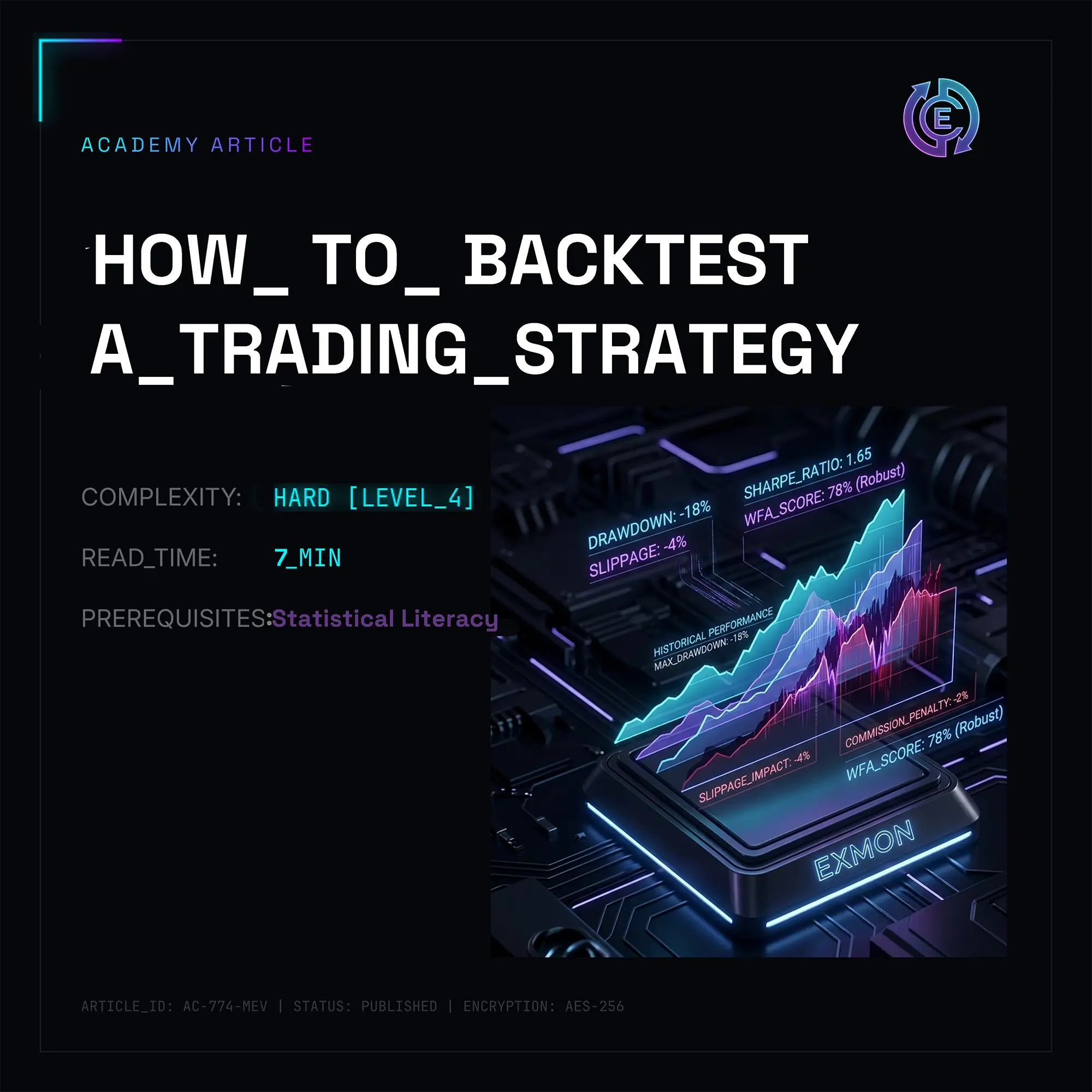
- Drawdown: The biggest peak-to-trough drop in your balance. If you hit a 50% drawdown, you need a 100% gain just to get back to breakeven.
- Sharpe Ratio: This tells you if the returns are actually worth the risk you're taking. Anything over 1.0 is generally solid.
- Win Rate: Percentage of winning trades. Note: A 30% win rate can be insanely profitable if your Risk/Reward ratio is high enough.
- Profit Factor: The ratio of gross profit to gross loss.
5. The Pitfalls (The stuff they don't tell you)
This is where most newbies get wrecked—their real-money results look nothing like their backtests.
Look-ahead Bias
This happens when your algorithm accidentally "cheats" by using future data. For example, calculating the day's average price and making a trade in the morning based on that average. In the real world, you wouldn't know the evening's price yet.
Survivorship Bias
Testing your strategy only on stocks or coins that are currently at the top. You’re ignoring the hundreds of projects that went to zero and were delisted. You need to test on the full universe of assets available at that time.
Slippage and Fees
On paper, you bought at $100. In reality, your order filled at $100.5 because of low liquidity, and the exchange took a 0.1% cut. Over 1,000 trades, this "hidden" cost turns a winning strategy into a loser.
6. Advanced Testing Methods: The Stress Test
Once your initial backtest spits out a "pretty" equity curve, it’s time to try and break it. A simple run through history isn't enough because markets are chameleons—they change constantly.
Walk-Forward Analysis (WFA)
Think of this as a "rolling" test. You slice your data into specific blocks:
- In-Sample (Training): You optimize your strategy’s settings (like picking the best MA length).
- Out-of-Sample (Testing): You run those exact settings on the next slice of data—stuff the algorithm hasn't seen yet.
Then, you shift the window forward and repeat. If the strategy holds up across all these "invisible" segments, it’s actually robust.
Monte Carlo Simulation
This involves shuffling the order of your trades thousands of times at random.
- The Goal: To figure out the odds of a "worst-case scenario" losing streak (Drawdown) blowing up your account.
If 500 out of 10,000 simulations end in bankruptcy, the strategy is a ticking time bomb—even if its average returns look great.
7. Optimization vs. Overfitting
The deadliest trap for any researcher is Overfitting. This happens when you’ve tuned your parameters so perfectly that the algorithm has essentially "memorized" the past, but has no idea how to handle the future.
How to stay out of the overfit trap:
- Less is more: The more indicators and "if/then" rules you cram into your code, the higher the chance you're just trading noise.
- Parameter Stability: If your strategy works with an indicator period of 20 but falls apart at 19 or 21, it’s a house of cards. Results should change gradually as you tweak settings.
- Logic first: Every parameter needs an economic reason for existing. "Because it made more money in the backtest" is a one-way ticket to a margin call.
8. Deep Cuts: MEV and JIT Liquidity in Backtesting
If you’re playing in the DeFi space (Uniswap v3/v4), standard backtesting will lie to you because of how blockchains actually work.
- LVR (Loss Versus Rebalancing): The gold standard metric for liquidity providers. It compares fee income against the loss taken when arbitrageurs pick your pockets at prices favorable to them.
- JIT (Just-In-Time) Liquidity: A strategy where liquidity is sniped into a pool a millisecond before a big trade and pulled immediately after. You can't track this with standard OHLCV candles; you need event-driven data.
9. The Practical Checklist: From Code to Exchange
| Phase | Action | Tool |
|---|---|---|
| 1. Hypothesis | Define entry/exit rules and stop-loss logic. | Notepad / Obsidian |
| 2. Data Sourcing | Pull historical candles or tick data. | API (Binance/CCXT), Python |
| 3. Backtest | First run of the strategy on history. | Backtrader, Pine Script |
| 4. Optimization | Account for fees (0.1%+) and slippage. | Code Parameters |
| 5. Validation | Walk-Forward and Monte Carlo. | Python (scipy, numpy) |
| 6. Paper Trading | Real-time trading on a virtual account. | TradingView / Paper Account |
| 7. Scaling Up | Go live with a small amount of real capital. | API Keys (Read/Write) |
10. Code Example: Accounting for Fees and Slippage
In professional testing, it’s vital to "penalize" your strategy. Here’s a basic breakdown of how that logic works:
# Pseudo-code for cost-aware logic
commission = 0.001  # 0.1% per trade
slippage = 0.0005    # 0.05% price slippage
def execute_trade(price, size, side):
    if side == 'buy':
        effective_price = price * (1 + slippage)
        cost = size * effective_price * (1 + commission)
    elif side == 'sell':
        effective_price = price * (1 - slippage)
        revenue = size * effective_price * (1 - commission)
    return effective_price, cost_or_revenue
The Golden Rule: If your strategy flips from profit to loss once you add realistic fees and slippage, don’t try to "fix" it. Throw it out and find a new idea. The market shows no mercy to those who ignore the cost of doing business.