
Pretty much everyone has noticed the recent surge in crypto hacks and bankruptcies. This latest wave of major exploits and Chapter 11 filings isn't a string of accidents or the "growing pains" of a young industry. What we're seeing is the predictable collapse of a massive technical and financial sham. And it's only going to happen more often.
Over the past few years, the Web3 market replaced the original vision of math-backed independence with a VC circus. Users are sold the promise of a "decentralized future," even though under the hood, most modern projects are just traditional client-server apps hosted on rented cloud instances and controlled by a handful of insiders.
The Illusion of L2 Networks and Cross-Chain Infrastructure
A real blockchain relies on consensus across thousands of independent nodes. Compromising Bitcoin or Monero requires immense computing power, infrastructure, and a full 51% attack—making it mathematically and economically unfeasible.
So what are most L2s, L3s, and cross-chain bridges actually built of? Fragile middle layers with paper-thin security.
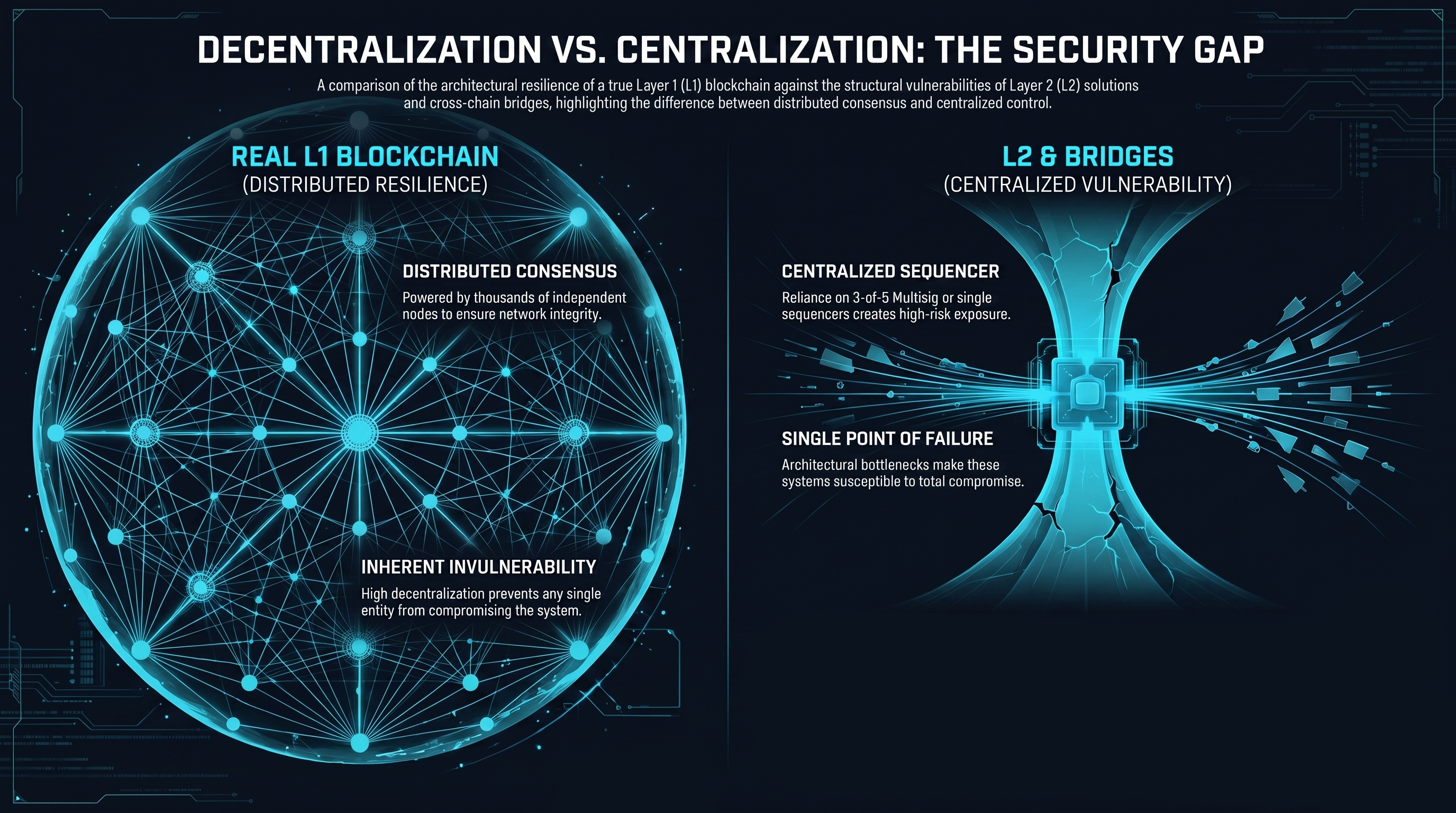
- Centralization masquerading as scaling. In most L2 networks, transaction sequencing is handled by a single centralized server run by the core dev company.
- Admin keys. The logic of most smart contracts is upgradeable via proxies. A 3-of-5 multisig can rewrite the code, reroute funds, or freeze transactions at any given moment.
When an exploit like the $10M (515M NIGHT) bridge drain on Wanchain/Cardano happens, devs stepping up to claim "the underlying L1 protocol wasn't affected" is pure, cynical PR spin. End users don't care if the base layer math holds up when their funds were drained from a centralized wrapper marketed as a safe product.
Financial Engineering: Exploits Born from Negligence
Take the $1.65M exploit on Allbridge Core on Solana—it perfectly demonstrates how shipping fast and breaking things obliterates security. This wasn't some NSA-level zero-day. It was a textbook math flaw in their liquidity logic:
- The attacker takes out a $1.1M USDC flash loan within a single block.
- Dumps the capital into the pool, artificially skewing the USDC/USDT price ratio.
- Deposits a trivial $2,000 and pulls out over $2M USDC at the manipulated exchange rate.
- Pays back the flash loan and walks away with the net profit.
The devs failed to implement basic intra-transaction slippage protection. And this exact negligence is baked into dozens of DeFi protocols. The $1.34M CLS Vault hack in Cascade stems from the exact same playbook. Contracts are rushed to mainnet without rigorous formal verification or economic modeling, all just to farm liquidity during airdrop hype.
Planned Exits: The Anatomy of Crypto Bankruptcies
Movement Labs filing for Chapter 11 bankruptcy in Delaware sets a critical precedent. A high-profile project that raised tens of millions in VC funding is left with a paltry $100k to $500k in assets against $10M in liabilities across 299 creditors.
This isn't a bad turn of financial luck. It's an optimized business model:
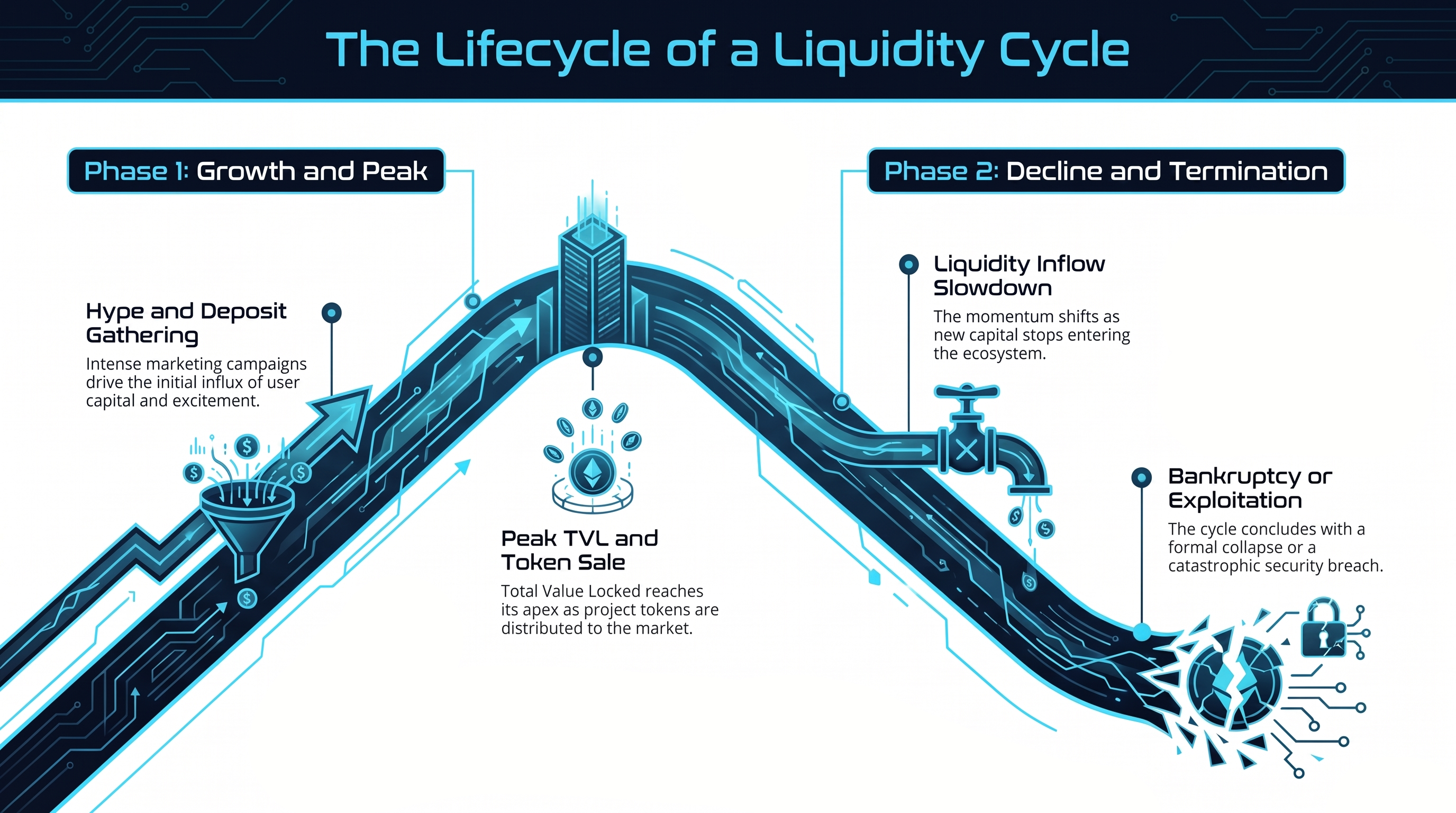
- The Hype & Raise Phase: The project promises "groundbreaking infrastructure," vacuuming up VC funds and user deposits.
- The Cash-Out Phase: At the peak of media noise, founders and early insiders lock in gains through token allocations and protocol fees.
- The Wind-Down Phase: As user acquisition stalls, paying for cloud infra and market makers turns into a money pit. Nobody is going to bankroll an unviable project out of their own pocket.
Right on queue, the protocol either conveniently suffers a bridge "exploit" or the lawyers file papers in Delaware court. Chapter 11 lets founders wipe their hands clean of debts to creditors and users alike, legally blaming it all on "adverse market conditions."
Real Web3 vs. Corporate Imitation
| Criteria | Sovereign L1 Blockchain | Corporate L2s / Bridges / DeFi |
|---|---|---|
| Architecture | Distributed network of independent nodes | 1–3 centralized servers (AWS/Hetzner) |
| Governance | Network consensus | Multisig keys controlled by a few founders |
| Code Modification | Impossible without a network-wide hard fork | Instant via Upgradeable Proxies |
| Shutdown Trigger | Technically impossible to shut down | Court order, exploit, or bankruptcy filing |
The market is shaking out the financial vaporware. Tech originally engineered to remove middlemen from finance has been hijacked by entities that recreated those exact same middlemen—just with zero legal accountability and terrible code.
True financial sovereignty isn't built on trusting Delaware LLCs, multisig signatures, or flashy VC announcements. Anything operating on a centralized sequencer, upgradeable proxy contracts, and a core team of managers isn't a blockchain. It's a fragile bank database whose story always ends the same way: either an exploit or a lawsuit.
All that glitters isn't gold—and just because a project is trending and looks legally buttoned-up doesn't mean it's secure. Far more often, battle-tested, low-profile platforms with years of history like EXMON prove to be vastly safer and more resilient in practice.