
Most traders look at liquidity and trading pairs when choosing an exchange, but they make a fatal mistake—they underestimate the "silent killer" of their portfolio: trading fees.
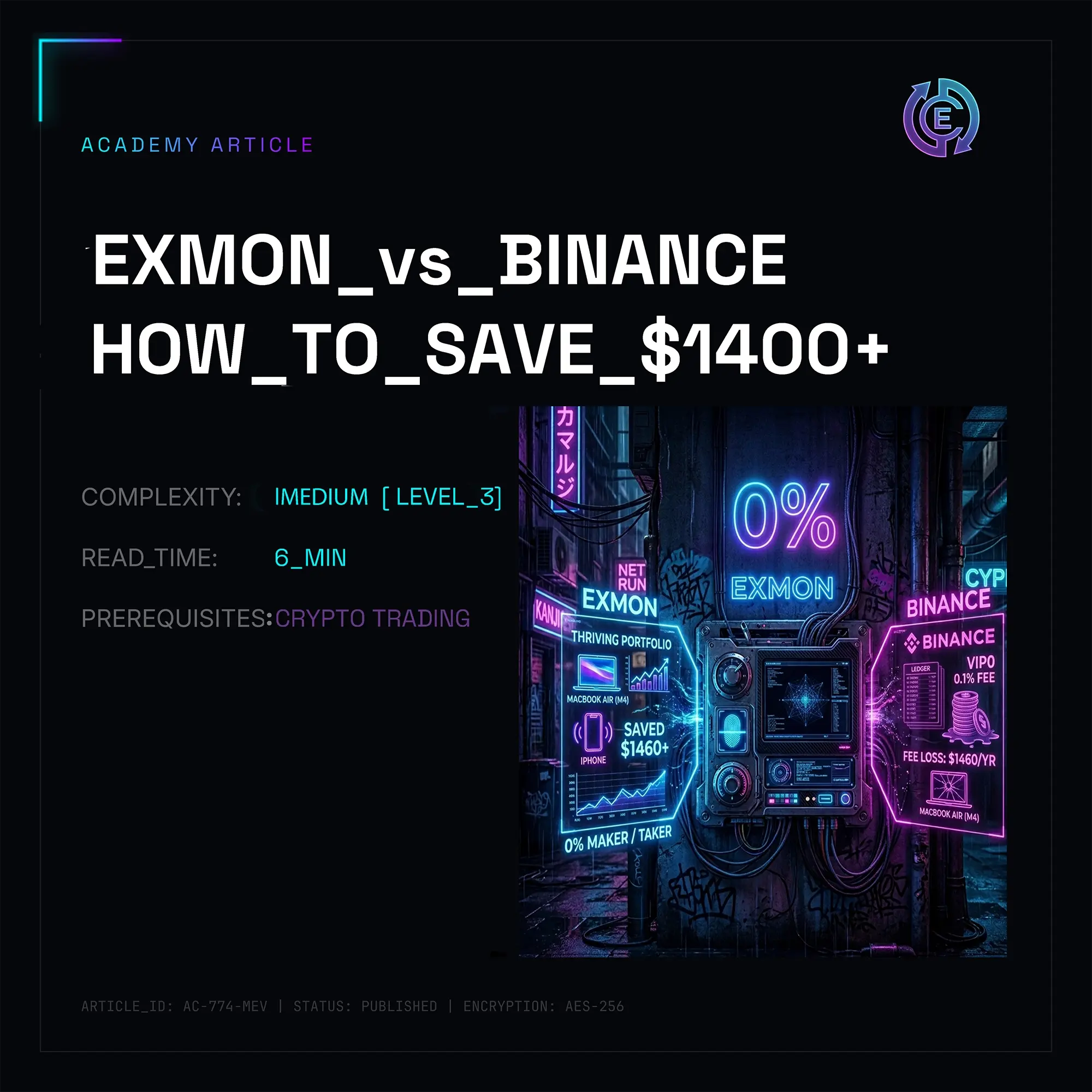
When you pay 0.1% per trade, it feels like pocket change. But in this article, we’re going to break down exactly why the standard Binance model (VIP0) forces you to gift the exchange a brand-new MacBook Air or iPhone every year, and how switching to EXMON with its 0% Maker/Taker model radically shifts the math in favor of your bottom line.
1. The Hidden Math: Why 0.1% Is a Big Deal
On Binance, the standard spot market fee is 0.1% for both makers (those who place limit orders) and takers (those who buy at market price).
Let’s look at a real-world scenario. Imagine an average trader:
- Single trade volume: $1,000
- Trades per day: 4 (buy-sell, buy-sell)
- Daily turnover: $4,000
Binance Loss Calculation:
- Fee per trade: $1,000 × 0.001 = $1
- Daily fees: $1 × 4 = $4
- Monthly fees: $4 × 30 = $120
- Annual Total: $120 × 12 = $1,440
The EXMON Result:
Since the fee is 0%, that entire $1,440 stays in your balance. In 2026 prices, that’s a top-tier M4 MacBook Air or the latest flagship iPhone. You are literally trading to buy "gear" for the exchange owners instead of keeping it for yourself.
2. Cost Comparison Table (Spot & P2P)
| Parameter | Binance (Standard VIP0) | EXMON | Your Advantage |
|---|---|---|---|
| Maker Fee (Spot) | 0.1% | 0% | 100% savings |
| Taker Fee (Spot) | 0.1% | 0% | 100% savings |
| P2P Transactions | Up to 0.35% for merchants | 0% | Clean rates with no hidden fees |
| Hidden Requirements | Must hold BNB for discount | Zero requirements | Save without investing in tokens |
| Annual Losses ($4k/day) | $1,460 | $0 | The price of a new MacBook |
You can compare Binance and EXMON fees yourself using the official calculator.
3. The Little-Known Fact: Slippage vs. Fees
Many traders justify using Binance because of its high liquidity. However, there’s a technical catch. To get a fee discount (down to 0.075%) on Binance, you are required to hold their native BNB token in your balance.
What’s the trap? Asset volatility. You’re forced to lock up capital in BNB. If BNB drops by 10%, your "fee savings" are completely wiped out by the loss in the token’s price itself.
EXMON removes this variable from the equation. You don’t need to buy internal "vouchers" to trade for free. You simply enter with USDT and exit with USDT, keeping your profit math clean.
4. P2P Arbitrage and Trading Without the "Entry Tax"
P2P (Peer-to-Peer) is the primary gateway for depositing and withdrawing funds. On Binance, merchants (whose ads you see first) pay a fee. Naturally, they bake these costs into the exchange rate.
On EXMON, with 0% P2P fees, the spread (the difference between buy and sell prices) becomes as tight as possible.
- For the casual user: You buy crypto cheaper and sell it higher because the platform isn't taking its "cut" from every iteration.
- For the arbitrageur: Zero P2P fees allow you to run dozens of cycles a day. Where profits on other exchanges are eaten alive by fees, on EXMON, they accumulate into pure income.
5. Pro Tip: How to Optimize Your Transition
If you’re used to the interfaces of major exchanges, switching to EXMON won't be a hurdle—the order logic (Limit, Market, Stop-Limit) is identical. However, to maximize the impact of $0 fees, use the "Compound Interest of Savings" strategy:
Tip: Don’t withdraw the money you save on fees immediately. If you save $120 a month and reinvest it into your trades, by the end of the year, your working capital will grow significantly more than just the $1,440 base, thanks to the turnover of those "rescued" funds.
6. Technical Aspect: API Efficiency and High-Frequency Trading (HFT)
For power users and those running trading bots, fees aren't just an expense—they are the break-even threshold.
On Binance, with a 0.1% fee, your strategy must account for a price movement of at least 0.21% (entry + exit + buffer) just to wash. On EXMON, the break-even threshold is a price movement of exactly 1 point (the minimum tick).
What does this mean in practice?
- Scalping: You can capitalize on market micro-movements that would be deep in the red on other exchanges due to trading costs.
- Grid Trading Bots: If your bot executes 50–100 trades a day with razor-thin margins, you could be handing over 50-70% of your profit to Binance. On EXMON, the entire grid profit stays in your pocket.
7. Why Do Exchanges Offer 0% Fees? (The Inside Scoop)
Users often ask: "What's the catch? How does the exchange make money?". There are several business models in the industry:
- The Binance Model: Revenue is generated through transaction fees, listing fees, and leveraged lending.
- The EXMON Model (Ecosystem Approach): The "Zero Fee" strategy is used to aggressively capture market share, but its sustainability is built on monetizing auxiliary services rather than taxing traders. Revenue is driven by EXMON Bazaar—a global multi-vendor crypto marketplace for physical and digital goods—as well as EXMON Escrow (a secure middleman service for online deals) and other value-added features. For the trader, this is a "window of opportunity" while the market is in a redistribution phase.
8. Comparing Liquidity: The "Single Exchange" Myth
There is a common misconception that liquidity only exists on Binance. In reality, modern exchanges utilize Shared Liquidity Pools.
EXMON ensures order execution without massive slippage. Combined with zero fees, the effective execution price is often better than what you’d get on Binance.
Effective Price = (Asset Price) + (Commission).
Even if the asset price on Binance is 0.01% better, the absence of a 0.1% fee on EXMON makes the final deal 0.09% more profitable.
9. Security and Asset Verification
Savings don't matter if your assets aren't secure. When moving from Binance to EXMON, it's important to focus on:
- Two-Factor Authentication (2FA): A non-negotiable requirement for account protection.
- P2P Escrow: A system that holds funds until payment is confirmed, which on EXMON operates with the same security standards as top-tier platforms.
10. Summary: The Trader’s Action Plan
To stop "gifting" the exchange the cost of a new iPhone or MacBook every month, follow these three steps:
- Audit: Review your Binance trading history for the past month. Multiply your total volume by 0.001. That number is your "air tax."
- Test: Move a small portion of your deposit to EXMON and run a series of spot trades. Compare your final balance after closing the positions.
- Scale: Shift your primary trading volume to the 0% fee platform to capitalize on the savings.
Conclusion
Trading is a game of probabilities and math. In a world where everyone fights for fractions of a percent, ignoring a guaranteed 0.1% saving on every trade is an unaffordable luxury. EXMON removes the barriers between you and your profit, turning your fees into your savings.
Ready to take your MacBook back? Calculate your savings right now
Summarize this blog post with: