
We’ve been conditioned to believe that the numbers we see on our banking apps represent "our" money. We work for it, we earn it, and we plan our lives around it. But the brutal truth, which 2024 and 2025 have made undeniably clear, is that you don’t own your money. You own a permission to use it.
We have entered the era of Permissioned Life, and if we don't change the trajectory now, the concept of a "Sovereign Individual" will become a historical relic.
The Invisible Lease
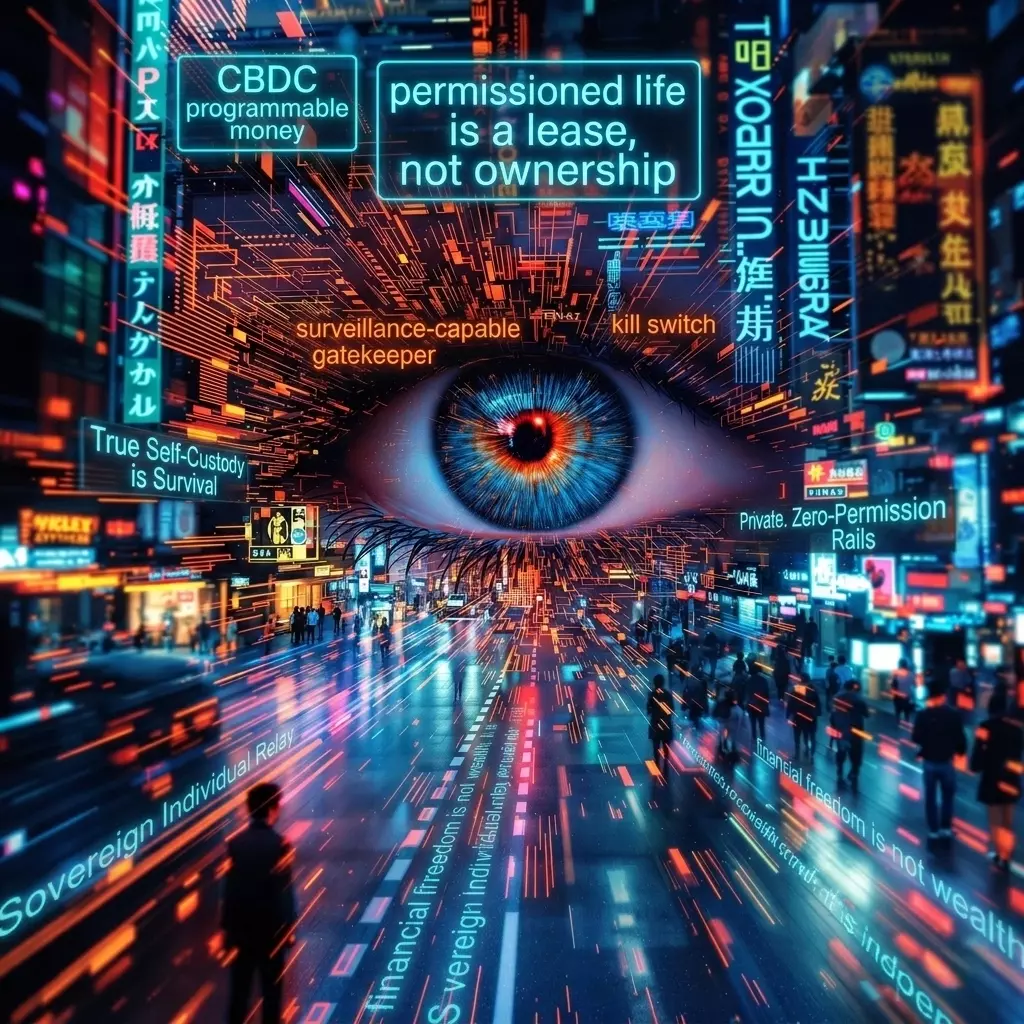
The traditional financial system is no longer just a service; it’s a surveillance-capable gatekeeper. When a bank can freeze your assets because of a "policy update," or when a payment processor de-platforms you for "legal but discouraged" activity, you aren't an owner. You are a tenant.
Look at the G7’s push for Programmable CBDCs (Central Bank Digital Currencies). This isn't just "digital cash." It’s money with an expiration date and "geographic boundaries." We are moving toward a world where your morning coffee could be denied because you’ve already hit your monthly carbon footprint or because you attended a protest the state didn't like.
The Great Crypto Betrayal
Blockchain was supposed to be the "Great Exit." It promised us a world where code is law and intermediaries are obsolete. But let’s be honest: the industry has largely failed that promise.
Instead of building tools for freedom, much of the space has spent the last few years building "Regulatory Sandboxes" and complex, fragmented L2 solutions that are as centralized as the banks they claimed to replace. We’ve traded the old masters for new ones who wear hoodies instead of suits, but the result is the same: users are still asking for permission.
If a DeFi protocol has a "kill switch" controlled by three people in a Telegram chat, it isn't decentralized. If an exchange requires you to link your entire digital identity just to move your own assets, it isn't freedom. It’s just a digital prison with better wallpaper.
Sovereignty as a Survival Strategy
At this point, financial privacy isn't a "feature" or a "niche preference." It is a practical necessity for survival.
Consider the "Choke Point 2.0" tactics we've seen in the US—a coordinated effort to de-bank entire industries without a single law being passed. Or look at the EU’s new Anti-Money Laundering (AML) package, which effectively targets self-custody wallets. The goal is clear: to make "unhosted" (read: private) money illegal.
Why? Because a person with an unfreezable wallet is a person who cannot be coerced.
Our Philosophy: Tools, Not Toys
The value of any technology is measured by one metric: Does it make the individual more powerful, or the institution?
In 2026, we don't need more "yield farms" or "NFT drops." We need infrastructure that honors the original cypherpunk vision:
- True Self-Custody: If you don't hold the keys, it's not your money. Period.
- Privacy by Default: Anonymity is not for criminals; it’s for people who don't want their life story sold to the highest bidder or tracked by a bureaucrat.
- Zero-Permission Rails: Financial movement should be as free as a handshake.
The Choice
We are at a crossroads. We can continue down the path of "Convenient Compliance," where our financial lives are managed by algorithms and overseen by state-aligned tech giants. Or, we can choose the harder path of Sovereignty.
Financial freedom is about more than just wealth. It’s about the right to be independent. It’s about the right to be wrong, the right to be different, and the right to exist without a digital overseer watching every transaction.
Crypto should work for people, not the other way around. At the end of the day, your independence is the only real security you have.
It’s time to stop asking for permission.
P.S.This article represents the personal vision of Elena Chernjaeva and is not financial advice
Summarize this blog post with: