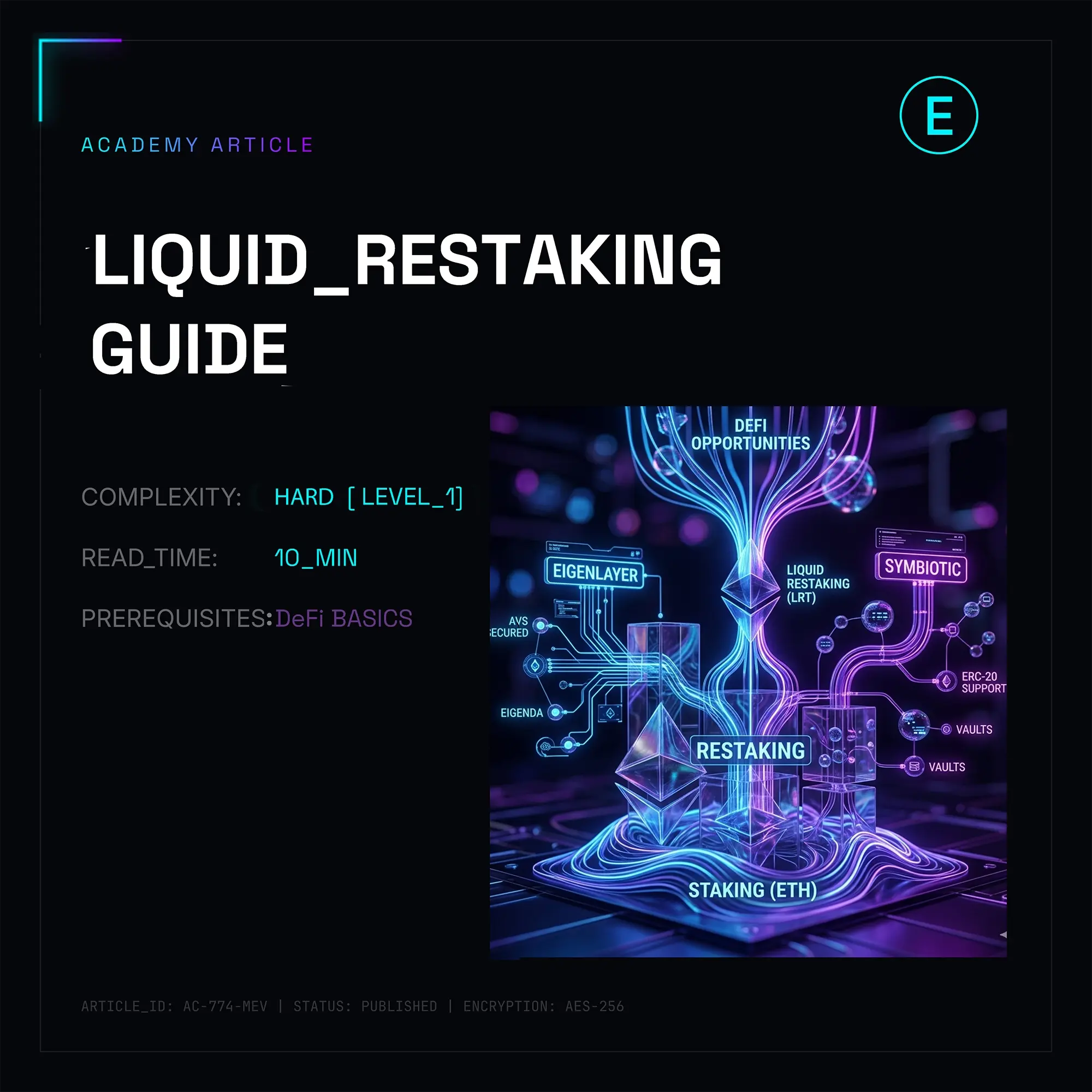
Staking has come a long way from simple token locking to the creation of complex, multi-layered yield strategies. Today, the cutting edge of this evolution is Liquid Restaking (LRT)—a technology that allows your capital to work across multiple protocols simultaneously without sacrificing liquidity.
In this article, we’ll break down how the restaking ecosystem functions through giants like EigenLayer and Symbiotic, and how to maximize your returns while maintaining a balanced risk profile.
1. The Foundation: What is LRT and Why Does the Market Need It?
While traditional staking (e.g., on Ethereum) secures only a single network, Restaking enables the same staked assets to provide security for other services: oracles, bridges, Layer 2 networks (L2s), and more. These services are known as AVS (Actively Validated Services).
The Problem: When you deposit ETH directly into EigenLayer, your capital is effectively "locked up."
The Solution: Liquid Restaking Tokens (LRT). Protocols like Ether.fi, Puffer, and Renzo take your ETH, restake it, and issue you a liquid token (eETH, pufETH) that can be used across DeFi to trade, provide collateral, or farm liquidity pools.
2. The Major Players: EigenLayer vs. Symbiotic
Although they share similar goals, their architectures represent different links in the same chain.
EigenLayer: The Pioneer and Industry Standard
- Focus: The Ethereum ecosystem. It allows the use of ETH and LSTs (Liquid Staking Tokens like stETH) to secure AVSs.
- Mechanics: Delegation to operators who run software for specific AVSs.
- Risk: "Slashing" penalties at both the Ethereum level and the AVS level.
Symbiotic: Limitless Flexibility
- Approach: Permissionless. Unlike EigenLayer, Symbiotic allows for the restaking of virtually any ERC-20 asset (stablecoins, ENA tokens, or wrapped BTC).
- Key Feature: Highly customizable risk levels and the ability to create isolated security networks.
3. Protocol Comparison Table
| Feature | EigenLayer | Symbiotic |
|---|---|---|
| Base Asset | Primarily ETH and its derivatives | Any ERC-20 token |
| Governance Model | Centralized AVS onboarding (currently) | Fully decentralized, per-project customization |
| Core Value Prop | Massive TVL and established AVS ecosystem | Modularity and multi-asset support |
| Current Stage | Mainnet (active phase) | Early Access / Mainnet with deposit caps |
4. Capital Maximization Strategies
To squeeze out maximum profit, power users utilize a "nesting doll" approach with protocols.
Strategy A: The Classic "Loop"
Typically executed on lending markets like Aave or Morpho.
- Deposit ETH into an LRT protocol (e.g., Ether.fi) to receive weETH.
- Go to Aave and supply weETH as collateral.
- Borrow ETH against it (usually at 70-80% LTV).
- Repeat step 1.
The Result: You exponentially increase your "points" accumulation from both the LRT protocol and EigenLayer.
Strategy B: Focusing on Symbiotic via Mellow
Mellow Finance allows for the creation of custom, modular LRTs built on Symbiotic.
The Play: You choose a specific Vault with a designated set of curators. This lets you earn staking yield while farming Symbiotic points at an early stage before deposit caps are hit.
Strategy C: Leveraging Pendle (For Pros)
Pendle splits an LRT into two components: PT (Principal Token) and YT (Yield Token/Points).
- If you’re betting on a massive airdrop, you buy YT-weETH. This grants you all the points and yield from a large amount of ETH for a fraction of the cost.
- Example: By purchasing YT worth 1 ETH, you can accumulate points as if you had 15-20 ETH staked.
5. Technical Corner: How It Works Under the Hood
For those looking to understand the code or interact via smart contracts, it's crucial to understand the delegation structure. In EigenLayer, this involves interacting with the StrategyManager.
Example interaction logic (Solidity pseudocode):
// Example function to deposit an asset into a restaking strategy
function restakeAsset(address strategy, address token, uint256 amount) external {
    // 1. Transfer tokens (e.g., stETH) to the contract
    IERC20(token).transferFrom(msg.sender, address(this), amount);

    // 2. Approve the StrategyManager
    IERC20(token).approve(address(eigenStrategyManager), amount);

    // 3. Deposit into the specific strategy
    eigenStrategyManager.depositIntoStrategy(strategy, token, amount);
}
6. Lesser-Known Details and Nuances
- Point Inflation: Many overlook that points are not hard currency. As a protocol's TVL grows, your individual "share" of the rewards is diluted. Entering new Symbiotic protocols early may currently be more lucrative than "diluted" restaking on EigenLayer.
- Operator Concentration Risk: If 50% of LRT protocols choose the same node operator and that operator goes offline, the market could face a massive cascade of liquidations.
- Withdrawal Delays: Unstaking usually takes 7 to 14 days. During market panic, liquid tokens (LRTs) can trade below the value of ETH (a depeg). This is a significant risk for those running "looping" strategies.
Let's dive into how to optimize AVS participation and which infrastructure solutions enable automated yield generation.
7. The Evolution of AVS: Where Real Yield is Born
Points are merely an early-stage marketing mechanic. True sustainable profit (Real Yield) in LRT is generated through rewards from AVS (Actively Validated Services). These are independent modules that "rent" security from EigenLayer.
Key AVS types to keep on your radar:
- EigenDA: A Data Availability layer that makes transactions in L2 networks cheaper.
- Witness Chain: The world's first "proof of diligence" network for aggregating physical server location data.
- Hyperlane: An interoperability protocol that utilizes restaking to verify cross-chain messages.
Pro tip: When choosing an LRT protocol (such as Renzo or Puffer), pay attention to their Operator Strategy. Some protocols allow you to choose exactly which AVS to delegate your capital to. Focusing on "fresh" AVS often yields higher returns in their native tokens.
8. Practical Case: Building an Automated Strategy via Vaults
For those who don't want to manually rotate assets, LRT Aggregators have emerged. One of the most tech-forward examples is the use of ERC-4626-based vaults.
Table: Yield Aggregator Comparison
| Protocol | Mechanics | Pros |
|---|---|---|
| Instadapp (Fluid) | Automatic deleveraging (liquidation protection) | Safety when using "loops" |
| Mellow Finance | Modular curated vaults | Access to Symbiotic with a custom risk profile |
| Beefy Finance | Auto-compounding rewards | Maximizing APY through compound interest |
9. Technical Details: Security and Slashing in the Code
In classic ETH staking, you can be penalized for downtime or double-signing. In restaking, these risks are multiplied.
If an AVS contract contains a bug, it could erroneously trigger a Slashing event. In EigenLayer, this is handled via the Slasher.sol contract. It’s crucial to understand that your funds are protected by a "Veto Committee," which can overturn unfair penalties.
How to check the risk level in an LRT contract:
When analyzing an LRT token's smart contract, look for withdrawal rate limit functions:
// Simplified withdrawal limit logic to prevent panic selling
function requestWithdrawal(uint256 amount) public {
    require(amount <= currentGlobalLiquidityLimit, "Exceeds daily limit");
    // Logic for a 7+ day withdrawal queue
    _initiateWithdrawalProcess(msg.sender, amount);
}
If a contract lacks limits on instant minting/burning for large volumes, it increases the risk of a depeg (losing parity with ETH).
10. Symbiotic: A Deep Dive into "Sovereign Restaking"
Symbiotic introduces the concept of Vaults as the core management element. Unlike EigenLayer, where the protocol dictates the rules, in Symbiotic, every project (e.g., an oracle or rollup) can create its own Vault.
Why this matters for your capital:
- No hard peg to ETH: If you hold a large stack of project tokens (like $ENA or $wBTC), you can use them to secure the network and earn extra yield without selling the underlying asset.
- Risk Isolation: The failure of one AVS in Symbiotic doesn't affect other Vaults, as they use different sets of collateral assets and operators.
11. Little-Known Hack: Gas-Efficient Point Farming
Many newcomers spend hundreds of dollars on gas moving LRTs between protocols on the Ethereum Mainnet.
The Solution: Use L2 solutions (Arbitrum, Base, Linea).
Protocols like Renzo or Ether.fi have native bridges. Depositing on an L2 counts toward the overall EigenLayer points system just like on Mainnet, but the transaction costs $0.1 instead of $50.
12. LRT Project Evaluation Checklist Before Entry
Before sending your funds to a liquid restaking protocol, go through these points:
- Audits: Has the code been audited by Tier-1 firms (Sigma Prime, Spearbit, Trail of Bits)?
- Operator Decentralization: Who is running the nodes? If it's only five large companies, the censorship risk is high.
- DEX Liquidity: Check the
eETH/ETHorpufETH/ETHpools on Uniswap/Curve. Can you exit the asset instantly if panic sets in? - Backing: Is there support from major funds like Polychain, Paradigm, or Binance Labs? This is a proxy indicator of the project's longevity.
Now for the "meat"—advanced risk management, tax logic, and the future that is already unfolding.
13. Risk Management: Avoiding "Black Swan" Ruin
LRTs are essentially protocol-level leverage. When you use LRTs, you are taking on chain risk across multiple layers:
- Ethereum L1 (Consensus)
- LST (e.g., Lido)
- LRT (e.g., Ether.fi)
- AVS (EigenLayer/Symbiotic)
The "Delta-Neutral" Method in Restaking
If you want to farm LRT points and yield but are wary of ETH volatility:
- Deposit $ETH$ into an LRT protocol.
- Open an $ETH$ short position for the same amount on a decentralized perpetual exchange (e.g., Hyperliquid or dYdX).
The result: You stay price-neutral on ETH while capturing all restaking rewards and airdrop allocations.
14. Symbiotic’s Hidden Mechanics: External Collateral Networks
Few realize that Symbiotic enables Shared Security for applications that don't necessarily need Ethereum.
Example: A new project is building an oracle network. Instead of forcing users to buy their own volatile native token for staking, they set up a Symbiotic Vault that accepts USDC.
- For the user: Safe stablecoin farming with yields that beat the market.
- For the project: Instant security bootstrapping backed by a stable asset.
15. Tax and Accounting Logic (Alpha)
In most jurisdictions, swapping ETH for an LRT is considered a taxable event (exchanging one asset for another).
Pro Tip: Using protocols with a Reward-Bearing Token model (e.g., Kelp DAO’s rsETH, where the token price appreciates relative to ETH) is often more tax-efficient than a Rebasing Token model (where the token count in your wallet increases). This is because gains are typically realized only upon sale, rather than daily.
16. 2026 Outlook: "Smart Restaking"
We are heading toward an era where AI agents will manage your LRT portfolio autonomously.
The Workflow (Scenario):
Your local AI agent monitors:
- Current APY across all AVSs.
- Health Factors of your leveraged positions.
- Upcoming deadlines for point-farming campaigns.
Sample Automation Logic (JSON config for the agent):
{
  "strategy": "Max_Yield_Low_Risk",
  "assets": ["ETH", "stETH"],
  "platforms": {
    "eigenlayer": {"min_yield": "4%", "max_slashing_risk": "low"},
    "symbiotic": {"vault_collateral": "USDC", "priority": true}
  },
  "automation": {
    "auto_compound": "weekly",
    "rebalance_on_depeg": 0.98
  }
}
17. Little-Known Fact: "The Restaking Dark Forest"
There is a risk of MEV attacks at the AVS level. Validators participating in restaking can see transactions in AVS networks ahead of others and manipulate them by leveraging their staker position. This is giving rise to a "defensive restaking" market, where priority is given to operators with proven reputations and a commitment to non-malicious MEV behavior.
18. Final Summary: What’s the Play?
- Diversify across engines: Don’t put everything in EigenLayer. Symbiotic offers a fundamentally different architecture and potentially fresher airdrop opportunities.
- Watch for the de-peg: During periods of turbulence, LRTs can trade at a discount to ETH. While bad news for those in a "leverage loop," it’s a massive opportunity for those sitting in cash to buy LRTs at a discount.
- Research the AVSs: The real winners of the restaking cycle won't just be point-holders, but those who delegate capital to truly useful services (EigenDA, bridges, oracles).
Liquid Restaking is more than just a way to squeeze out extra yield. It’s a fundamental shift in how capital secures the decentralized web. Watch your leverage, stay on top of audits, and remember: personal responsibility is the price of freedom.