
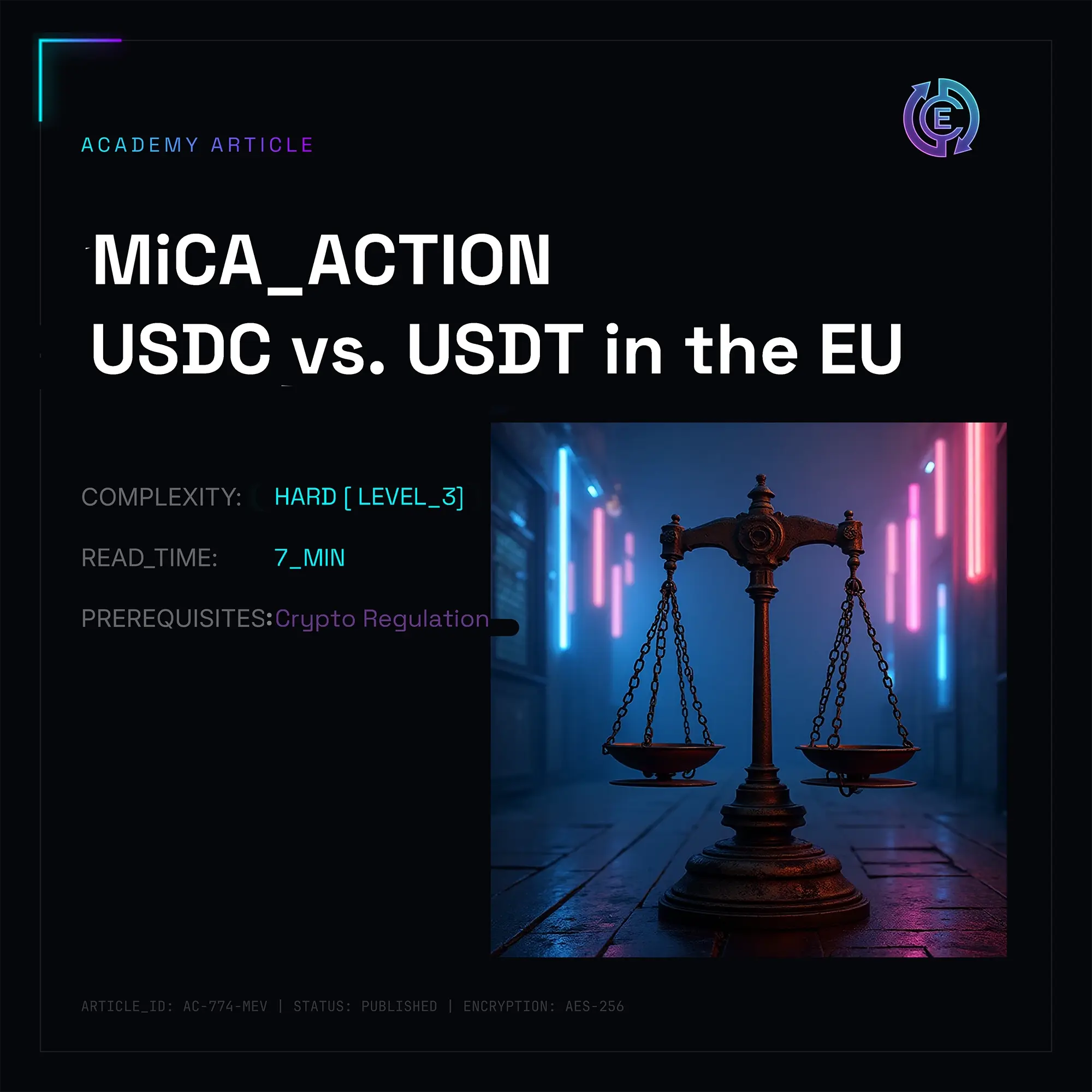
The Markets in Crypto-Assets (MiCA) Regulation isn’t just another rulebook — it’s the world’s first full-scale attempt to bring the crypto market under control across an entire continent. As of February 2026, we’re already seeing the impact of this tectonic shift: the era of unchecked stablecoins in Europe is officially over.
In this article, we’ll break down the practical realities of working with the “new” stablecoins, explain why Tether (USDT) has ended up in a regulatory gray area, and look at how transaction caps are actually enforced at the technical level.
1. A New Classification: The End of the Term “Stablecoin”
Forget the word “stablecoin” in legal documentation. MiCA splits these assets into two strict categories:
- EMT (E-Money Tokens): Tokens pegged to a single official currency (for example, USDC, EURC). These are legally treated as electronic money.
- ART (Asset-Referenced Tokens): Tokens pegged to a basket of currencies, commodities, or other crypto-assets (for example, PAX Gold).
A lesser-known detail: If your stablecoin is pegged to the US dollar (like USDC) but operates within the EU, it is still classified as an EMT. However, strict limits apply if it’s used as a means of payment and daily transaction volume exceeds €200 million.
2. The Great Divide: Circle vs. Tether
The years 2025–2026 have marked a clear regulatory split.
- Circle (USDC, EURC): Chose the full compliance route, securing an Electronic Money Institution license in France. This allowed USDC to remain listed on European exchanges (Binance, Kraken, Coinbase) in euro and crypto trading pairs.
- Tether (USDT): Paolo Ardoino, CEO of Tether, has repeatedly criticized MiCA’s requirement to hold 60% of reserves in bank deposits, arguing that it introduces systemic risk rather than reducing it.
The outcome: Most EU-based exchanges have delisted USDT or restricted it to “professional clients” only, replacing it with USDC or EURC for retail users.
3. Technical Caps and the “€200 Million Curse”
One of MiCA’s most controversial provisions is Article 23, which limits the use of non-euro stablecoins (for example, dollar-pegged tokens) as a means of payment.
The hard numbers:
If a dollar-denominated stablecoin is used to pay for goods or services within the EU and daily transaction volume exceeds:
- 1 million transactions per day.
- €200 million in nominal value.
The issuer is required to halt the issuance of new tokens.
How does this work in practice? (A developer-oriented example)
Exchanges and Crypto-Asset Service Providers have implemented monitoring systems that “tag” transactions. If you buy a coffee in Paris using USDC, it’s classified as a “means of exchange” transaction (and counts toward the cap). If you swap USDC for BTC on an exchange, that’s treated as an “investment operation” (and does not count).
Example filtering logic in Python (pseudocode):
def process_stablecoin_tx(tx_data):
    # Check transaction type for regulatory reporting (ESMA)
    if tx_data['category'] == 'payment_for_goods':
        if current_daily_volume_eur > 200_000_000:
            return "Transaction Blocked: MiCA limit reached"
        else:
            update_mica_counter(tx_data['amount_eur'])
            return "Transaction Approved"

    elif tx_data['category'] == 'trading_pair':
        # Investment transactions are not capped under Article 23
        execute_trade(tx_data)
        return "Trade Executed"
4. Practical Guidance for Users and Businesses
A. For individuals:
Check your exchange’s status: If your platform doesn’t require enhanced KYC and provides no disclosure about the MiCA status of tokens, you risk having withdrawals frozen at any time.
Keep reserves in EURC/USDC: If you operate within the eurozone, it’s safer to use stablecoins backed by an EMI license. This guarantees your Redemption Right — the ability to redeem tokens directly with the issuer at a 1:1 nominal value at any time.
B. For businesses (merchants):
Integrate White Paper checks: MiCA requires issuers to publish a White Paper. If you accept stablecoins as payment, your payment gateway should automatically verify that a current White Paper is registered with ESMA.
DTI (Digital Token Identifiers): Each token must now have an ISO-standard code (ISO 24165). Use this in your accounting systems instead of standard tickers.
5. A Lesser-Known Detail: Algorithmic Stablecoins
MiCA has effectively banned algorithmic stablecoins (like the now-defunct UST/Terra) in their traditional form. To qualify as a “stablecoin” in the EU, an asset must have real reserve backing held under custodial management.
Any project attempting to stabilize its price through a seigniorage-style algorithm is now classified as an “other crypto-asset,” with no right to market itself as stable and a strict prohibition on being promoted as a “safe asset.”
6. Timelines and the “Grandfathering Clause”
Although the stablecoin provisions came into force ahead of most other rules (in the summer of 2024), the full transitional period for existing Crypto-Asset Service Providers runs until 1 July 2026.
7. Technical Implementation of the "Redemption Right"
Under MiCA, every holder of an EMT (E-Money Token) has an unconditional right to request the exchange of their token for fiat currency (euros) at face value at any time. The issuer is not allowed to charge a redemption fee unless explicitly stated in the White Paper and within a specified timeframe.
Practical example for integrators (API):
If you are building a fintech application that works with EURC, your backend should check the issuer's liquidity status via public endpoints (for example, Circle attestations).
# Example of checking reserve status (conceptual)
import requests

def verify_token_backing(token_symbol):
    # Request to the issuer's transparency registry
    api_url = f"https://api.compliant-issuer.com/v1/attestations/{token_symbol}"
    response = requests.get(api_url)

    if response.status_code == 200:
        data = response.json()
        reserve_ratio = data['total_reserves'] / data['total_supply']

        if reserve_ratio >= 1.0:
            return "Compliant: 1:1 Backing Verified"
        else:
            return "Warning: Undercollateralized (MiCA Violation)"
    return "Error: Data Unavailable"
8. Lesser-Known Aspect: "Significant" Tokens
MiCA introduces the concept of "Significant EMTs" (Significant E-Money Tokens). If a stablecoin becomes too popular (over 10 million users or market capitalization > 5 billion euros), oversight shifts from national regulators (e.g., AMF in France) directly to the European Banking Authority (EBA).
What does this mean in practice?
- Enhanced supervision: The EBA can conduct unscheduled audits of smart contract code.
- Capital requirements: The issuer must increase its own funds from 2% to 3% of reserve assets.
- Recovery plans: The issuer must have a "living will" (Recovery Plan) in case the banks holding the reserves go bankrupt.
9. Impact on DeFi and "Workarounds"
The most debated aspect of MiCA is decentralized finance (DeFi). Formally, if a protocol is fully decentralized (no specific legal entity managing it), it does not fall under MiCA.
However, in practice:
- Front-ends: If a company in the EU provides access to Uniswap via its interface, it becomes a CASP and must filter "illegal" stablecoins.
- Liquidity aggregators: Popular European wallets (e.g., Ledger Live) have started hiding or labeling as "risky" stablecoins that are not MiCA-registered.
- The DAI case (MakerDAO/Sky): Since DAI is backed by a basket of assets, it is closer to the ART category. However, due to its decentralized nature, its status in the EU remains "uncertain." Most regulated exchanges in Europe have started replacing DAI with fully legal alternatives to avoid legal risks.
10. The Future: MiCA 2.0 and Staking
Already in early 2026, discussions are underway to expand the regulation. An important nuance often overlooked: MiCA prohibits the payment of interest (yield) to EMT holders.
- Ban on passive income: You cannot earn "interest on balance" just by holding USDC in an EU wallet. This is meant to prevent stablecoins from competing with bank deposits and destabilizing the banking system.
- Workaround: Users are forced to transfer stablecoins to lending protocols, which formally constitutes a separate service requiring its own risk disclaimer.
Practical checklist for verifying a stablecoin's "MiCA compliance":
- Does the issuer have an EMI license (for EMT) or a credit institution license in the EU? (Check the ESMA registry).
- Is the White Paper published according to MiCA Annex III? (It should be on the project’s website).
- Where are the reserves held? (At least 30% for ART and 60% for EMT must be in deposits across different EU banks).
- Is there a right to direct redemption? (Check the Terms of Service).
Conclusion: The New Reality
The stablecoin market in Europe is no longer a "Wild West." Yes, this reduces anonymity and creates barriers for new projects, but in return it provides institutional confidence. Large capital now flows into EURC and USDC, knowing they are backed by law and real bank reserves.
For technical specialists, this means integrating complex reporting and real-time transaction monitoring systems. For users, it is a choice between "grey" USDT with blocking risks and "white" USDC/EURC with government-backed guarantees of fund return.
Summarize this blog post with: