
Yo. Let’s get straight to it. Every single time you hit BUY or SELL on spot or futures, the exchange takes a bite out of your stack. Maker or taker, doesn't matter—you’re paying fees. It’s crazy, but like 90% of retail normies don't even track how much capital they’re throwing away on trading fees. If you're an active scalper or running an algo bot, that shit adds up over a month to a balance that could easily buy you a killer dedicated server. Or two. Check out this fee calculator and see for yourself exactly how much you're bleeding.
Yesterday I was digging through the logs of one of my market-making bots and looked at the total fees paid... Yikes. So today, we’re breaking down rebates—how to claw back up to 40-50% of those fees straight into your balance. Pure cashback. No shady sign-ups, no friction, just pure account optimization and a couple of lines of code.
What is a Rebate and Where Does the Cash Come From?
Exchanges live off volume. Liquidity is their oxygen. To keep you trading on their platform instead of the competition, they’re down to split a cut of their revenue. A rebate is simply getting a slice of your paid fees kicked back to you.
Actually, scratch that... Let’s separate the signal from the noise. There are two completely different ways to get your money back:
- Affiliate (Referral) Kickback. The lazy man’s route. You sign up via the right link (like a Tier-1 partner or a sub-account setup), and the exchange drops a percentage of your own fees back into your spot wallet daily or hourly.
- Exchange Negative Fees (B2B/VIP Rebates). This is the whale tier. When you place a limit order (maker) and it gets filled, the exchange doesn't charge you a fee—they literally PAY you a percentage of the trade volume. Your fee structure goes negative.
I used to say this was strictly gatekept for hedge funds pumping millions in daily volume. But it’s 2026, CEX competition is cutthroat, and hitting VIP-1 or locking in custom tier rates is way easier now. Half the time you can just flash a statement from a competing exchange showing your volume, and they’ll instantly match your VIP level via a Fast Track promo.
The Optimization Matrix: Spot vs. Futures
Let’s do some quick back-of-the-napkin math. These are average market rates for a typical Tier-1/Tier-2 CEX, but the logic is airtight.
| Order Type / Tier | Base Fee (Maker / Taker) | Native Token Discount (BNB/KCS/OKB) | Affiliate Kickback | Net PnL Impact per $100k Volume |
|---|---|---|---|---|
| Standard Normie | 0.1% / 0.1% | 0% | 0% | minus $100 |
| Optimized (with tokens) | 0.075% / 0.075% | Disabled (paying in fiat/stable) | 0% | minus $75 |
| Smart (Tokens + Kickback) | 0.06% / 0.06% | Enabled (25% off) | 20% | minus $45 |
| VIP Maker (Algo Bot) | -0.005% / 0.03% | Depends | 30% (via sub-account) | PLUS $5 (on maker volume) |
See the spread? On the exact same $100k volume, one guy hands over a hundred bucks to the exchange, while the other literally gets paid a fiver. Now scale that up with leverage and high-frequency trading on futures. Volume gets spun out of thin air into the millions.
Account Toggles You’re Completely Sleeping On
Exchange UIs are built by degens for degens. The most critical toggles are usually buried so deep in the settings profile that you'll need a guide to map them out.
Toggle #1: Paying Fees in Native Tokens
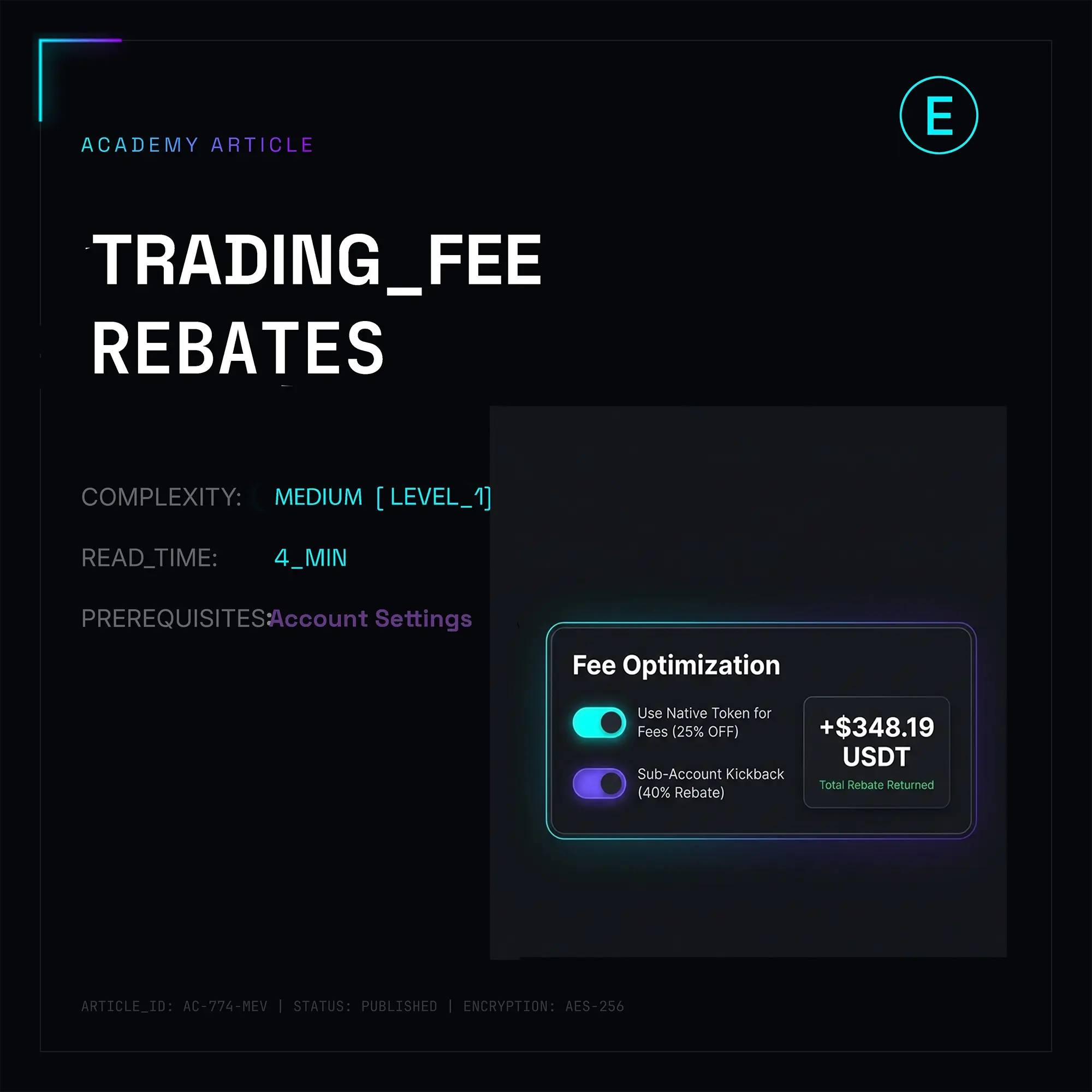
The absolute basics. BNB on Binance, HTX on Huobi, OKB on OKX. If you’re trading on Binance without holding a bag of BNB and without the "Use BNB to pay for fees" toggle switched on, you are literally financing CZ's next yacht. Turning this on instantly slashes your fees by 25% on spot and 10% on futures.
Or am I tripping? Drop a comment if you still think holding an exchange utility token for the discount is too much directional risk. Real risk is printing money and giving up a quarter of it just to execute the trades.
Toggle #2: Smart Sub-Account Architectures
If you're pulling decent volume, stop trading off your main account. Fire up a sub-account instead. Why? Because a lot of exchanges let you link sub-accounts to different referral codes or map custom fee tiers via API. You can essentially set up a self-referral kickback (if the exchange Terms of Service allow it—though they watch this closely now, so it’s safer to use an account belonging to a friend, your wife, or your dog) and extract maximum cashback.
Automation: A Quick Script to Audit Your Real Fees
Most traders just glance at their balance and think they're good. Try pulling your raw logs via API and calculating your net fee breakdown. Let's write a quick Python script using ccxt. It hits the exchange's private endpoints, totals up what you actually paid across your recent fills, and spits out your effective rate.
import ccxt
import time
# Init exchange. Using Bybit here because their API isn't garbage.
exchange = ccxt.bybit({
    'apiKey': 'YOUR_API_KEY',
    'secret': 'YOUR_SECRET_KEY',
    'enableRateLimit': True,
})
def analyze_my_fees(symbol='BTC/USDT', limit=50):
    try:
        # Fetch latest fills
        print(f"[+] Fetching last {limit} trades for {symbol}...")
        trades = exchange.fetch_my_trades(symbol, since=None, limit=limit)

        total_volume = 0.0
        total_fee = 0.0

        for trade in trades:
            # Calc trade size: price * amount
            price = trade['price']
            amount = trade['amount']
            volume = price * amount
            total_volume += volume

            # Extract fee data.
            # Handles multi-currency fees (USDT, BTC, BNB...)
            if 'fee' in trade and trade['fee'] is not None:
                fee_cost = trade['fee']['cost']
                fee_currency = trade['fee']['currency']

                # Fast fallback: assuming all fees are in USDT for now.
                # If using BNB, add a spot rate converter. Too tired for that tonight.
                total_fee += fee_cost

        if total_volume == 0:
            print("[-] No trades found. Stop sitting on your hands.")
            return

        effective_fee_rate = (total_fee / total_volume) * 100

        print("\n=== FEE AUDIT REPORT ===")
        print(f"Total Traded Volume: {total_volume:.2f} USDT")
        print(f"Total Fees Eaten:    {total_fee:.4f} USDT")
        print(f"Effective Fee Rate:  {effective_fee_rate:.4f}%")

        if effective_fee_rate > 0.06:
            print("⚠️ YOU ARE GETTING REKED! Fix your settings or get a rebate setup ASAP.")
        else:
            print("✅ Looks solid. Discounts are applying correctly.")

    except Exception as e:
        print(f"[!] Hit an error: {e}")
if __name__ == "__main__":
    # Quick sanity check execution
    analyze_my_fees('BTC/USDT', 20)
Gotchas and Hidden Rebate Mechanics
Think it's all free money? Think again. CEXs operate like casinos.
First up: stealth kickback decay. Here’s the play: you sign up under a sweet 40% rebate deal. You trade for a month or two. Then you audit the stats and realize you're barely getting 10% back. You grill support, and they pull out the classic: "Oh, it's in the fine print. If you trade inside the spread or use API sub-accounts, the rate scales down."
Second: API Execution and Post-Only flags. If you're building a bot and banking on maker rebates, your orders MUST be flagged as Post-Only (in ccxt, you pass this via params={'timeInForce': 'PostOnly'}). Without this, if the book shifts fast, your limit order can cross the spread and execute immediately as a market order. Boom—you’re a taker. Instead of collecting a rebate, you just ate a premium taker fee. Miss the execution window by a single millisecond, and you’re leaking cash.
Let’s keep pulling on this thread until all the dirty laundry is out in the open.
Gotcha #3: Cross-Currency Rates and the Hidden Tax
When an exchange promises you something like a 30% rebate on futures, you naturally assume that racking up $100 in USDT fees means $30 USDT flows straight back to your wallet. Makes sense, right? Wrong. Exchanges love to pay out rebates in their own native utility token or the specific margin currency of that contract. And they calculate the conversion rate right BEFORE the payout hits.
- You trade an ETH futures contract.
- Your trading fees are deducted in USDT.
- Your rebate gets paid out in BNB or exchange points.
- During the conversion process, the exchange bakes in a hidden 1-2% internal spread.
By the time the dust settles, your 30% rebate has shriveled down to 27.5%. Sounds like pocket change? When you’re spinning tens of millions in monthly volume, that "pocket change" easily adds up to the price tag of a high-end German sports car.
Alpha for Power Users: The VIP Status Match Loophole (VIP Sharing / Fast Track)
Almost nobody leverages this, even though it’s sitting right there for the taking. Say you’re trading heavy on Bybit and you’ve scraped your way up to VIP-2 or VIP-3 status. Your fee tiers over there are already looking sweet. But then some hyper-volatile shitcoin drops on OKX or Gate, and you need to scalp it immediately. What are you gonna do, bridge over with a fresh, naked account like a total retail normie and eat a massive 0.1% fee? Hell no.
Just about every major CEX runs a low-key status match program for whales and high-volume traders. You hit up their support desk or ping their sales manager directly on Telegram. Drop a screenshot of your Bybit dashboard showing your UID and your 30-day trailing volume. Tell them straight up: "I'm looking to migrate my volume over to your book, match my VIP tier or I'm not deploying capital."
95% of the time, they will instantly drop a 30-to-60-day Welcome VIP Level straight into your account on credit. No upfront deposit required. You step onto the new platform on day one enjoying rock-bottom fee rates and maximum rebates.
Implementation: Catching the Right Execution Status (Post-Only)
Let’s bring this back to the bots. I mentioned the Post-Only flag earlier. If you are market-making or just farming rebates using limit orders, knowing whether your fill executed as a maker or a taker is life or death for your alpha. If your order crosses the book and executes at market, you’re bleeding taker fees. If you sit in the order book and get filled, you harvest the rebate.
Here is a Python script using async ccxt.pro to stream your execution data via WebSockets in real time and verify if you're actually banking on those fees.
import asyncio
import ccxt.pro as ccxtpro

# Whipped this up late night, full of hacks but runs like a Swiss watch.
async def watch_my_trades_and_fees():
    # Using OKX because their WS feeds are lightning fast
    exchange = ccxtpro.okx({
        'apiKey': 'YOUR_API_KEY',
        'secret': 'YOUR_SECRET_KEY',
        'password': 'YOUR_API_PASSWORD', # OKX requires a passphrase
        'enableRateLimit': True,
    })

    symbol = 'BTC/USDT:USDT' # Linear Perpetual
    print(f"[+] Connecting to WS trade stream for {symbol}...")

    try:
        while True:
            # Stream private execution reports
            trades = await exchange.watch_my_trades(symbol)

            for trade in trades:
                trade_id = trade.get('id', 'N/A')
                side = trade.get('side', 'unknown')
                price = trade.get('price', 0)
                amount = trade.get('amount', 0)

                # CRITICAL: extract maker vs taker execution status
                # Plucked straight from the 'takerOrMaker' key
                role = trade.get('takerOrMaker', 'unknown')

                fee_info = trade.get('fee', {})
                fee_cost = fee_info.get('cost', 0) if fee_info else 0
                fee_curr = fee_info.get('currency', '') if fee_info else ''

                print(f"\n[!] Trade {trade_id} Filled!")
                print(f"    Side: {side.upper()} | Exec Type: {role.upper()}")
                print(f"    Px: {price} | Sz: {amount}")

                if role == 'maker':
                    # Negative fee means the exchange is paying us!
                    if fee_cost < 0:
                        print(f"    💰 REBATE CAPTURED! Payout: {abs(fee_cost)} {fee_curr}")
                    else:
                        print(f"    😐 Filled as maker, but standard tier fee applied: {fee_cost} {fee_curr}")
                elif role == 'taker':
                    print(f"    🚨 TAKER ALERT! Crossed the book and paid: {fee_cost} {fee_curr}")
                    print("    Check your entry logic. You're suffering execution slippage.")

    except Exception as e:
        print(f"[-] Bot crashed, get the medic: {e}")
    finally:
        await exchange.close()

if __name__ == "__main__":
    # Fire up the async loop. Standard procedure.
    asyncio.run(watch_my_trades_and_fees())
The Checklist: Setting Up Your Account Prior to Deployment
Let’s wrap this up with zero fluff. If you're setting up a fresh account or auditing an old one, here is your deployment checklist:
- Audit Your Referral Tag. If you've been trading on a "naked" account registered without a code, message support and demand they link you to a high-percentage cashback affiliate. Certain exchanges (like HTX or Gate) let you fix this retroactively within a short window after signing up. If they deny it, burn the account and spin up a new one using a clean identity. It’s well worth the hassle.
- Load Up on Gas. Buy a baseline allocation of the platform's native utility token (BNB, OKB, etc.) explicitly to cover fee burn. Go into your profile preferences and toggle the fee discount switch on.
- Architect Your Sub-Accounts. Do not mix strategies. Isolate your spot trading, your perpetual futures bots, and your manual execution across entirely separate sub-accounts. It makes parsing clean PnL and auditing rebate distribution infinitely easier.
- Run an API Sanity Check. Let my first script ingest data after you've logged 10 to 20 fills. Check your actual effective rate. If your realized fee is clocking in higher than what your tier schedule states, you are getting hosed. You're either slipping into market execution (taker) or the exchange isn't applying your native token discount correctly.
That pretty much lays it out. The raw reality of how rebates operate is right in front of you. Stop trading like a casual, account for your operational overhead, and stop donating capital back to the exchange that belongs in your equity balance. Drop any questions below. Peace.