
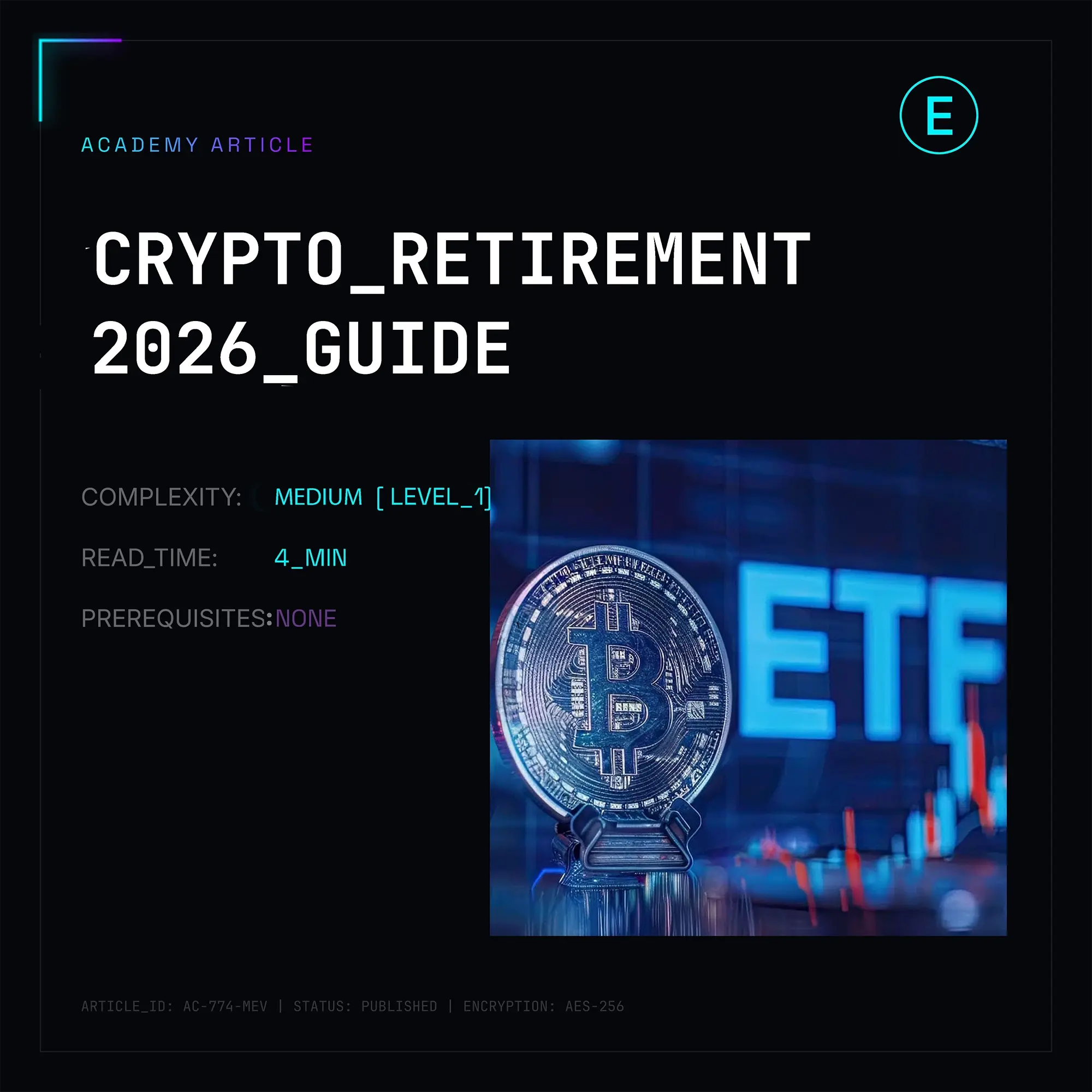
Welcome to 2026 — an era when the phrase “saving for retirement in Bitcoin” no longer sounds like a reckless gamble and has become an industry standard. As recently as 2024, crypto assets in retirement plans were mostly the domain of enthusiasts. Today, after the widespread approval of spot ETFs and the integration of blockchain into traditional financial systems, the landscape has changed beyond recognition.
In this article, we’ll break down how modern crypto retirement tools work, which accumulation strategies are relevant right now, and how to technically set up an “autopilot” for your capital.
1. The ETF Revolution: From Bitcoin to “Baskets” and Staking
The main breakthrough of 2025–2026 isn’t just the existence of Bitcoin ETFs, but their evolution into yield-generating instruments.
Yield (Staking) ETFs
At the beginning of 2026, a historic milestone was reached: Grayscale Ethereum Staking ETF made its first staking reward distribution directly to shareholders’ accounts through a public exchange.
How it works: In the past, ETFs only tracked the price of an asset. Now, funds (especially those based on Ethereum and Solana) actively participate in network validation. The yield (APR) they earn, minus the fund’s fee, is either distributed to shareholders or reinvested, increasing the net asset value (NAV).
Practical tip: When choosing a fund in 2026, look not only at the Expense Ratio, but also at the Yield Pass-Through (the percentage of staking income passed on to investors).
Index and Multi-Asset ETFs
Funds have emerged that automatically rebalance a retirement portfolio across the TOP-10 assets (BTC, ETH, SOL, XRP, and others). This eliminates the need to monitor the market on a daily basis.
2. Modern Retirement Accounts (SDIRA and Solo 401k)
In the U.S. and several European jurisdictions, Self-Directed IRAs (SDIRAs) have become the gold standard. These are accounts where the owner decides which alternative assets to purchase.
Advantages in 2026:
- Tax shield: All transactions within a Roth SDIRA are exempt from capital gains tax. If you bought Solana at $150 and by retirement it grew to $1500, you withdraw the full amount tax-free (provided age requirements are met).
- DeFi integration: Modern custodians, such as Bitcoin IRA or iTrustCapital, allow accounts to connect directly to licensed lending protocols.
A lesser-known fact: As of January 1, 2026, the IRS introduced Form 1099-DA, requiring brokers to provide detailed reporting on every transaction. However, using retirement accounts (IRAs) spares you from filing dozens of pages of reports for every minor trade — you report only contributions and distributions.
3. Hands-On: Automating Contributions (DCA 2.0)
A professional approach to retirement investing is the DCA (Dollar Cost Averaging) strategy. But in 2026, we use its smarter version. Instead of simply buying a fixed amount, we use scripts that factor in volatility.
Example Python Script for “Smart DCA”
This code can be run on a server and connected via API to an exchange (for example, Coinbase or Kraken) so that it buys more when the price falls below the 200-day simple moving average (SMA).
import ccxt # Library for working with exchanges
import pandas as pd
# Exchange initialization
exchange = ccxt.coinbasepro({
    'apiKey': 'YOUR_API_KEY',
    'secret': 'YOUR_SECRET',
})
def smart_dca(symbol, base_amount):
    # Fetch historical data
    ohlcv = exchange.fetch_ohlcv(symbol, timeframe='1d', limit=200)
    df = pd.DataFrame(ohlcv, columns=['timestamp', 'open', 'high', 'low', 'close', 'volume'])

    current_price = df['close'].iloc[-1]
    sma_200 = df['close'].mean()

    # Strategy: if the price is below the average, increase purchase by 50%
    if current_price < sma_200:
        buy_amount = base_amount * 1.5
        print(f"Price is below SMA200. Buying more: {buy_amount} USD")
    else:
        buy_amount = base_amount
        print(f"Standard purchase: {buy_amount} USD")

    # Execute order (uncomment to enable)
    # exchange.create_market_buy_order(symbol, buy_amount)
# Run once a week via cron
smart_dca('BTC/USD', 100)
4. Risks and Security: New Standards for 2026
With the rise of quantum computing and AI-driven attacks, retirement custody has shifted to the MPC (Multi-Party Computation) standard.
- Forget about seed phrases on a scrap of paper: Modern retirement programs use distributed keys. One key is with you (biometrics + device), the second with the custodian, and the third with the insurance provider. To steal funds, an attacker would have to compromise all parties at once.
- Insurance: Leading platforms are now required to carry insurance against smart contract failures, not just direct exchange hacks.
5. Battle of the Giants: Comparative Analysis of ETFs (February 2026)
By early 2026, the spot crypto-ETF market had become segmented. While in 2024 everyone fought for volume, today the competition is focused on additional services.
| Fund | Ticker | Fee (TER) | Feature | Liquidity |
|---|---|---|---|---|
| iShares Bitcoin Trust (BlackRock) | IBIT | 0.12% | Integration with Aladdin platform for institutional investors. | Maximum |
| Fidelity Wise Origin | FBTC | 0.15% | Proprietary custody solution (independent of Coinbase). | High |
| Grayscale Dynamic Income | GDIC | 0.35% | Multi-asset staking. Includes SOL, DOT, ETH, and CBETH. | Medium |
| ARK 21Shares Core | ARKB | 0.21% | Active management using AI models for hedging. | High |
Insight: Retail investors have started shifting from IBIT to GDIC in large numbers, as the latter not only allows ownership of the asset but also provides "crypto dividends," which is crucial for retirement savings with the power of compounding.
6. Corporate 401(k) Plans and Crypto Options
In 2026, Fortune 500 companies began offering crypto-matching. It works like a traditional 401(k), but a portion of employer contributions can go into BTC or ETH.
How it works technically:
- Most companies use intermediaries like Fidelity Digital Assets.
- Employees select a "risk profile" (e.g., 5% or 10% of salary into crypto fund).
- The provider automatically converts the fiat portion into shares of the corresponding ETFs.
- Taxes are deferred: taxes are paid only upon withdrawal after age 59.5.
Important addition: An ERISA-compliant crypto standard emerged, legally protecting employers from employee lawsuits in case of high market volatility. This opened the door to mass adoption of crypto in benefit packages.
7. Asset Selection Matrix: 20+ Year Horizon
For long-term planning (retirement in 15–30 years), analysts in 2026 highlight three layers of assets:
- Core (60–70%): BTC and ETH. This is "digital gold" and "digital oil." Their volatility over the past two years has decreased to the level of tech stocks.
- Growth layer (20–30%): Solana (SOL), Chainlink (LINK), and new modular blockchain leaders (Celestia). These assets provide technological infrastructure.
- Experimental layer (5–10%): Tokenized real-world assets (RWA). In 2026, buying tokenized real estate in Dubai or U.S. Treasury bonds (T-bills) via blockchain became commonplace.
8. Practical Case: Building an "Everlasting" Pension Portfolio
Imagine a user who wants to create a retirement fund that operates fully decentralized but with tax optimization in mind.
Step 1: Choosing the structure.
Use L2 solutions (Base or Arbitrum) to minimize fees for regular contributions.
Step 2: Automating yield.
Instead of manual staking, use Liquid Staking Tokens (LST). For example, swapping regular ETH for wstETH (Lido) or rETH (Rocket Pool).
Why this matters for retirement: the token price grows relative to ETH, accumulating rewards internally, which simplifies tax accounting (no hundreds of small reward transactions).
Step 3: Technical implementation (Example of a "Piggy Bank" smart contract):
Below is a conceptual Solidity code example for a contract that locks funds until the user's "retirement age."
// SPDX-License-Identifier: MIT
pragma solidity ^0.8.20;
contract CryptoPension {
    address public owner;
    uint256 public unlockDate;
    constructor(uint256 _yearsToRetire) {
        owner = msg.sender;
        // Set unlock date (current time + number of years)
        unlockDate = block.timestamp + (_yearsToRetire * 365 days);
    }
    receive() external payable {} // Allows sending ETH to the contract
    function withdraw() external {
        require(msg.sender == owner, "Not an owner");
        require(block.timestamp >= unlockDate, "Too early to retire!");

        payable(owner).transfer(address(this).balance);
    }
    function timeToRetire() public view returns (uint256) {
        if (block.timestamp >= unlockDate) return 0;
        return unlockDate - block.timestamp;
    }
}
9. Inheritance: How Not to Leave Your Pension "Stuck in the Blockchain" Forever
One of the most painful topics in crypto accounts is the risk of losing access in the event of the owner’s death. In 2026, this issue is addressed in three ways:
- Social Recovery: Modern wallets allow you to assign "guardians" (trusted people or lawyers) who can verify account access rights without knowing your seed phrase.
- Dead Man’s Switch Smart Contracts: This is code that triggers if you don’t log in (or make a transaction) within, for example, 12 months. Funds are automatically redistributed to the heirs’ addresses.
- Inheritance Trusts with Custodians: If you use a pension account like an SDIRA through a custodian (for example, Fidelity), the inheritance procedure is standard and goes through legal beneficiary documentation, just like in traditional banking.
10. "Black Swans" and 2026+ Risks
Despite institutionalization, crypto pensions are not a safe haven.
- Regulatory Reversal: The risk that tax benefits on crypto IRAs may be revised, increasing taxes on withdrawals.
- Technical Debt: Transitioning to quantum-resistant signature algorithms. If you store assets at an old address (created before 2024), its security may be at risk by 2035.
- Stablecoin Depegging: Many pension strategies use stablecoins to lock in gains. The collapse of a major issuer (even at the level of USDC or USDT) can wipe out the "protected" portion of your portfolio.
11. Final Checklist: Launching Your Crypto Plan
If you’ve decided to start building a crypto pension today, follow this roadmap:
- Determine the Legal Structure:
- For the USA: Open a Roth SDIRA (for tax-free withdrawals).
- For Europe/CIS: Set up a separate "cold" wallet (hardware wallet) with a clear funding schedule.
- Choose a Retirement ETF: For passive investors, funds with built-in staking (yield-bearing ETFs) are best to hedge against cryptocurrency inflation.
- Automate DCA: Set up automatic purchases via API or bank autopay. Remember: in retirement planning, consistency matters more than timing.
- 3-2-1 Security: Three copies of keys, in two different formats (digital and analog), stored in one secure location (safe/vault).
- Annual Rebalancing: Once a year, bring asset shares back to target allocations. If BTC has grown too much — move some into stablecoins or RWAs (tokenized bonds) to reduce crash risk.
Conclusion
Crypto retirement accounts are no longer just an experiment; they are a tool for those who don’t trust traditional pension funds eaten by inflation and demographic crises. By combining ETF tax advantages with the technological power of DeFi, you build capital independent of central bank printing presses.
Your Next Step: Check whether your current broker supports spot crypto ETFs, or explore opening a Self-Directed IRA. Time is your most valuable asset in compound interest.
Summarize this blog post with: