
Securing your seed phrase (recovery phrase) is the cornerstone of your financial independence. In the world of crypto, there is no "customer support" to reset your password. If your phrase is lost or stolen, your assets are gone forever.
Below are the three most effective and professional storage methods that strike a balance between security, durability, and common sense.
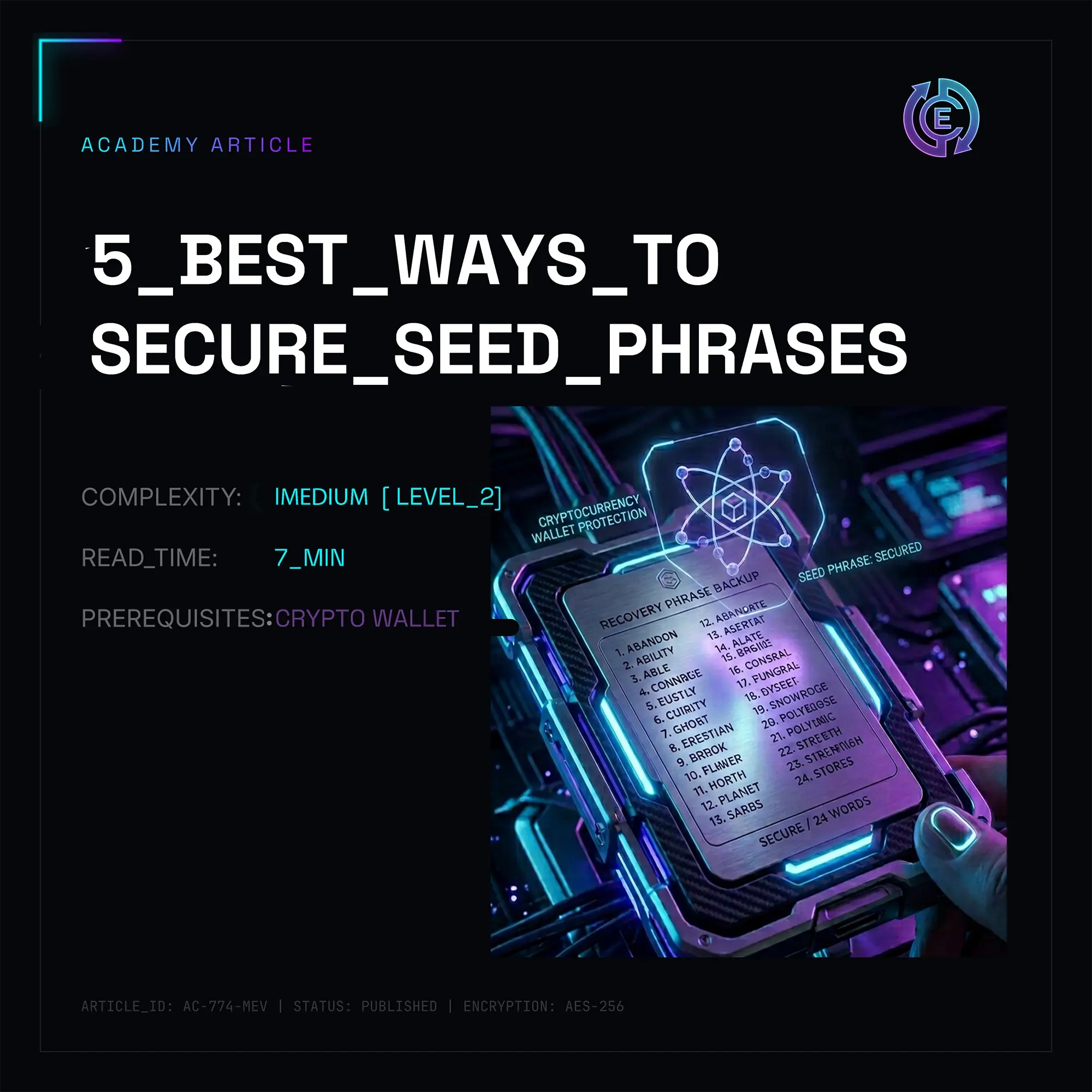
1. Steel Backups: Protection Against Physical Destruction
Paper is the worst possible medium for millions of dollars. It burns, rots from humidity, and fades over time. The professional standard today is Metal Seed Storage.
Why does it matter?
Steel plates can withstand temperatures up to 1400°C (an average house fire is around 600–800°C) and are impervious to flooding and corrosion.
Common Implementations:
- Cassette/Tile Sets: You slide metal letters into slots. It's convenient, but extreme physical deformation could potentially cause tiles to fall out.
- Punch/Engraving Plates: You hammer dots or engrave words onto a solid sheet of stainless steel or titanium. This is the most reliable option since the metal's structure is physically altered.
Pro Tip: Use the BIP39 standard. You don't need to record the full words—the first 4 letters of each word are enough. In the BIP39 dictionary, no two words share the same first 4 letters, so your wallet will identify them without ambiguity.
2. Splitting the Secret: Shamir’s Secret Sharing
Storing your entire phrase in one place (even in a safe) creates a "single point of failure." If the safe is stolen or cracked, your defenses fail. Shamir’s Secret Sharing (SLIP-0039) solves this at a mathematical level.
How it works:
Your seed phrase is split into several unique shares. You define the recovery "threshold." For example, you can create 5 shares, but only need any 3 of them to recover the wallet.
| Parameter | Description |
|---|---|
| Security | Stealing a single share gives an attacker absolutely nothing. |
| Fault Tolerance | If you lose 1 or 2 shares, you can still recover access. |
| Implementation | Supported via hardware (e.g., Trezor Model T) or specialized software. |
A subtle distinction:
Many people confuse this with Multi-sig. The difference is that Multi-sig involves multiple distinct signatures (wallets), whereas Shamir’s Secret Sharing splits a single key into parts. It’s "stealth mode" for your backup.
3. Passphrase (The 25th Word): A Hidden Layer of Defense
This is perhaps the most powerful and underrated tool. A Passphrase is an arbitrary string of characters that you add to your 12 or 24 words.
Where is the magic?
Each new passphrase creates a completely new, independent wallet based on your original seed phrase.
- Physical Theft Protection: If someone finds your 24-word steel backup, they will see a $0 balance (or a "decoy" account with a small amount). Without the 25th word—which exists only in your head or a separate location—reaching the main funds is impossible.
- Device Compromise Immunity: Even if your hardware wallet is compromised, the passphrase is not stored permanently on the device.
Example Structure:
Seed Phrase (Steel plate in a safe) + Empty Passphrase = Decoy Wallet ($50).
Seed Phrase (Same one) + My$ecurePass2026 = Main Wallet ($100,000).
Comparison Table
| Method | Complexity | Physical Theft Protection | Environmental Protection |
|---|---|---|---|
| Paper Sheet | Low | Zero | Zero |
| Steel Plate | Medium | Medium | Maximum |
| Shamir’s Secret | High | Maximum | High |
| Passphrase (25th Word) | Medium | Maximum | Dependent on memory |
Technical Bonus: Integrity Check via CLI
If you are an advanced user and want to verify the checksum of your phrase without entering it into a wallet UI, you can use the Python mnemonic library.
Warning: Only do this on an air-gapped device that has never been, and will never be, connected to the internet.
# Example of phrase validity check in Python
from mnemonic import Mnemonic
mnemo = Mnemonic("english")
my_seed = "abandon abandon abandon abandon abandon abandon abandon abandon abandon abandon abandon about" # Example
if mnemo.check(my_seed):
    print("Phrase is valid and checksum is correct.")
else:
    print("Error: phrase is corrupted or incorrectly recorded.")
While the first three methods covered physical and mathematical storage, the following points focus on operational security and protection against specific attack vectors.
4. Hidden Volumes and Duress Wallets
In cryptography, there is a concept known as Plausible Deniability. This serves as protection in the event that an attacker physically forces you to open your wallet.
Professional Implementation:
By utilizing the previously mentioned 25th word (Passphrase), you create a "layered" access structure.
- Layer 1 (No Passphrase): The main seed holds a small amount (e.g., 0.01 BTC). You show this balance to the attacker.
- Layer 2 (Weak Passphrase): A simple codeword like
Guest123. This contains a slightly larger sum, making it look like your "entire life savings." - Layer 3 (The Real Deal): A complex phrase stored in your memory or an encrypted password manager. This is where your primary capital is held.
Pro Tip: Never use birth dates or names of loved ones as your 25th word. These are the first things an attacker will check using brute-force scripts.
5. The "Blind Copying" Methodology
A lesser-known but highly effective tactic for those forced to store backups in places where third parties might gain access (e.g., a safe deposit box or a rental apartment).
The Character Substitution Method:
You write down your seed phrase but intentionally swap specific words according to an algorithm known only to you.
Algorithm Example: "Swap every 3rd and 7th word" or "Shift all words one position to the right and move the last word to the first position."
The Result: Even if someone takes a photo of your steel plate, they end up with an invalid seed or an empty wallet.
The Risk: The main danger here is your own memory. If you forget the offset algorithm, you lock yourself out. Therefore, the algorithm must be simple and logical to you.
6. Digital Hygiene: The "Zero Digital Footprint" Rule
The most common mistake is leaving a digital trail of your phrase before it is ever etched into steel.
The Crypto Owner's "Deadly Sins" Checklist:
- Screenshots or Photos: Never take a picture of your seed phrase. Cloud storage services (iCloud, Google Photos) scan images for text.
- Printing: Modern printers keep a print history in local memory, and office MFPs send logs to the network.
- Password Managers: Even if you trust Bitwarden or KeePass, storing a raw seed phrase there creates a "hot" access risk. If you must store it, only keep an encrypted portion or store the 25th word separately.
Advanced Level: The Air-Gapped "Cold" Computer
If you don’t trust hardware wallets (Ledger, Trezor), professionals use the Air-Gapped Laptop method.
- Take an old laptop and physically remove the Wi-Fi and Bluetooth modules.
- Install Tails OS or a clean Linux distribution.
- Generate the phrase entirely offline.
- Sign transactions via QR codes or a USB drive (the PSBT method — Partially Signed Bitcoin Transactions).
Manual Entropy Generation Code (For the Paranoid):
Instead of trusting a wallet’s random number generator, you can flip a coin 256 times and use that input.
import hashlib
# Your manual entropy (coin flip results: 0 and 1)
entropy_string = "101101010..." # this should be 256 characters
binary_data = int(entropy_string, 2).to_bytes(32, byteorder='big')
# Hash to obtain the final key
final_seed = hashlib.sha256(binary_data).hexdigest()
print(f"Your unique hash for key generation: {final_seed}")
The Final Security Protocol (Golden Standard):
- Generation: Only on a hardware wallet or an offline PC.
- Storage: Two steel plates in different geographical locations.
- Logic: Use a Passphrase (25th word) that is not stored alongside the main phrase.
- Audit: Check the physical integrity of your backup once a year (ensure the safe hasn't been tampered with and there is no corrosion).