
Anatomy of a Spread: Why DEXs and CEXs Can Never Stay Fully in Sync
If you think DEX-CEX arbitrage is a literal "free money printer" where you just spot a 2% spread and shuttle tokens back and forth, you’re in for a brutal reality check. Inter-exchange spreads aren't free cash—they're a risk premium for illiquidity, execution slippage, and infrastructure lag.
On a CEX (like Binance, Bybit, or EXMON), price discovery happens inside a Limit Order Book. Liquidity there is hyper-dynamic: market makers adjust their order grids in microseconds, and algorithms constantly re-calculate fair value off perpetual futures indexes.
On a DEX (like Uniswap, Raydium, or PancakeSwap), price is locked to the math curve of a liquidity pool. In a classic AMM v2 (x · y = k), the price moves only when an actual transaction hits the pool on-chain. If token X dumps 5% in a single second on Binance because a whale market-sold, the Uniswap pool will sit dead still at its old, inflated price until:
- An arb bot's transaction gets broadcast to the network.
- The transaction actually gets validated and mined into a block.
That exact time gap—ranging from a couple of seconds on high-throughput L1s/L2s to several full blocks on Ethereum—is precisely where the spread is born.
Under the Hood: Where Manual Spreads Actually Come From
Manual traders can't compete with HFT bots and MEV searchers running private RPC nodes, spamming high priority fees, and paying block builders via Flashbots to backrun trades in the exact same block. Micro-spreads of 0.2%–0.5% on ETH or BTC get gobbled up by algorithms in microseconds.
Instead, manual arb traders hunt for an entirely different flavor of mispricing:
- Impulse dumps/pumps on mid-caps. A whale hits a DEX pool and market-sells $50k worth of a mid-cap token. In a lower-liquidity pool, that instantly tanks the price by 4–7%. CEX bots can't immediately arb this out because order book depth on the CEX hasn't moved, meaning there's no immediate fill for them on the other side.
- Network congestion and gas spikes. During crazy market volatility, the mempool gets completely choked. MEV bots either back off temporarily or demand insane priority fees, leaving wide DEX spreads hanging for 2–5 minutes at a time.
- Desynced listings and deposit/withdrawal halts. A CEX pauses wallet deposits or withdrawals for a specific network due to a node upgrade or chain maintenance. The liquidity bridge between DEX and CEX gets completely cut. The CEX order book becomes a walled garden, and its price starts trading in its own world, sometimes decoupling from the DEX by 15%+ .
Battle Station Architecture and Capital Allocation
The ultimate rookie mistake: spotting a spread on a DEX, buying on the CEX, hitting "Withdraw to Wallet," and sitting there for 15 minutes waiting on chain confirmations. By the time those tokens land in your web3 wallet, the spread hasn't just evaporated—you've locked in a guaranteed loss.
Manual spread trading requires a delta-neutral setup or pre-positioned balance splits.
The Split Balance Model
Forget moving funds between platforms during an active trade. You bridge and transfer capital *before* you ever take a setup.
Your total capital gets split straight down the middle:
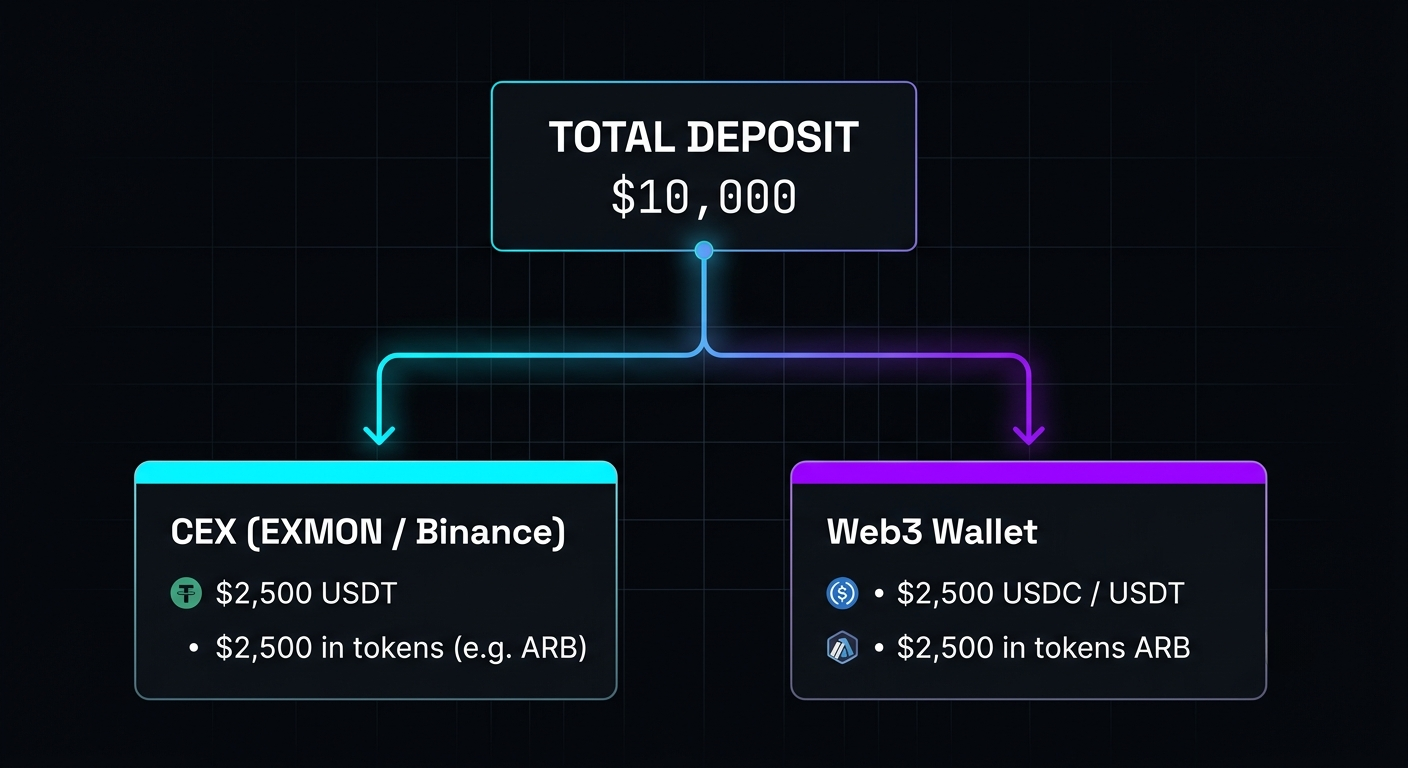
With this layout, you execute both legs of the trade simultaneously:
- If ARB is trading at $1.10 on the DEX and $1.00 on the CEX: You instantly dump your ARB on the DEX (pocketing $1.10 per token) and buy the exact same amount of ARB on the CEX (at $1.00).
- Zero cross-chain transfers required during execution. You just bagged a 10% delta (minus trading/gas fees) in under 3 seconds.
- Rebalancing your funds between your hot wallet and the exchange happens later, once the market settles down and gas prices drop back to baseline.
Trade Math: Calculating Net Spread and the Real Breakeven Point
Seeing a juicy 3% spread on your screen and mentally turning it into guaranteed profit is the single fastest way for novice arbers to blow up their stack. Gross spread is pure vanity—it means nothing. The only metric that matters is net spread after every single piece of infrastructure extracts its toll.
Net Yield Formula
Net_Profit = (Psell · V) - (Pbuy · V) - FeeCEX - FeeDEX - Gas - Impact
Where:
- Psell and Pbuy - Actual execution prices (not the mid-price shown in the UI header, but volume-weighted average prices based on order book depth).
- V - Trade volume in base assets or stablecoins.
- FeeCEX - Taker fee charged by the exchange (typically 0.05%–0.1%).
- FeeDEX - Pool fee (0.01%, 0.05%, 0.3%, or 1% depending on the pool tier).
- Gas - Cost to land the transaction in a block, converted to USD.
- Impact - The price impact your own trade size exerts on the AMM pool.
The Final Boss: DEX Price Impact
On a CEX order book, if you see 10,000 tokens sitting at $1.00, you hit those asks and get filled at exactly $1.00 (plus fees). On a DEX running standard Constant Product mechanics (x · y = k), every incremental token you buy costs more than the last.
Here is the formula for selling token x for token y in an x · y = k pool:
yout = (yreserve · xin · (1 - fee)) / (xreserve + xin · (1 - fee))
Fire a $5,000 order into a pool with $100,000 in liquidity, and you will move the price by ~5%. That paper spread of 3% instantly flips into a -2% loss before your tx even gets validated.
Real Net Spread Breakdown by Trade Volume ($50k Pool, 2.5% Gross Spread)
| Trade Volume ($) | Price Impact (%) | Total Fees (Gas + Trading) | Net Spread (%) | Trade Outcome |
|---|---|---|---|---|
| $100 | ~0.2% | ~$1.50 (1.5%) | +0.8% | Small profit |
| $500 | ~1.0% | ~$1.50 (0.3%) | +1.2% | Sweet spot profit |
| $2,000 | ~3.8% | ~$1.50 (0.075%) | -1.375% | Lost money to price impact |
The takeaway: every pool depth has a strict mathematical ceiling for position sizing. Oversizing your order completely destroys your unit economics.
Automated Opportunity Hunting: Building a Python Monitor
Staring at a browser and manually refreshing DexScreener tabs alongside exchange order books is relic trading. Manual traders use scripts not to outrun MEV bots on automated execution—that is a losing game—but to get instant audio or push alerts on Telegram/terminal the moment an anomalous spread opens up.
Below is a fully functional script written for Python 3.10+. It queries live PancakeSwap v2 (BNB Chain) pool reserves directly via RPC in real time and checks them against CEX order book depth (using Binance's REST API here, which easily maps over to EXMON). It's a lightweight bare-bones build with room for polish, but it gets the job done right out of the box.
Spread Scanner Code (Factoring In Reserves & Fees)
import sys
import time
import requests
from web3 import Web3
# ============================================================
# CONFIG
# ============================================================
BSC_RPC = "https://bsc-dataseed1.binance.org"
POOL_ADDRESS = Web3.to_checksum_address(
   "0x16b9a82891338f9bA80E2D6970FddA79D1eb0daE"
)
BINANCE_DEPTH_URL = (
   "https://api.binance.com/api/v3/depth"
   "?symbol=BNBUSDT&limit=20"
)
TRADE_VOLUME_USD = 300.0
CEX_TAKER_FEE = 0.001
DEX_FEE = 0.0025
MIN_NET_SPREAD_PCT = 0.8
# rough gas cost estimate for swap
ESTIMATED_GAS_COST_USD = 0.15
REQUEST_TIMEOUT = 3
# ============================================================
# WEB3
# ============================================================
w3 = Web3(Web3.HTTPProvider(BSC_RPC))
if not w3.is_connected():
   print("Error connecting to BSC RPC")
   sys.exit(1)
# ============================================================
# ABI
# ============================================================
PAIR_ABI = [
   {
       "constant": True,
       "inputs": [],
       "name": "getReserves",
       "outputs": [
           {"name": "_reserve0", "type": "uint112"},
           {"name": "_reserve1", "type": "uint112"},
           {"name": "_blockTimestampLast", "type": "uint32"},
       ],
       "stateMutability": "view",
       "type": "function",
   },
   {
       "constant": True,
       "inputs": [],
       "name": "token0",
       "outputs": [{"name": "", "type": "address"}],
       "stateMutability": "view",
       "type": "function",
   },
   {
       "constant": True,
       "inputs": [],
       "name": "token1",
       "outputs": [{"name": "", "type": "address"}],
       "stateMutability": "view",
       "type": "function",
   },
]
pair = w3.eth.contract(
   address=POOL_ADDRESS,
   abi=PAIR_ABI
)
# ============================================================
# KNOWN TOKENS
# ============================================================
WBNB = Web3.to_checksum_address(
   "0xbb4CdB9CBd36B01bD1cBaEBF2De08d9173bc095c"
)
USDT = Web3.to_checksum_address(
   "0x55d398326f99059fF775485246999027B3197955"
)
# ============================================================
# VERIFY PAIR
# ============================================================
try:
   token0 = Web3.to_checksum_address(
       pair.functions.token0().call()
   )
   token1 = Web3.to_checksum_address(
       pair.functions.token1().call()
   )
except Exception as e:
   print("Error fetching token0/token1")
   print(e)
   sys.exit(1)
PAIR_LAYOUT = None
if token0 == WBNB and token1 == USDT:
   PAIR_LAYOUT = "WBNB_USDT"
elif token0 == USDT and token1 == WBNB:
   PAIR_LAYOUT = "USDT_WBNB"
else:
   print("Pool is not a WBNB/USDT pair")
   print("token0 =", token0)
   print("token1 =", token1)
   sys.exit(1)
print("Pair verified:")
print("token0 =", token0)
print("token1 =", token1)
# ============================================================
# BINANCE
# ============================================================
def get_orderbook():
   try:
       response = requests.get(
           BINANCE_DEPTH_URL,
           timeout=REQUEST_TIMEOUT
       )
       response.raise_for_status()
       data = response.json()
       if "bids" not in data:
           return None
       if "asks" not in data:
           return None
       return data
   except Exception:
       return None
def calculate_execution_buy_price(
   asks,
   target_usd
):
   """
   Buying BNB with USDT.
   Returns:
       avg_price,
       received_bnb
   """
   spent_usd = 0.0
   received_bnb = 0.0
   for price_str, qty_str in asks:
       price = float(price_str)
       qty = float(qty_str)
       level_usd = price * qty
       if spent_usd + level_usd >= target_usd:
           remaining_usd = target_usd - spent_usd
           partial_qty = remaining_usd / price
           received_bnb += partial_qty
           spent_usd += remaining_usd
           break
       received_bnb += qty
       spent_usd += level_usd
   if spent_usd < target_usd:
       return None, None
   avg_price = spent_usd / received_bnb
   return avg_price, received_bnb
def calculate_execution_sell_price(
   bids,
   sell_bnb
):
   """
   Selling BNB for USDT.
   Returns:
       avg_price,
       received_usdt
   """
   remaining_bnb = sell_bnb
   received_usdt = 0.0
   sold_bnb = 0.0
   for price_str, qty_str in bids:
       price = float(price_str)
       qty = float(qty_str)
       take_qty = min(
           remaining_bnb,
           qty
       )
       received_usdt += take_qty * price
       sold_bnb += take_qty
       remaining_bnb -= take_qty
       if remaining_bnb <= 0:
           break
   if remaining_bnb > 0:
       return None, None
   avg_price = received_usdt / sold_bnb
   return avg_price, received_usdt
# ============================================================
# DEX
# ============================================================
def get_reserves():
   try:
       reserves = (
           pair.functions
           .getReserves()
           .call()
       )
       raw0 = reserves[0]
       raw1 = reserves[1]
       if PAIR_LAYOUT == "WBNB_USDT":
           reserve_bnb = raw0 / 1e18
           reserve_usdt = raw1 / 1e18
       else:
           reserve_usdt = raw0 / 1e18
           reserve_bnb = raw1 / 1e18
       return (
           reserve_bnb,
           reserve_usdt
       )
   except Exception:
       return None, None
def amm_out(
   amount_in,
   reserve_in,
   reserve_out
):
   if (
       amount_in <= 0
       or reserve_in <= 0
       or reserve_out <= 0
   ):
       return 0.0
   amount_in_fee = (
       amount_in
       * (1 - DEX_FEE)
   )
   numerator = (
       amount_in_fee
       * reserve_out
   )
   denominator = (
       reserve_in
       + amount_in_fee
   )
   return numerator / denominator
# ============================================================
# MONITOR
# ============================================================
def monitor():
   print()
   print("DEX/CEX Arbitrage Monitor Started")
   print("-" * 80)
   while True:
       book = get_orderbook()
       if book is None:
           time.sleep(1)
           continue
       reserve_bnb, reserve_usdt = (
           get_reserves()
       )
       if (
           reserve_bnb is None
           or reserve_usdt is None
       ):
           time.sleep(1)
           continue
       bids = book["bids"]
       asks = book["asks"]
       # ====================================================
       # SCENARIO A
       # BUY ON DEX
       # SELL ON CEX
       # ====================================================
       bnb_from_dex = amm_out(
           TRADE_VOLUME_USD,
           reserve_usdt,
           reserve_bnb
       )
       if bnb_from_dex <= 0:
           time.sleep(1)
           continue
       sell_price, usdt_received = (
           calculate_execution_sell_price(
               bids,
               bnb_from_dex
           )
       )
       if usdt_received is None:
           time.sleep(1)
           continue
       usdt_received *= (
           1 - CEX_TAKER_FEE
       )
       usdt_received -= (
           ESTIMATED_GAS_COST_USD
       )
       spread_a = (
           (usdt_received - TRADE_VOLUME_USD)
           / TRADE_VOLUME_USD
       ) * 100
       # ====================================================
       # SCENARIO B
       # BUY ON CEX
       # SELL ON DEX
       # ====================================================
       buy_price, bought_bnb = (
           calculate_execution_buy_price(
               asks,
               TRADE_VOLUME_USD
           )
       )
       if bought_bnb is None:
           time.sleep(1)
           continue
       bought_bnb *= (
           1 - CEX_TAKER_FEE
       )
       usdt_from_dex = amm_out(
           bought_bnb,
           reserve_bnb,
           reserve_usdt
       )
       usdt_from_dex -= (
           ESTIMATED_GAS_COST_USD
       )
       spread_b = (
           (usdt_from_dex - TRADE_VOLUME_USD)
           / TRADE_VOLUME_USD
       ) * 100
       dex_price = (
           reserve_usdt
           / reserve_bnb
       )
       sys.stdout.write(
           "\r"
           f"DEX={dex_price:.2f} | "
           f"A:{spread_a:+.2f}% | "
           f"B:{spread_b:+.2f}%"
       )
       sys.stdout.flush()
       if spread_a >= MIN_NET_SPREAD_PCT:
           print(
               "\n"
               f"[SIGNAL] "
               f"BUY DEX -> SELL CEX "
               f"({spread_a:.2f}%)"
           )
       elif spread_b >= MIN_NET_SPREAD_PCT:
           print(
               "\n"
               f"[SIGNAL] "
               f"BUY CEX -> SELL DEX "
               f"({spread_b:.2f}%)"
           )
       time.sleep(1.5)
# ============================================================
# ENTRY
# ============================================================
if __name__ == "__main__":
   try:
       monitor()
   except KeyboardInterrupt:
       print("\nStopped.")
What makes this script accurate is that it accounts for true slippage—instead of pulling a static spot rate, it simulates pushing your exact $300 order size directly through the pool's bonding curve math.
Manual Execution Protocol: How Not to Become Exit Liquidity for Sandwich Bots
Clicking a couple of buttons across different platforms sounds trivial on paper. In reality, 80% of manual traders leak their profits the exact second they broadcast a transaction to the public mempool.
The moment your buy order on a DEX hits the public mempool on Ethereum, BNB Chain, or Arbitrum, MEV (Maximum Extractable Value) bots spot it instantly. If your slippage tolerance is set above 0.5%, the bot drops a classic sandwich attack on you:
- The bot frontruns your order by buying the token first, driving the price up.
- Your transaction executes at the worst possible price right at the edge of your slippage limit.
- The bot backruns you, selling the token immediately after for an instant profit.
At the end of the day, you bag the token at an inflated price, while the MEV searcher pockets the entire spread.
Securing Your Execution Pipeline
If you want to capture spreads manually without feeding the bots, configure your workflow using this battle-tested setup:
- Private RPC Nodes (MEV-Blocker / Flashbots). Forget about default MetaMask network settings. All DEX transactions must route exclusively through private relays that beam your tx straight to the block validator, bypassing the public mempool entirely.
For Ethereum: https://rpc.mevblocker.io or https://rpc.flashbots.net
For BNB Chain / Polygon / Arbitrum: use MEV-protection endpoints from QuickNode or services like BloXroute. - Strict Slippage Limit. Throw out those default 1% or 2% settings on Uniswap or 1inch. Your max allowed slippage for an arbitrage trade should be 0.1%–0.3%. If the price shifts a millisecond before block inclusion, the tx needs to revert hard rather than executing at a loss.
- Gas Fee Optimization. Switch your Web3 wallet fee settings to Advanced Gas Controls. Bump your Max Priority Fee (validator tip) slightly above the current network median to secure front-of-block priority. On L2s (Arbitrum, Base, OP), keep a sharp eye on L1 Data Fee spikes—during heavy Ethereum congestion, pushing transactions through L2 can easily cost 5x more than usual.
Advanced Technique: Delta-Neutral "DEX Spot vs CEX Futures" Arbitrage
Physically holding altcoins on both balances exposes you to market price risk while you wait for a spread to open up. If the token dumps 15%, a measly 2% captured spread won't save your portfolio from drawdown.
The advanced methodology taught at EXMON Academy revolves around delta-neutral spread trading using futures.
Mechanics of the Short Hedge
Instead of buying the spot asset on a CEX, you open a 1x leveraged short futures position there.
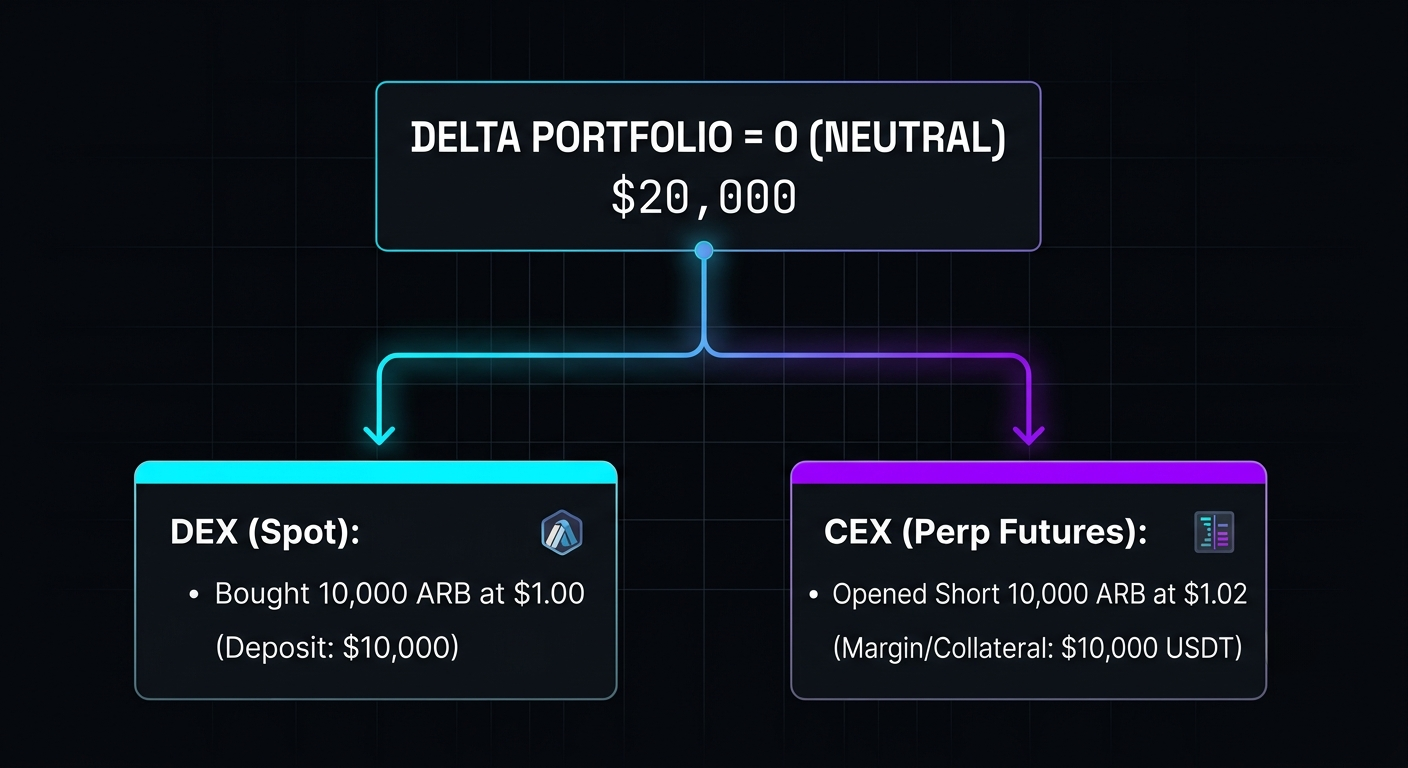
Execution Workflow:
- A price dip hits the DEX: the token drops to $0.95, while the spot and futures price on the CEX holds at $1.00 (a 5.2% spread).
- You scoop up the spot token on the DEX for $0.95.
- Simultaneously, you open a short futures position on the CEX at $1.00.
- Your delta is instantly neutralized: regardless of market direction, your total portfolio value remains rock steady.
- When the DEX price converges with the CEX (say, both settle at $0.98), you close out both legs:
- Sell the DEX spot at $0.98 (Profit: +$0.03 per token).
- Close the CEX short at $0.98 (Profit: +$0.02 per token).
Total net profit: $0.05 per token (a 5% return on deployed capital) with zero exposure to token price depreciation risk.
Pro tip: If the CEX futures are trading in contango (futures price higher than spot), you'll also rake in a positive funding rate payout every single settlement hour.
Hidden Pitfalls and Edge-Case Risks
If a strategy looks too clean, you just haven't found the blind spots yet. Manual spread trading is riddled with low-key engineering landmines.
1. Transfer Tax / Reflection Tokens
Certain ERC-20 and BEP-20 tokens hardcode a transfer fee directly into their smart contract (e.g., a 2%–5% burn or routing cut on every single move).
If you fail to inspect the contract code via a block explorer or security scanner (like TokenSniffer or GoPlus), pulling the token out of the pool will instantly trigger that token tax, tack on another 0.3% AMM fee, and slam you right into a heavy net loss.
2. The Uniswap v3 Concentrated Liquidity Trap
In Uniswap v2, liquidity is spread evenly from zero to infinity. In v3, liquidity is hyper-concentrated into tight price ranges called ticks.
If a spread pops up simply because the price breached the primary market maker's active range, the visual price discrepancy can look massive (up to 10%–20%). However, the actual liquidity depth on that specific tick might be a mere $15. Trying to execute a trade there will cause brutal price impact, instantly shifting the market against you by double digits.
3. Liquidity Imbalance & Inventory Risk
If you capture a directional spread 5 times in a row (e.g., Buy on DEX -> Sell on CEX), you'll completely drain your USDT balance on the CEX while flooding your Web3 wallet with altcoins.
Manual rebalancing takes time and costs extra gas/fees. If the market starts trending hard, you'll find yourself trapped in a single-legged position. Risk rule of thumb: never let your venue asset allocation skew past a 70/30 split.
Pre-Flight Trader Checklist
Tape this checklist to your monitor. Do not pull the trigger unless all 5 conditions check out green:
- MEV Protection Enabled: Your wallet is locked onto a private RPC endpoint (MEV-Blocker / Flashbots).
- Pool Depth Verified: Your trade size doesn't exceed 1%–2% of the total DEX pool reserves (Price Impact < 0.3%).
- Net Spread Confirmed: The price variance covers total CEX + DEX + Gas fees by at least a 2.5x multiplier.
- Contract Audit Clean: The token has zero hidden transfer taxes (Transfer Fee = 0%).
- Capital Balanced: Both CEX and DEX hold sufficient asset balances for instant execution without waiting on bridging or transfers.
Cross-venue spread trading between DEXs and CEXs is a pure math discipline. Winners aren't chosen by who predicts trend directions, but by who masters fee calculations, controls their infrastructure, and patiently waits for market anomalies.