
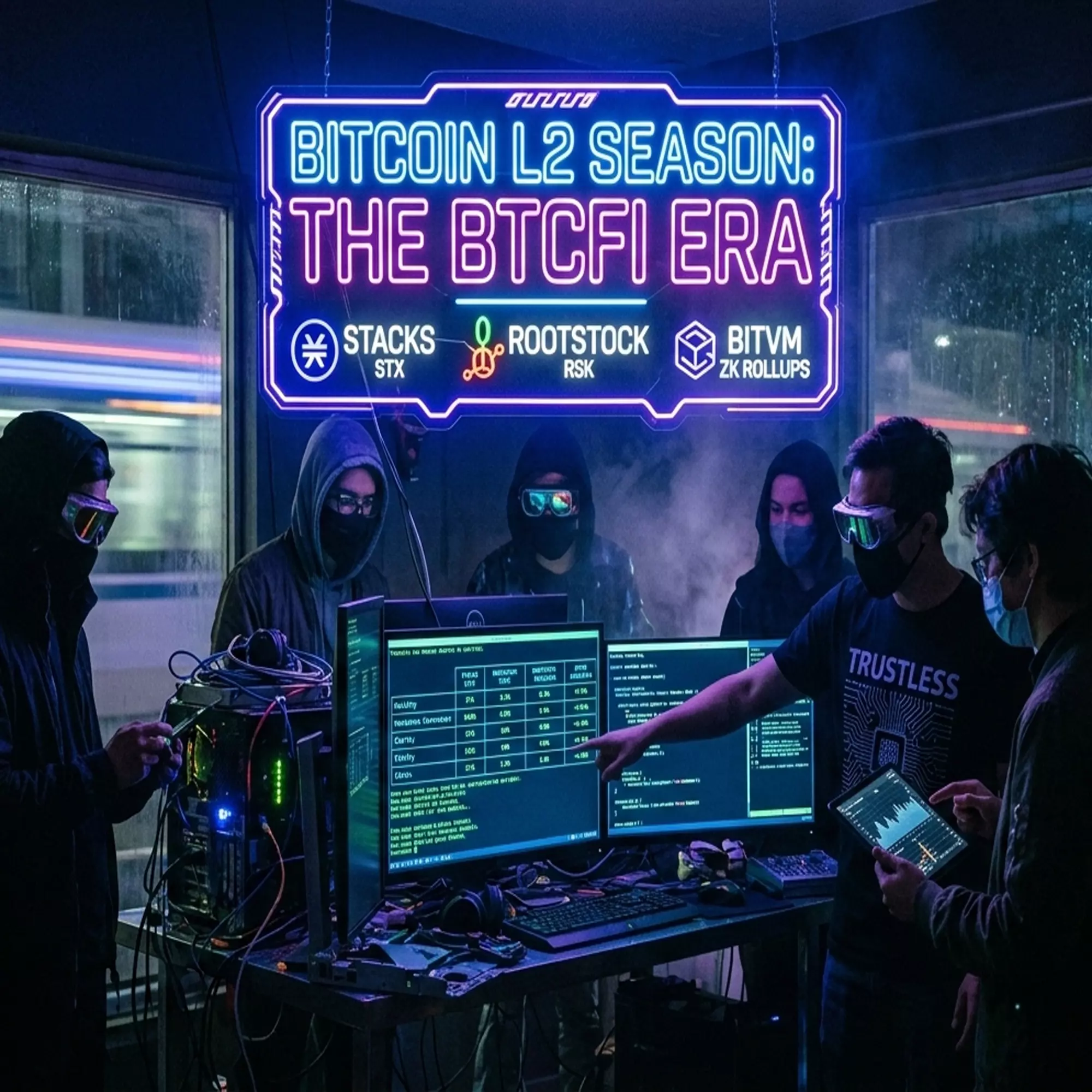
The year 2026 has arrived, and Bitcoin has finally stopped being just "digital gold." If 2024 was the year of ETFs, and 2025 was the year of institutional adoption, then 2026 marks the era of BTCFi. We are at the epicenter of the "L2 season," where Bitcoin assets have finally started working and generating yield without custodial risks.
In this article, we’ll take a deep technical and practical look at the three pillars of the modern ecosystem: the veteran Rootstock, the revamped Stacks, and revolutionary BitVM solutions.
1. Stacks (STX): Evolution After Nakamoto
Stacks has journeyed from a slow sidechain to a full execution layer with "Bitcoin finality." After the historic Nakamoto upgrade (completed at the end of 2025), Stacks’ architecture underwent a radical transformation.
Technical Overview
The main issue with the old Stacks was that its blocks were tied to Bitcoin’s 10-minute intervals. Now, the Tenure Extensions mechanism is used, allowing fast blocks (every 5 seconds) that are confirmed by a group of Stackers.
Practical Aspect: sBTC
sBTC is the holy grail of Stacks. It’s not a "wrapped" token like WBTC, but a decentralized BTC in/out mechanism.
- How it works: You send BTC to a special multisig address on the mainnet, and sBTC is automatically minted on Stacks.
- Security: The staked STX tokens act as collateral. If signers try to steal BTC, they lose their STX.
Sample Clarity code for a simple sBTC deposit:
;; Simple sBTC deposit contract
(define-map deposits principal uint)
(define-public (deposit-sbtc (amount uint))
    (begin
        ;; Transfer sBTC from the user to the contract
        (try! (contract-call? 'ST1PQHQKV...sbtc-token transfer amount tx-sender (as-contract tx-sender) none))
        ;; Update the balance
        (map-set deposits tx-sender (+ (default-to u0 (map-get? deposits tx-sender)) amount))
        (ok true)
    )
)
2. Rootstock (RSK): King of Merge-Mining and EVM
Rootstock remains the world’s most secure sidechain thanks to merge-mining. Over 60% of Bitcoin’s hashrate simultaneously secures Rootstock without consuming extra energy.
Why it Matters in 2026
Rootstock is a bridge for those used to Ethereum. It’s fully EVM-compatible (Solidity). If you can code for Ethereum, you can already build on Bitcoin.
PowPeg Upgrade
In February 2026, Rootstock rolled out the PowPeg Composition Change, expanding the set of signers (Functionaries) and making the BTC-RBTC bridge even more decentralized.
Practical Tip: For developers, moving to Rootstock now is the fastest path to BTCFi. Use standard tools like Hardhat, Foundry, and MetaMask. Just switch the RPC to https://public-node.rsk.co.
3. BitVM and BitVM2: True Bitcoin Rollups
This is the "major league" of 2026 tech. BitVM (developed by Robin Linus) is not a separate blockchain but a computation paradigm.
What’s the "Magic"?
BitVM allows arbitrary computations off Bitcoin’s main chain, yet enables proof of correctness on Bitcoin itself via Optimistic Fraud Proofs.
BitVM-Based Projects (Citrea, GOAT, Bitlayer)
- BitVM2: In early 2026, the mainnet of Citrea, the first ZK rollup using BitVM for proof verification, went live.
- GOAT Network: Actively implements BitVM2 to create trustless bridges, where fund withdrawals don’t require a "federation" approval (as in Rootstock or Liquid). One honest participant is enough to prevent theft.
Lesser-known detail: BitVM uses a Merkle tree to pack large programs into a single Taproot output. This turns Bitcoin into a "judge" that only intervenes in case of a dispute.
Comparison Table (As of February 2026)
| Feature | Stacks (Nakamoto) | Rootstock (RSK) | BitVM (Citrea/GOAT) |
|---|---|---|---|
| Type | L2 (own state) | Sidechain | Optimistic/ZK Rollup |
| Contract Language | Clarity (secure) | Solidity (EVM) | Any (via ZK/Fraud Proofs) |
| Block Speed | ~5 sec | ~30 sec | Milliseconds (off-chain) |
| Bridge Security | Economic (STX) | PowPeg (Federation) | Cryptographic (BitVM) |
| Stage | Mature (Mainnet) | Very Mature (Mainnet) | Early / Mainnet Launch |
Practical Tips for Investors and Users
- For passive income: Use Stacking 5.0 on Stacks. Lock STX and earn yield directly in native BTC. This is the only way to "mine" Bitcoin without ASICs.
- For DeFi trading: Rootstock offers the highest liquidity through protocols like Sovryn and new institutional vaults from Fireblocks.
- For "early birds": Follow BitVM solution testnets (Bitlayer, Citrea). They’re shaping the future of trustless bridges.
4. A Deep Dive into BitVM: How the “Bitcoin Computer” Actually Works
While Stacks and Rootstock build external layers, BitVM is a way to make Bitcoin itself verify complex contracts without changing its core code (no soft fork required).
The Technical Magic: Bit Gates
At the heart of BitVM is the use of Taproot and a system of Bit Commitments. All complex code (for example, bridge logic or ZK-proof verification) is broken down into the simplest logical operations: AND, OR, NOT.
- Off-chain: The Prover and the Verifier compile the program into a massive Merkle tree.
- On-chain: Only the root of that tree (the hash) is written into the Bitcoin transaction.
- Dispute resolution: If the Prover lies, the Verifier initiates a “fault proof game” (Binary Search). The Bitcoin script checks a single operation where the disagreement occurred. Whoever is caught cheating loses their bond.
A little-known fact from 2026: With the launch of BitVM2 (the optimized version), the number of Bitcoin transactions required to resolve a dispute dropped from hundreds to just a handful. That made the technology commercially viable for rollups like Citrea.
5. Practical Example: Deploying a Simple Smart Contract on Rootstock (RSK)
Since Rootstock is fully EVM-compatible, you can deploy a Solidity contract in under five minutes. This is especially relevant for creating custom Bitcoin-backed stablecoins.
Code example: A minimalist contract for distributing BTC rewards
// SPDX-License-Identifier: MIT
pragma solidity ^0.8.20;
contract BTCRewards {
    address public owner;
    mapping(address => uint256) public balances;
    constructor() {
        owner = msg.sender;
    }
    // Function to receive RBTC (native Bitcoin on the Rootstock network)
    receive() external payable {
        balances[msg.sender] += msg.value;
    }
    // Distribute rewards (owner only)
    function distribute(address to, uint256 amount) public {
        require(msg.sender == owner, "Not authorized");
        require(address(this).balance >= amount, "Insufficient balance");
        payable(to).transfer(amount);
    }
}
Tooling:
- Wallet: MetaMask (add the Rootstock network via Chainlist).
- Gas: Paid in RBTC (pegged 1:1 to BTC). You can obtain it through a bridge (FastBTC) directly in your wallet or on exchanges.
6. Stacks 2026: The “Stacking” Strategy for Pros
In 2026, Stacking (locking up STX to support consensus) became one of the primary sources of low-risk BTC yield.
How to maximize returns:
- Direct participation (Solo Stacking): Requires a high entry threshold (~100k STX), but you retain control of your keys and receive BTC directly to your mainnet address.
- Liquid staking (LiSTX/stSTX): Projects like StackingDAO allow you to stake STX and receive a liquid token in return. You can then deploy it in Stacks DeFi (for example, in liquidity pools on Alex Lab) to earn additional yield on top of your BTC rewards.
Important detail: Thanks to Nakamoto finality, Stacks transactions are now secured at the Bitcoin level. This means that once a Bitcoin block is confirmed, the corresponding Stacks transaction is effectively irreversible.
7. The Challenges and Risks of “L2 Season”
Despite the hype, 2026 also exposed some weak spots:
- Bridge centralization: Many new L2s still rely on “training wheels” — security councils or multisigs that technically retain control over funds. Always check a bridge’s decentralization level on resources like L2Beat for Bitcoin.
- Liquidity fragmentation: BTC is spread across dozens of networks. The solution is emerging in the form of cross-chain messaging protocols such as LayerZero or Wormhole, now being integrated into Bitcoin L2s.
- L1 fees: During spikes in activity on the Bitcoin mainnet (for example, due to new Inscriptions or heavy BitVM channel closures), the cost of moving funds in or out of L2 can surge to $50–100 per transaction.
Conclusion: Which Solution Should You Choose?
- If you’re a developer from the Ethereum world: Go with Rootstock. Familiar tooling, battle-tested security, and a large DeFi ecosystem.
- If you’re a BTC holder looking for passive income: Choose Stacks. Earning native BTC payouts for holding STX is a unique value proposition in today’s market.
- If you’re after “True Crypto” and maximum decentralization: Keep an eye on BitVM and rollups like Citrea. This is the technological frontier that may soon make trusted federations obsolete.
The Bitcoin L2 season is just getting started. In 2026, we stopped asking “Why does Bitcoin need smart contracts?” and started asking “How fast can we move the entire global financial system onto it?”
Summarize this blog post with: