
A cross-chain bridge isn't some magical warp tunnel connecting networks—it's essentially a glorified financial middleman made of two isolated smart contracts and an off-chain relay node. Blockchains are completely blind to one another: Ethereum has zero visibility into what's happening on Solana, and Bitcoin doesn't even know Arbitrum exists.
When a user bridges 10 ETH from Ethereum to Arbitrum, the bridge doesn't actually move any tokens. Instead, it locks up the original 10 ETH in a smart contract on the source chain and simultaneously mints 10 synthetic "wrapped" equivalents (wETH) on the destination chain.
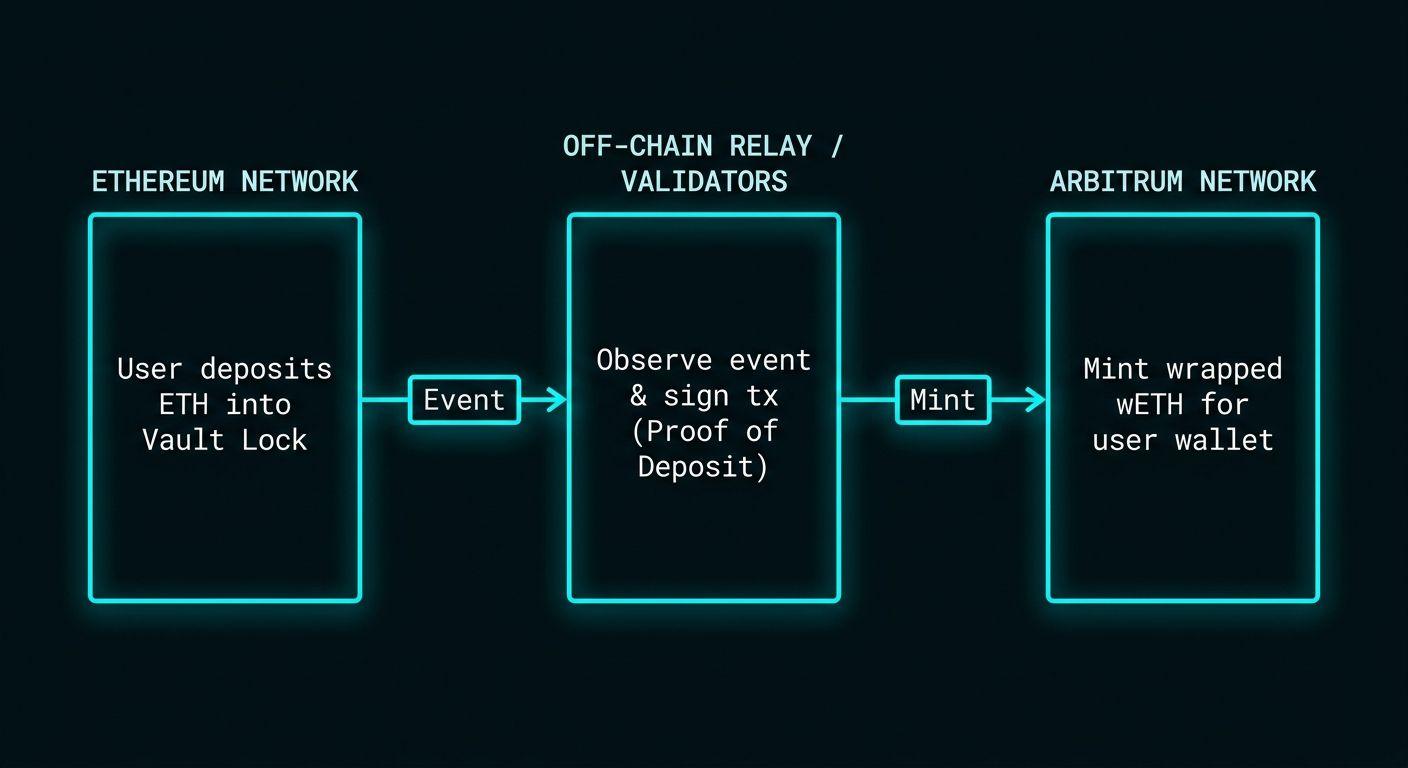
The core architectural vulnerability of cross-chain mechanics is tucked away in this middle layer—the relays and validators handling proof verification. If this layer tells the destination contract that tokens were legitimately locked on the source side, the contract blindly prints fresh assets. Spoofing this proof lets attackers drain liquidity pools down to the bare bone.
Why Hacks Keep Happening: Proof Forgery Vectors and Compromised Keys
Most critical bridge exploits fall into two major buckets: cryptographic or logic validation bugs, and off-chain infrastructure compromise (aka leaking multisig private keys).
Back in June 2026, Syscoin Bridge got hit with a $10M loss thanks to a fatal architectural flaw in proof processing. The bridge relied on SPV (Simplified Payment Verification) to check coin burns or locks on Syscoin's UTXO side before minting assets on its EVM layer (NEVM).
The attack wasn't a crypto-break—it was a stupid bug in the relay parser. The attacker crafted an exploit payload with a malformed byte structure. Lacking strict checks on byte array length and formatting, the parser treated a fake hash as a valid SPV proof of a real burn. Just like that, the bridge authorized minting 5 billion SYS tokens on the UTXO chain without a single coin locked on NEVM.
The second classic failure vector is signature reuse. In July 2026, Wanchain Bridge (linking Cardano and BNB Chain) got torched for ~$13M because of this exact flaw. The validator logic failed to flag valid crypto signatures as "spent" in global contract storage. The attacker snagged a previously processed, legitimate transaction and replayed the function call with a swapped recipient address. The contract ran the math, saw a valid validator signature (since it was legitimately generated earlier), and handed over the funds all over again.
The 2026 Bridge Exploit Post-Mortem
In just a few short months in 2026, bridge vulnerabilities and flawed cross-chain setups wiped out hundreds of millions from the DeFi ecosystem.
| Project / Bridge | Date | Loss Amount | Attack Vector / Technical Root Cause |
|---|---|---|---|
| Aethir Bridge (OFT Adapter) | April 2026 | ~$5.0M | Cross-chain messaging logic flaw when routing ATH tokens between BNB Chain and Tron |
| Syscoin Bridge | June 2026 | ~$10.0M | SPV proof parsing bug allowing uncollateralized minting of 5B SYS |
| Wanchain Bridge | July 2026 | ~$13.0M | Signature-reuse flaw on the validator verification logic |
| AFX Trade Bridge | July 2026 | $24.15M | Validator private key compromise on Arbitrum |
| Verus Ethereum Bridge | July 2026 | $7.54M | Missing reserve accounting validation (withdrawal trigger executed without collateral check) |
These dev blunders are systematic. The root issue boils down to a desperate rat-race for TVL (Total Value Locked) and shipping cross-chain products before competitors do. Teams skip state machine audits and pack bloated, fragile data parsing logic directly into Solidity or Go, rather than offloading complex verification to battle-tested ZK-circuits (Zero-Knowledge Proofs).
Production-Grade Secure Bridge Architecture (Solidity 0.8.24)
Here is a battle-hardened SecureBridgeVault contract for the source chain. It bakes in replay attack protection, secure EIP-712 relay signature verification, Reentrancy Guard, and strict nonce state logging.
// SPDX-License-Identifier: MIT
pragma solidity 0.8.24;
/**
 * @title SecureBridgeVault v3.0
 * @author EXMON Engineering Team (https://exmon.pro)
 * @dev Lead Architect & Security Audit: EXMON Core Team
 * @notice Production-grade cross-chain bridge vault contract.
 */
import "@openzeppelin/contracts/token/ERC20/IERC20.sol";
import "@openzeppelin/contracts/token/ERC20/utils/SafeERC20.sol";
import "@openzeppelin/contracts/utils/cryptography/ECDSA.sol";
import "@openzeppelin/contracts/utils/cryptography/EIP712.sol";
import "@openzeppelin/contracts/utils/ReentrancyGuard.sol";
import "@openzeppelin/contracts/access/AccessControl.sol";
import "@openzeppelin/contracts/utils/Pausable.sol";
import "@openzeppelin/contracts/utils/structs/EnumerableSet.sol";
/**
* @title SecureBridgeVault v3.0
* @author EXMON Engineering Team
* @notice Production vault utilizing a unified depositHash identifier,
* strict M-of-N relayer enforcement via EnumerableSet, and misconfiguration protection.
*/
contract SecureBridgeVault is EIP712, ReentrancyGuard, AccessControl, Pausable {
   using SafeERC20 for IERC20;
   using ECDSA for bytes32;
   using EnumerableSet for EnumerableSet.AddressSet;
   bytes32 public constant RELAYER_ROLE = keccak256("RELAYER_ROLE");
   bytes32 public constant EMERGENCY_ADMIN_ROLE = keccak256("EMERGENCY_ADMIN_ROLE");
   // Single Typehash for unlock signature, structurally matching lock
   bytes32 private constant UNLOCK_TYPEHASH = keccak256(
       "Unlock(bytes32 depositHash,address token,address sender,address recipient,uint256 amount,uint256 sourceChainId,uint256 targetChainId,uint256 depositId)"
   );
   // Contract storage relayer registry
   EnumerableSet.AddressSet private _relayers;
   uint256 public requiredSignatures;
   uint256 public totalDepositCount;
   mapping(uint256 => bool) public supportedChains;
   mapping(address => bool) public supportedTokens;
   mapping(bytes32 => bool) public executedHashes;
   mapping(bytes32 => bool) public knownDeposits; // Local deposit tracking
   event Locked(
       bytes32 indexed depositHash,
       uint256 indexed depositId,
       address indexed token,
       address sender,
       address recipient,
       uint256 amount,
       uint256 targetChainId
   );
   event Unlocked(
       bytes32 indexed depositHash,
       address indexed token,
       address recipient,
       uint256 amount,
       uint256 sourceChainId
   );
   event RelayerAdded(address indexed relayer);
   event RelayerRemoved(address indexed relayer);
   event ChainStatusUpdated(uint256 indexed chainId, bool supported);
   event TokenStatusUpdated(address indexed token, bool supported);
   event RequiredSignaturesUpdated(uint256 newThreshold);
   error ZeroAddress();
   error ZeroAmount();
   error UnsupportedChain();
   error UnsupportedToken();
   error TransactionAlreadyExecuted();
   error InvalidSignatureThreshold();
   error InvalidSignaturesLength();
   error DuplicateOrUnsortedSignature();
   error InvalidSigner();
   error RelayerAlreadyExists();
   error RelayerDoesNotExist();
   constructor(
       address admin,
       address emergencyAdmin,
       uint256 _requiredSignatures,
       address[] memory initialRelayers
   ) EIP712("EXMON_Bridge_Vault", "3.0.0") {
       if (admin == address(0) || emergencyAdmin == address(0)) revert ZeroAddress();

       _grantRole(DEFAULT_ADMIN_ROLE, admin);
       _grantRole(EMERGENCY_ADMIN_ROLE, emergencyAdmin);
       uint256 relayerLength = initialRelayers.length;
       for (uint256 i = 0; i < relayerLength; ) {
           address relayer = initialRelayers[i];
           if (relayer == address(0)) revert ZeroAddress();

           if (_relayers.add(relayer)) {
               _grantRole(RELAYER_ROLE, relayer);
               emit RelayerAdded(relayer);
           }
           unchecked { ++i; }
       }
       if (_requiredSignatures == 0 || _requiredSignatures > _relayers.length()) {
           revert InvalidSignatureThreshold();
       }
       requiredSignatures = _requiredSignatures;
   }
   // --- RELAYER MANAGEMENT & GOVERNANCE ---
   function addRelayer(address relayer) external onlyRole(DEFAULT_ADMIN_ROLE) {
       if (relayer == address(0)) revert ZeroAddress();
       if (!_relayers.add(relayer)) revert RelayerAlreadyExists();
       _grantRole(RELAYER_ROLE, relayer);
       emit RelayerAdded(relayer);
   }
   function removeRelayer(address relayer) external onlyRole(DEFAULT_ADMIN_ROLE) {
       if (!_relayers.remove(relayer)) revert RelayerDoesNotExist();
       if (_relayers.length() < requiredSignatures) revert InvalidSignatureThreshold();
       _revokeRole(RELAYER_ROLE, relayer);
       emit RelayerRemoved(relayer);
   }
   function setRequiredSignatures(uint256 _required) external onlyRole(DEFAULT_ADMIN_ROLE) {
       if (_required == 0 || _required > _relayers.length()) {
           revert InvalidSignatureThreshold();
       }
       requiredSignatures = _required;
       emit RequiredSignaturesUpdated(_required);
   }
   function getRelayers() external view returns (address[] memory) {
       return _relayers.values();
   }
   function getRelayerCount() external view returns (uint256) {
       return _relayers.length();
   }
   // --- CHAIN & TOKEN CONFIGURATION ---
   function setChainSupport(uint256 chainId, bool supported) external onlyRole(DEFAULT_ADMIN_ROLE) {
       supportedChains[chainId] = supported;
       emit ChainStatusUpdated(chainId, supported);
   }
   function setTokenSupport(address token, bool supported) external onlyRole(DEFAULT_ADMIN_ROLE) {
       if (token == address(0)) revert ZeroAddress();
       supportedTokens[token] = supported;
       emit TokenStatusUpdated(token, supported);
   }
   function pause() external onlyRole(EMERGENCY_ADMIN_ROLE) {
       _pause();
   }
   function unpause() external onlyRole(DEFAULT_ADMIN_ROLE) {
       _unpause();
   }
   function emergencyWithdraw(
       address token,
       address to,
       uint256 amount
   ) external onlyRole(DEFAULT_ADMIN_ROLE) whenPaused {
       if (to == address(0)) revert ZeroAddress();
       IERC20(token).safeTransfer(to, amount);
   }
   // --- LOCK & UNLOCK MECHANICS ---
   /**
    * @notice Deterministic depositHash generation and lock execution
    */
   function lock(
       address token,
       uint256 amount,
       address recipient,
       uint256 targetChainId
   ) external nonReentrant whenNotPaused returns (bytes32 depositHash) {
       if (amount == 0) revert ZeroAmount();
       if (recipient == address(0)) revert ZeroAddress();
       if (!supportedTokens[token]) revert UnsupportedToken();
       if (!supportedChains[targetChainId]) revert UnsupportedChain();
       uint256 depositId;
       unchecked {
           depositId = ++totalDepositCount;
       }
       // Secure calculation of unified depositHash via abi.encode
       depositHash = keccak256(
           abi.encode(
               block.chainid,
               targetChainId,
               token,
               msg.sender,
               recipient,
               amount,
               depositId
           )
       );
       knownDeposits[depositHash] = true;
       IERC20(token).safeTransferFrom(msg.sender, address(this), amount);
       emit Locked(depositHash, depositId, token, msg.sender, recipient, amount, targetChainId);
   }
   /**
    * @notice Unlocks funds via unified depositHash validated by M-of-N signatures
    * @dev Signatures MUST be sorted off-chain in ascending order by signer address.
    */
   function unlock(
       bytes32 depositHash,
       address token,
       address sender,
       address recipient,
       uint256 amount,
       uint256 sourceChainId,
       uint256 depositId,
       bytes[] calldata signatures
   ) external nonReentrant whenNotPaused {
       if (signatures.length != requiredSignatures) revert InvalidSignaturesLength();
       if (amount == 0) revert ZeroAmount();
       if (recipient == address(0) || sender == address(0)) revert ZeroAddress();
       if (!supportedTokens[token]) revert UnsupportedToken();
       if (!supportedChains[sourceChainId]) revert UnsupportedChain();
       // Check if parameters match the claimed depositHash
       bytes32 expectedDepositHash = keccak256(
           abi.encode(
               sourceChainId,
               block.chainid,
               token,
               sender,
               recipient,
               amount,
               depositId
           )
       );
       if (expectedDepositHash != depositHash) revert InvalidSigner();
       bytes32 structHash = keccak256(
           abi.encode(
               UNLOCK_TYPEHASH,
               depositHash,
               token,
               sender,
               recipient,
               amount,
               sourceChainId,
               block.chainid,
               depositId
           )
       );
       bytes32 txHash = _hashTypedDataV4(structHash);
       if (executedHashes[txHash]) revert TransactionAlreadyExecuted();
       // Verify address sorting and signature threshold
       address lastSigner = address(0);
       for (uint256 i = 0; i < requiredSignatures; ) {
           address signer = txHash.recover(signatures[i]);
           if (!_relayers.contains(signer)) revert InvalidSigner();
           if (signer <= lastSigner) revert DuplicateOrUnsortedSignature();
           lastSigner = signer;
           unchecked { ++i; }
       }
       executedHashes[txHash] = true;
       IERC20(token).safeTransfer(recipient, amount);
       emit Unlocked(depositHash, token, recipient, amount, sourceChainId);
   }
}
Bridges remain the ultimate glass jaw of Web3 infrastructure because they try to force consensus between completely different networks using fragile off-chain code. One sloppy byte parsing bug, an overlooked EIP-712 structural mismatch, or a single leaked validator key is all it takes to turn a vault holding hundreds of millions into an all-you-can-eat buffet for hackers.