

Back in 2017, when my team and I were first standing up bare-metal infrastructure for local exchange nodes, the market felt like the Wild West—wild, but fundamentally honest in its math. Fast forward to today, and it’s wrapped in corporate polish, Times Square billboards, and multi-billion-dollar Formula 1 sponsorship deals.
And that has created a dangerous illusion.
Most newcomers (and plenty of institutional players with short memories) gauge a project's reliability using three vanity metrics: trading volume, market cap, and X follower count. That’s a fundamental flaw—and one that routinely wipes out people’s life savings.
Scale does not equal security. A billion dollars in volume won't save you from a fatal smart contract bug or a straight-up founder rug pull. The only true measure of resilience in crypto is whether a project’s architecture and team can survive a full cycle of stress tests: grueling crypto winters, extreme drawdowns, and targeted exploits.
Let’s take an honest, data-driven look at the on-chain numbers and hard facts to see why so-called "industry giants" are collapsing right now in 2026—and how to actually separate battle-tested financial systems from pure marketing vaporware.
2026: The Graveyard of Giants and High-Profile Collapses
As of 2026, the market has undergone a brutal purge. At least 109 crypto projects have officially shuttered operations or filed for bankruptcy.
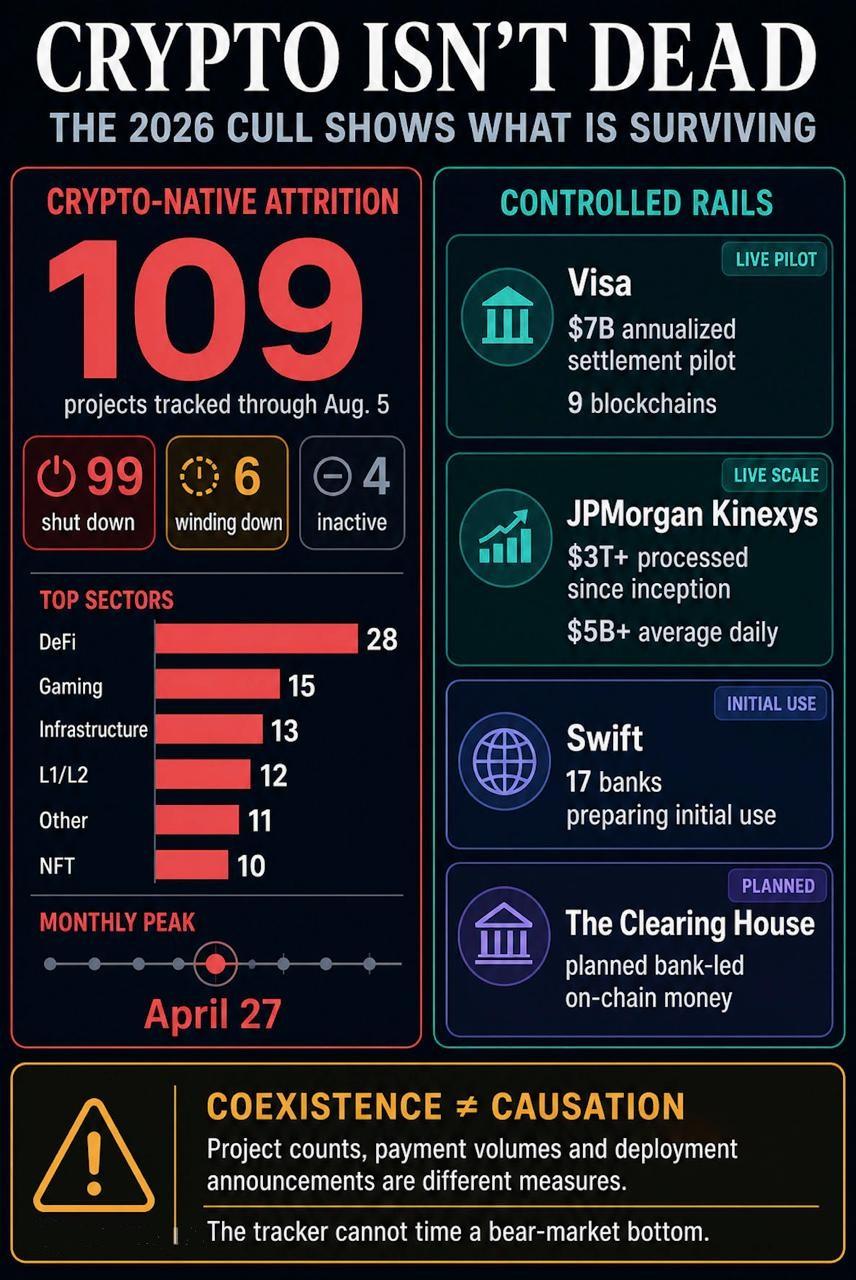
Breaking down the data by sector reveals exactly where systemic risk is heavily concentrated:
| Sector | Projects Dead / Collapsed (2026) | Primary Cause of Failure |
|---|---|---|
| DeFi Protocols | 28 | Flash loan exploits, liquidity crunches, oracle manipulation/math flaws |
| GameFi / P2E / M2E | 15 | Hyper-inflationary tokenomics collapse, massive user churn |
| Blockchain Infrastructure | 13 | High node maintenance costs combined with a lack of Real Yield |
| L1 / L2 Networks | 12 | Low TVL, fragmented liquidity, unsustainable gas subsidies from treasury |
| NFTs & Marketplaces | 10 | Total collapse of speculative demand, founder rug pulls/insider fraud |
| Other Services | 31 | Regulatory crackdowns, hacks on central/custodial storage |
Case Studies: High-Profile Collapses of 2026
1. The Demise of Step App (M2E)
Move-to-Earn heavyweight Step App officially pulled the plug. After four years, over 1 million app downloads, and a massive marketing push, it all unraveled. The ecosystem relied on a dual-token model: KCAL (reward payouts for physical activity) and FITFI (governance and staking). What went wrong? A classic architectural flaw: reward token emission outpaced incoming capital by orders of magnitude. The moment new user growth slowed—and people stopped buying virtual sneakers—the economy spiraled into a death loop. A million users couldn't stop the token from trending to absolute zero.
2. The Few and Far Scandal: From NFT Marketplace to Federal Wire Fraud
The downfall of Few and Far founder Taj Tarcha is a textbook lesson in the dangers of unmonitored treasury management. After raising over $10M from at least 67 investors, Tarcha siphoned funds for personal expenses—buying Miami real estate, gambling, and funding his side hobby as a DJ—instead of building infrastructure. Launched in May 2024, the FAR token bled out all liquidity and flatlined by 2026. The result? Federal indictments for securities and wire fraud facing up to 20 years in prison. Unfortunately, a jail sentence won't bring investors' money back.
3. Precision Exploits and Infrastructure Vulnerabilities
- Coinsbuy: The crypto payment processor lost ~$7.9M after hot wallets and signing keys were compromised.
- Bifrost: The DeFi protocol was exploited for 881,150 DOT (~$720K) due to a vulnerability in its cross-chain logic and oracle feeds.
Even hardware vendors and custodians are constantly put through the ringer. For years, ColdCard set the gold standard for air-gapped cold storage security, but even legendary setups face the ultimate test of time.
The Cold Math of Survival: Why "Buy and Hold" Is a Fast Track to Getting Rekt
Let's look at the hard data that VC funds love to ignore while dumping their latest altcoin unlocks on retail.
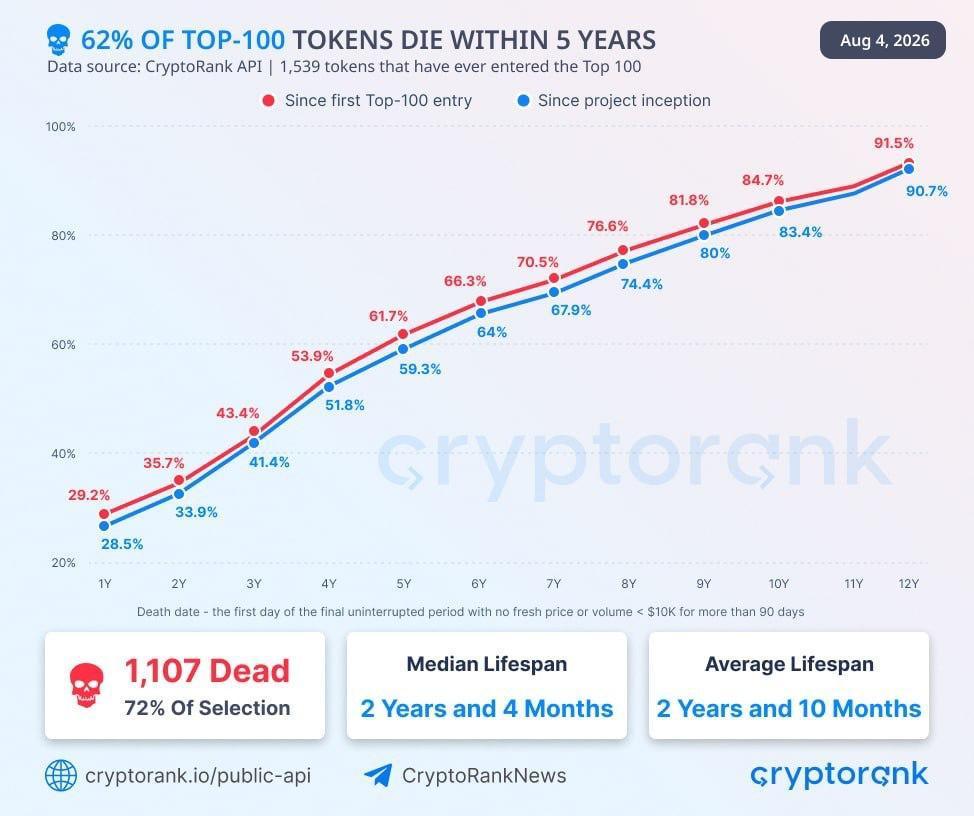
62% of top-100 tokens don't even survive a single 5-year cycle.
Looking at a broader sample of 1,539 projects that hit the top 100 by market cap at any point in crypto history:
- 71.9% of projects are effectively dead. They've either been delisted from major exchanges or see daily volume drop below $10,000.
- The median token lifespan is just 2 years and 4 months.
- Over a 10-year horizon, fewer than 15% of projects survive.
The grim reality of altcoins:
[ Project Launch ] ---> ( 2 Yrs 4 Mos — Median Lifespan ) ---> [ 71.9% Mortality ]
                                                                      |
                                                                      v
                                                         Volume < $10k/day or Delisted
A long-term "Buy and Hold" strategy only reliably works for two assets backed by massive network effects and battle-tested math: Bitcoin (BTC) and Ethereum (ETH).
Every other altcoin is a high-risk asset with a finite expiration date. VCs and core devs ride their vesting schedules, cash out at the peak of retail hype, and move on to launch the next "game-changing" startup—leaving you holding zombie tokens.
The Golden Rule of Trading Alts: Ride the momentum, relentlessly take profit into hard assets (BTC/Cash), and never, ever marry a project.
Let’s clear the air right now so there’s zero confusion.
BitMart wasn’t hacked. This wasn't some exploit or cyber attack; it was a quiet, calculated shutdown—a textbook liquidity crunch and the total collapse of their CEX business model. They officially announced an "orderly wind-down" of all trading operations, derivatives, Earn products, and deposits. It’s the end of a 9-year run for an exchange that posted fake multi-billion-dollar daily volumes while secretly packing its bags.
And BitMart is far from the only casualty this summer. Literally last week, BitMEX met the exact same fate. After 11 years in the game, the platform halted new registrations and called it quits.
The Great Exchange & Infrastructure Shutdown
We’re witnessing a full-blown systemic liquidity crisis. In just the past month, a wave of major players previously considered "too big to fail" hit the wall:
1. CEX Giants Are Calling It Quits
- BitMEX: The platform that once held 57% of the global crypto derivatives market and processed $1T in annual volume announced it’s shutting down derivatives trading and winding down operations. The culprit? Compressing fee margins, relentless regulatory pressure, and an inability to compete with real on-chain liquidity.
- AscendEX: Officially kicked off its sunsetting process. On-chain forensics revealed that over $240M leaked from the exchange’s wallets right before the announcement, draining liquid reserves to critical lows.
- Bit.com: The heavy-hitting options and derivatives venue completely suspended trading and sunsetted its platform following a prolonged, lethal nose-dive in active users.
2. Infrastructure & L1/L2 Collapse
The fallout isn't limited to exchanges—the underlying plumbing of the ecosystem is cracking too:
- Moonbeam (Polkadot parachain): On July 31, 2026, the Moonbeam blockchain completely stopped producing blocks. Users and DeFi protocols (including Moonwell) who failed to bridge out in time are now trapped inside a dead chain.
- Tally: The DAO governance infrastructure titan—which helped secure up to $80B in on-chain assets for heavyweights like Uniswap, Arbitrum, and ENS—filed for bankruptcy. The VC-funded DAO tooling model simply ran out of runway.
- Everclear (formerly Connext): The cross-chain clearing layer, despite hitting $500M in monthly volume, burned through its treasury and shut down due to a lack of commercial depth in the cross-chain solver ecosystem.
- Leap Wallet: The go-to multi-chain wallet for the Cosmos ecosystem completely sunsetted development and went offline.
Anatomy of a CEX Insolvency (The BitMart / AscendEX Playbook):
[ Liquidity Squeeze ] ➔ [ Desperate Deposit Campaigns (High APY / Promo Hype) ] ➔ [ Whale Flight ] ➔ [ Sunset / Insolvency ]
Battle-Testing Your Stack: How to Audit Exchanges and Protocols for Real Solvency
If you’re keeping funds on a CEX or parked in a DeFi protocol, stop relying on CoinMarketCap rankings. Here are 6 battle-tested on-chain metrics to verify if a project is actually solvent:
- 1. Track Record & "Crypto Winter" Survival
Longevity is the ultimate litmus test. A project that hasn't survived at least one full 4-year cycle has never faced a real-world liquidity stress test. If a platform was born in a bull market and has only seen net inflows, its risk management team is completely unproven. - 2. Proof of Reserves (PoR) Quality
If an exchange’s Proof of Reserves relies on more than 15-20% of its own native token (like BitMart’s BMX or FTX’s old FTT holdings)—get your capital out immediately. During a bank run, these illiquid native tokens crater to zero, leaving the platform with zero liquid assets to honor withdrawals. - 3. Desperation-Driven Marketing
When a platform constantly spams you with "Refer a friend, get $100!", "500% deposit match!", and endless influencer shilling—red flags should be flashing.
Here's the deal: Legit infrastructure spends capital on security, deep order books, and R&D. Hyper-aggressive marketing eats up insane amounts of cash. If an exchange lacks real organic revenue, they're likely using user deposits to fund these promos, run a Ponzi scheme, and lure in fresh exit liquidity. Standard referral programs are fine, but manic marketing campaigns mean they’re trying to patch a massive hole in their balance sheet. - 4. Volume-to-Deposit Ratio
If an exchange claims $1B–$2B in daily volume but their publicly tracked on-chain wallets hold less than $100M in total user deposits, you’re looking at blatant wash trading. The volume is completely faked. - 5. Real Yield vs. Token Inflation
For DeFi protocols: always check where the yield actually comes from. If you're being paid via hyper-inflationary emissions of their native farm token (think Step App or failed M2E/L2 schemes) rather than real protocol revenue generated from actual users, the project is guaranteed to enter a hyper-inflationary death spiral. - 6. Whale Netflow Trends
Monitor institutional capital movement using tools like Nansen or Arkham. When smart money and whales start consistently pulling capital off a platform for 2-3 straight weeks, take the hint—insiders always spot balance sheet red flags long before retail gets the news.
Survival Architecture: How EXMON Was Built to Defy the VC Trap
When we launched as a local OTC desk back in 2017, we didn't have millions in VC backing or flashy Dubai office suites. All we had was a rock-solid grasp of math, network security, and bare-metal infrastructure.
Later on, as we watched the industry take a wrong turn—devolving into a circus of shady market makers and custodial honeypots—we made a defining strategic call: we refused to follow the standard CEX playbook.
We skipped the naive exchange model and traditional centralized custody in all its toxic forms. Instead, we architected the EXMON ecosystem on core principles that completely eliminate the risk of internal insolvency or rehypothecating user funds.
3 Engineering Pillars of EXMON’s Architecture:
- Treasury and Liquidity Segregation: Ecosystem OPEX is strictly firewalled from customer funds. Zero user assets are ever deployed into yield farming, staking, or collateralizing external credit lines.
- Multi-Tier Cold Storage & MPC Architecture: The vast majority of funds sit in air-gapped nodes with zero public internet access, secured via Threshold Multi-Party Computation (MPC) multi-sig setups.
- Real Yield & Transparency: Infrastructure revenue comes purely from sustainable, value-driven sources—flat fiat cash-out fees, B2B merchant acquiring and payment APIs, escrow services, automated arbitrage protection, enterprise infra solutions, and integrated marketplaces—never from printing inflationary junk tokens out of thin air.
Our ecosystem scales alongside the real-world utility of our tech—not by nickel-and-diming retail traders with hidden fees.
Action Plan for Retail Traders: A Practical Portfolio Audit
If you want to survive the ongoing market purge currently wiping out fragile projects, execute this game plan immediately:
[ Step 1: Capital Segregation ] ───> Sweep idle reserves to cold storage;
                                    keep active capital on battle-tested infra
          │
          ▼
[ Step 2: Portfolio Purge ] ──────> Rot out trash altcoins into blue chips
                                    and Real Yield instruments
          │
          ▼
[ Step 3: On-Chain Hygiene ] ─────> Revoke stale smart contract allowances
Practice Smart Capital Allocation
Don't put all your eggs in one basket—it's Security 101. Split your portfolio into two distinct buckets:- Cold Storage Vault (HODL): Funds earmarked for the long haul should stay offline on cold hardware wallets. Period.
- Working Capital (Trading & Utility): Funds for active trades, P2P, fiat off-ramps, and day-to-day operations should live strictly on battle-tested platforms with proven revenue models, zero hidden fees, and transparent balance sheets. Steer clear of fly-by-night exchanges dangling insane APYs just to bait deposits.
- Dump the Zombie Projects
Take a hard look at your altcoin holdings. If a project lacks organic on-chain revenue (Real Yield) and relies purely on token unlocks and marketing hype to pump its price, take the hit and cut it loose. Don't baghold out of misplaced brand loyalty. Rotate those speculative gains into fundamental assets (BTC, ETH) or real ecosystem utility. - Run an On-Chain Revoke Audit
If you've ever hooked your wallet to third-party DEXs, cross-chain bridges, or DeFi protocols (especially deprecated or defunct ones), revoke those smart contract approvals right away using tools like Revoke.cash. An unpatched vulnerability in an abandoned protocol shouldn't cost you your self-custodial stack.
True financial sovereignty isn't about chasing the next 100x ape play. It's about maintaining absolute control over your private keys, understanding on-chain mechanics, and refusing to blindly trust loud-mouthed platforms running on paper liquidity.