
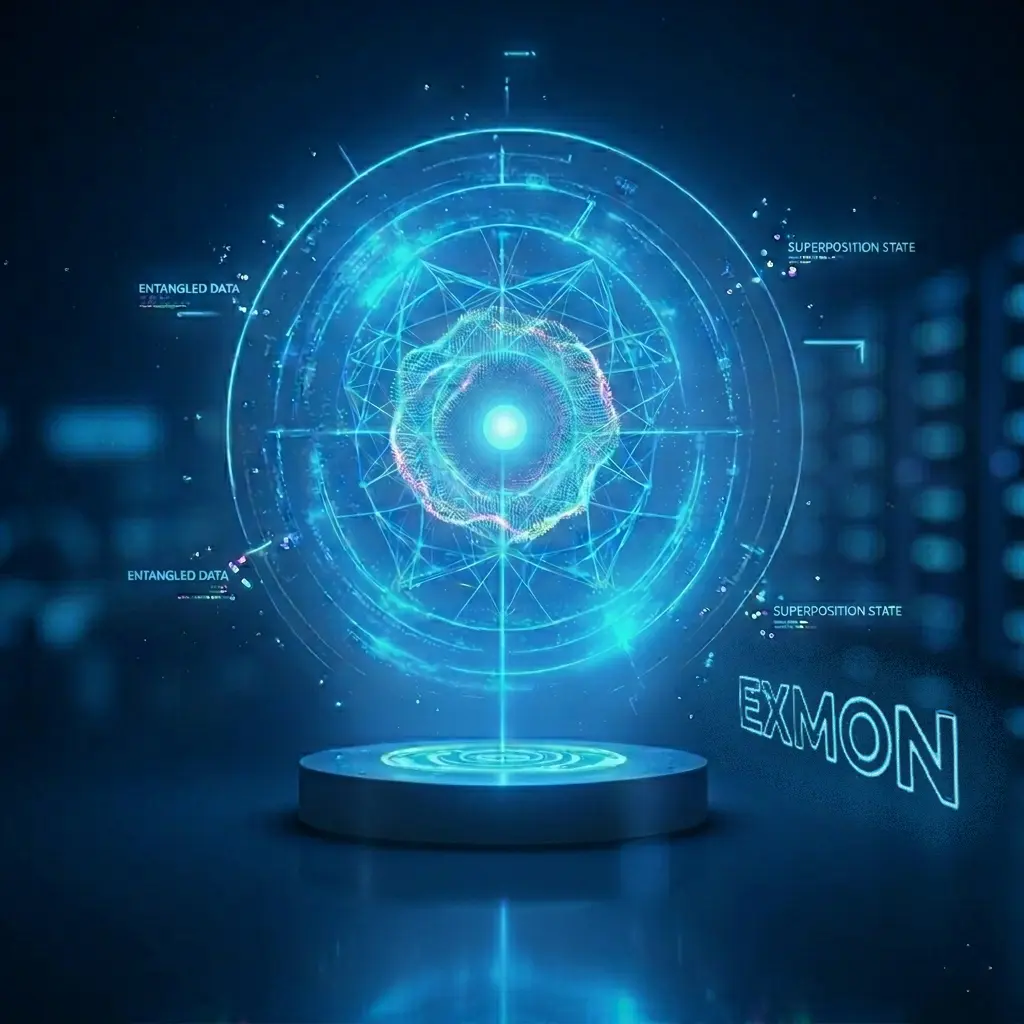
The "Quantum Apocalypse" in cryptography has been one of the most talked-about "bogeymen" in recent years. Marketers for new blockchain projects skillfully leverage the fear of the unknown to promote tokens labeled as "Quantum Resistant." But is the threat truly that imminent, or are we simply dealing with a well-orchestrated hype machine?
What is the "Quantum Threat" on Paper?
The theoretical danger lies in Shor's algorithm. This is a quantum algorithm capable of efficiently solving the integer factorization problem and the discrete logarithm problem.
Since modern cryptography (including Bitcoin and Ethereum) is built on ECDSA (Elliptic Curve Digital Signature Algorithm), it is widely believed that a sufficiently powerful quantum computer could derive a private key from its public counterpart.
Why is this being called a "bluff"?
- The Scaling Problem (Physical vs. Logical Qubits): Cracking a 256-bit ECDSA key doesn't just require a "powerful computer"; it requires a machine with roughly 10 to 20 million physical qubits. Currently, industry leaders are working with hundreds—or at best, a few thousand—qubits, which suffer from massive noise (error) levels.
- Decoherence: Quantum states are extremely fragile. Maintaining the stability of millions of qubits long enough to complete complex calculations is a technological barrier that might not be overcome even 20 years from now.
- Cryptographic Agility: Blockchains are code. If a real threat becomes tangible, major networks will simply execute a hard fork to implement Post-Quantum Cryptography (PQC) algorithms.
The Psychology of Selling "Quantum Tokens"
Projects positioning themselves as "Quantum-Proof" often rely on the following tactics:
- Sense of Urgency: "Your Bitcoin will be worthless in 5 years; switch to us now."
- Complex Jargon: Using terms like "Lattice-based cryptography" without explaining that it significantly slows down transactions and balloons the size of the blockchain.
- Closed Ecosystems: Often, these tokens have no intrinsic value other than their supposed "security."
The Practical Side: How Does it Actually Work?
If you want to understand what post-quantum protection looks like, you should look into Lattice-based or Hash-based signatures.
Example: Lamport Signature Scheme (Hash-based)
This is the simplest one-time signature that is quantum-resistant. It relies on the security of hash functions (like SHA-256), which quantum computers can only speed up marginally. Grover's algorithm only provides a quadratic speedup, which is easily countered by increasing the hash length.
Simplified logic in Python:
import hashlib
import os
# Generating a key pair for a single signature (Lamport Signature)
def generate_keys():
    # Generate 256 pairs of random numbers (the private key)
    priv_0 = [os.urandom(32) for _ in range(256)]
    priv_1 = [os.urandom(32) for _ in range(256)]

    # The public key consists of the hashes of these numbers
    pub_0 = [hashlib.sha256(x).digest() for x in priv_0]
    pub_1 = [hashlib.sha256(x).digest() for x in priv_1]

    return (priv_0, priv_1), (pub_0, pub_1)
# Simplified logic: this signature is Shor-resistant
# because quantum computers cannot efficiently invert SHA-256.
The Downside: This signature is massive in terms of data size, and a key can only be used once. This makes the technology almost impossible to use in today's mobile wallets.
Little-Known Facts About Quantum Resistance
- Bitcoin is already partially protected: If you don't reuse addresses (i.e., you send change to a new address after every transaction), your public key is never actually exposed to the network. The blockchain only stores the hash of the public key (H160). A quantum computer cannot calculate a private key from a hash. The public key is only revealed at the moment the transaction is broadcast.
- Grover's Algorithm: While it allows for brute-forcing symmetric keys and hashes faster, it's not instantaneous. For SHA-256, the complexity drops to 2^128. That is still absolutely unreachable for any known computing method.
- "Harvest Now, Decrypt Later" (HNDL): This is the only legitimate threat. Intelligence agencies might be recording your traffic today to decrypt it 15 years from now. However, for crypto tokens, this is largely irrelevant since the state of the ledger will be entirely different in 15 years.
Practical Tips for Users
- Don't Panic: If a project advertises "quantum protection" as its primary or only selling point, it’s likely a marketing trap.
- Practice Good Address Hygiene: Never use the same address twice. Not only does this improve privacy, but it also protects you from a hypothetical Shor’s algorithm attack by keeping your public key hashed.
- Keep an Eye on NIST: The U.S. National Institute of Standards and Technology has already selected finalists for post-quantum algorithms (e.g., CRYSTALS-Kyber, Dilithium). Major blockchains like Ethereum and Cardano are already testing these within their research departments.
- Verify the Signature Type: If a project is serious about being quantum-resistant, its whitepaper should mention specific implementations such as XMSS, BPQS, or Falcon.
The Anatomy of "Quantum Marketing": How to Spot the Hype
Marketers often rely on the "shock and awe" effect, throwing around physics terminology to dazzle users. However, if you dig a little deeper, most "quantum-secured" tokens turn out to be either basic forks of existing networks or projects using incredibly inefficient signing methods that effectively centralize the entire network.
Red Flags of a "Quantum Bluff":
- Lack of Peer Review: The project claims to have its own unique quantum-resistant algorithm, yet it hasn't been audited by cryptographers or submitted to the NIST competition.
- Excessive Node Load: Post-quantum signatures (such as lattice-based ones) can take up 10 to 50 times more space than standard ECDSA. If a project promises "millions of transactions per second" alongside "quantum protection," it’s likely sacrificing decentralization by forcing the network to run only on high-end, overpowered servers.
- Ignoring "Grover’s Algorithm": If developers only talk about Shor’s algorithm (breaking keys) but stay silent on Grover’s (weakening hashes), they either don’t understand the underlying math or are intentionally oversimplifying the situation.
Technical Deep Dive: Why Hashes Are Our "Silent" Saviors
Quantum computers are a major threat to asymmetric encryption—where public and private keys are linked by complex math—but they are surprisingly weak against standard hashing.
- Shor’s Algorithm: Reduces the difficulty of cracking RSA/ECDSA from exponential to polynomial (essentially instantaneous).
- Grover’s Algorithm: Only reduces the difficulty of finding a hash by half (it extracts the square root).
Mathematical Example:
If we have a hash function with a 256-bit security level (like Bitcoin), a quantum computer would reduce its strength to 128 bits.
2128
This is still a number that exceeds the estimated number of atoms in the observable universe. To return to the original level of protection, a network simply needs to upgrade to 512-bit hashes. This requires minimal code changes compared to the massive undertaking of building an entirely new blockchain.
Practical Example: Analyzing "Quantum-Proof" Code
If you look into the repository of a project that is genuinely implementing PQC (Post-Quantum Cryptography), you should see the integration of libraries like liboqs (Open Quantum Safe).
Here is an example of a transaction structure using Dilithium integration (one of the NIST finalists):
// Pseudocode for node-side verification logic
#include <oqs/oqs.h>
bool verify_transaction(uint8_t *message, size_t message_len, uint8_t *signature, uint8_t *public_key) {
    // Unlike standard ECDSA verification, this uses
    // a structure for Lattice-based cryptography
    OQS_SIG *sig = OQS_SIG_new(OQS_SIG_alg_dilithium_2);

    if (OQS_SIG_verify(sig, message, message_len, signature, OQS_SIG_dilithium_2_length_signature, public_key) == OQS_SUCCESS) {
        return true; // The transaction is legitimate
    }
    return false;
}
If the project's code only shows standard OpenSSL libraries or the good old secp256k1 without any additional layers, you're looking at a standard token wrapped in fancy marketing paper.
The Inside Track: The "Transition Period" Problem
The biggest risk isn't the quantum computer itself, but the transition period. If a powerful quantum computer were to emerge tomorrow, all "dormant" wallets—like Satoshi's coins and old addresses where the public key has already been revealed on the blockchain—would be instantly vulnerable to being drained.
New blockchains try to capitalize on this fear, saying, "Switch to us before it's too late." However, the reality is that:
- Major exchanges and custodians will be the first to implement "quantum filters."
- Bitcoin developers can implement a soft fork requiring transactions to be signed with new quantum-resistant methods to unlock old funds (a "Proof of Ownership" via new algorithms).
The Bottom Line on Quantum Bluffs
The threat of quantum computing is a long-term challenge for the entire internet infrastructure, not just crypto. But buying a token today just because it has the "Quantum" prefix is like buying a ticket to Mars from a company that hasn't even finished the blueprints for a rocket.
"Quantum Bridge" Risks: Where the Danger Truly Lies
When a project invites you to swap your "outdated" coins (like BTC or ETH) for their "secured" token via a Cross-chain Bridge, it introduces a major technical vulnerability.
The majority of these bridges operate on smart contracts using multi-signature (multisig) setups that rely on the exact same ECDSA or EdDSA algorithms. This creates a paradox: you are purchasing "quantum protection" by passing through a gateway that is itself vulnerable to a quantum attack. If a quantum computer cracks the bridge validators' keys, all your "protected" tokens become worthless because the collateral on the main network will have been stolen.
Alternative Reality: QKD (Quantum Key Distribution)
There is another layer of deception often found in marketing—claims of integrating Quantum Key Distribution (QKD) into a blockchain.
- The Core Technology: QKD uses the properties of photons to transmit a key. If anyone attempts to intercept the key, the quantum state of the photon changes, making the intrusion immediately detectable.
- Why this is a lie for tokens: QKD requires a physical fiber-optic channel between participants. It is physically impossible to implement a "quantum blockchain" over the standard internet and home PCs just by buying a token on an exchange. Any project promising QKD protection for your mobile wallet without specialized hardware is pure marketing fluff.
[Image of Quantum Key Distribution process]
How Blockchains Will Actually Defend Themselves (Without Buying New Tokens)
Instead of migrating to dubious new projects, existing industry giants will adopt a path of hybrid cryptography.
- Hybrid Signatures: A transaction is signed simultaneously with two keys—a classical one (ECDSA) and a post-quantum one (such as Dilithium). Even if one algorithm is compromised, the second maintains the security barrier.
- Commitment Schemes: Moving toward schemes where the public key isn't broadcast to the network at all until the moment of spending (similar to Bitcoin's address hashing), but utilizing longer hash functions like SHA-3 or BLAKE3.
- ZKP (Zero-Knowledge Proofs): Quantum-resistant zero-knowledge proof protocols (like STARKs) were originally designed to resist Shor’s algorithm because they are based on hash functions rather than elliptic curves.
Summary for Investors and Developers
If you encounter a new project with a "Quantum Resistant" slogan, ask the developers these three questions:
- What is the size of the signature and the public key? (If they are as small as ECDSA, it’s a red flag. PQC signatures are always significantly larger).
- Are you using NIST standards? (Custom, "homegrown" algorithms in cryptography are almost always security vulnerabilities waiting to happen).
- How do you solve the blockchain "bloat" problem? (Storing massive quantum signatures requires colossal resources).
The Verdict: Quantum computing is a serious scientific challenge, but for the crypto industry, it is more a matter of a scheduled software upgrade (like the transition from IPv4 to IPv6) than a reason to panic-buy "protected" shitcoins. Real protection will come through updates to the existing protocols you already use, not in the form of a new "miracle coin."
Summarize this blog post with: