
Let’s be real: every time Bitcoin maximalists or regulators start preaching about blockchain transparency, somewhere in the crypto underground, Monero (XMR) and ZCash (ZEC) maxis are quietly laughing. For the longest time, these two assets were treated as the ultimate digital offshore accounts—total black holes for financial tracking. "We’re untraceable," the community flexed.
But it’s 2026, and the rules of the game are being brutally rewritten. AI, heuristic models from Chainalysis and CipherTrace, and massive state-level computing power are now zeroing in on privacy chains. Lately, the space has been flooded with panic-inducing headlines like "AI completely cracks Monero" or "ZCash is compromised."
Is this legit, or just another coordinated FUD campaign to scare everyone off? Spoiler alert: the truth, as always, is buried deep in the code, the math nuances, and... human error. Let’s reverse-engineer this digital detective story byte by byte.
Privacy Architecture 101 (What the AI is Actually Trying to Crack)
Before looking at how AI attempts to "exploit" these networks, we need to understand how their defensive stacks work. To put it simply, their core philosophies are fundamentally different.
- Monero (XMR) relies on a "Privacy-by-Default" blueprint. It utilizes a stack of Ring Signatures, Stealth Addresses, and RingCT (Ring Confidential Transactions). When you ship XMR, the actual sender is masked within a group of "decoys," the transaction amount is encrypted, and the recipient's address is freshly generated for every single op. To any outside observer, the ledger looks like monolithic noise.
- ZCash (ZEC) opted for heavy moon-math: zk-SNARKs (Zero-Knowledge Succinct Non-Interactive Argument of Knowledge). These are zero-knowledge proofs. You can prove to the network that a transaction is valid and that you hold the funds without ever exposing the sender, receiver, or value. But there’s a massive catch: privacy on ZCash is optional. It uses transparent addresses (t-addresses) and shielded addresses (z-addresses). This split-world dynamic is its single biggest vulnerability.
How AI Attacks Monero: Statistical Surveillance and Decoy Exploits
Let's talk XMR first. Can AI brute-force Monero’s cryptography? No. As of mid-2026, there are no public quantum computers or LLMs/AI systems capable of snapping elliptic curves like twigs. If Chainalysis could just decrypt RingCT, they wouldn't be burning capital buying up heuristic analysis patents.
So, what is the AI actually doing? It's running timing analysis, link-graph mapping, and behavioral heuristics.
1. The Temporal Spend Attack
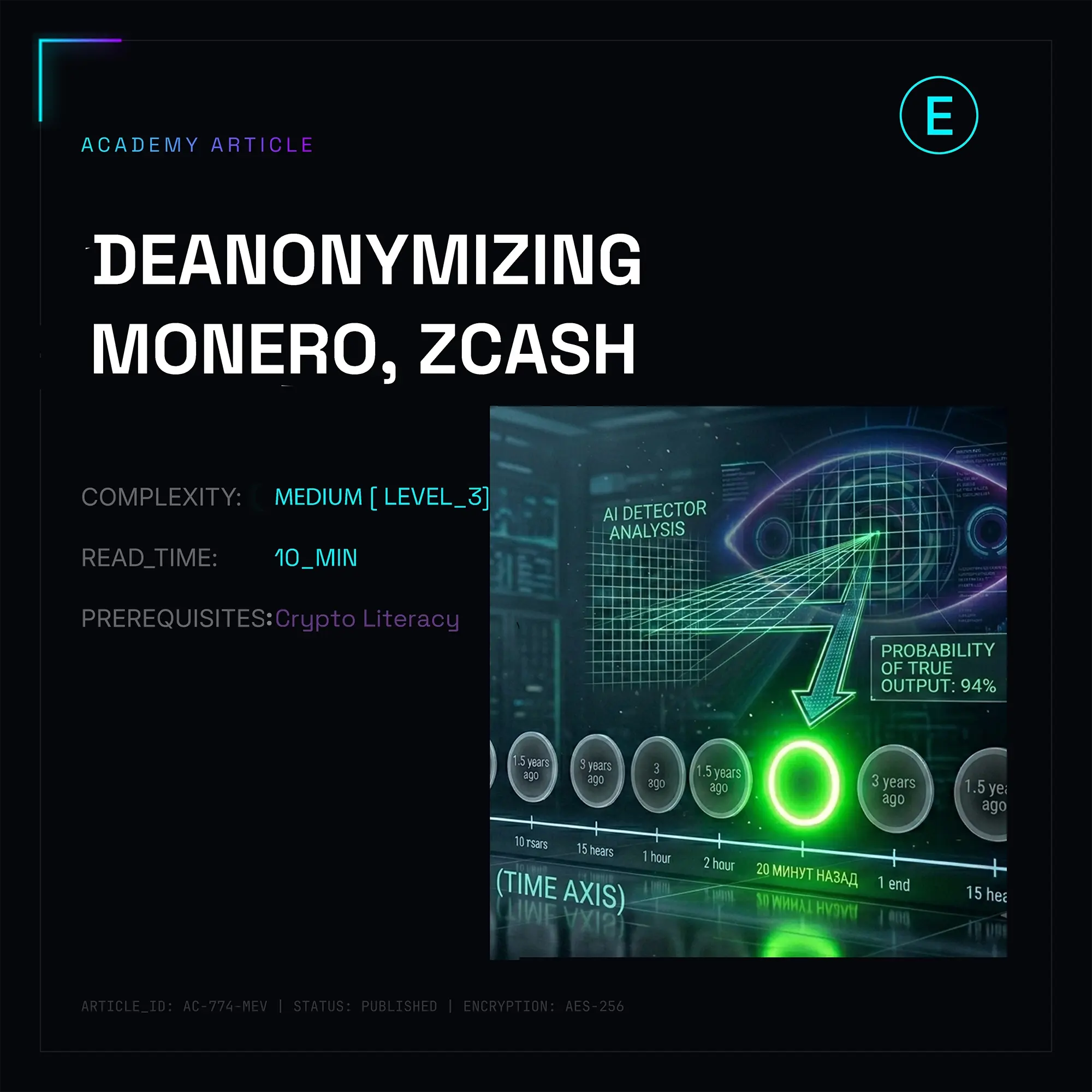
When you broadcast a Monero transaction, the protocol pulls 15 random outputs (decoys) from the ledger to mix with your real input (the ring size is currently set to 16). Historically, this selection process was too purely random. AI models trained on on-chain user behavior quickly picked up on a pattern: people usually spend coins shortly after receiving them. In the real world, assets rarely sit completely stagnant for years.
The AI analyzes the age distribution of the outputs inside a ring. If one output is "hot" (e.g., minted 20 minutes ago) and the other 15 are "ancient" (e.g., minted 3 years ago), the neural net flags the hot output as the true source with a 90%+ confidence interval. Did they break the math? No, they broke the distribution logic. Even though Monero core devs constantly tweak the decoy selection algorithm (gamma distribution), AI still sniffs out microscopic anomalies in block timings.
2. Graph Analysis and EAE (Eve-Alice-Eve) Attacks
This is a highly slept-on and dangerous attack vector. Imagine an exchange—whether a non-KYC instant swapper or a fully regulated fiat gateway—that is compromised or monitored by an analytical AI suite.
The Playbook: Alice withdraws XMR from an exchange to her self-custody wallet, and then, through a hop of transactions, sends those coins to Bob, who deposits them right back into the same (or a counterparty-linked) exchange.
The AI can't see what's happening under the hood of the Monero blockchain. But it maps the ingress and egress points—matching Alice’s withdrawal time and volume with Bob’s deposit time and volume. Using Recurrent Neural Networks (RNNs), the AI links these off-chain variables, accounting for network latency and mempool congestion. The result? Transaction linkability is reconstructed without cracking a single cipher. This is called black-box federated analysis.
ZCash’s Pain Points: Why AI Runs This Playground
With ZCash, the situation is even more critical. The underlying zk-SNARKs math is flawless, but user-behavior economics completely guts it.
Because shielded transactions demand significant computational overhead (especially on mobile wallets), the vast majority of network activity on ZCash remains either entirely transparent (t \rightarrow t) or mixed (t \rightarrow z or z \rightarrow t).
Blockchain analytics engines leverage what is known as structural pool analysis.
| Tx Type | Network Share (Est.) | AI-Analytics Risk Profile |
|---|---|---|
| t \rightarrow t (Fully Public) | ~65-70% | Extreme. Identical to Bitcoin. AI maps standard address clustering. |
| t \rightarrow z \rightarrow t (Round-Tripping) | ~20-25% | High. A user routes funds into a shielded pool and immediately off-ramps back to a public address. The AI correlates volumes (V_{in} \approx V_{out}) adjusted for network fees. |
| z \rightarrow z (Fully Shielded) | < 10% | Negligible. If a coin is minted in a z-address and settles in a z-address, the AI hits a brick wall. |
Essentially, AI uses machine learning to filter out the "noise" generated by the few private transactions occurring on-chain. If you enter a shielded pool with 1.5432 ZEC and 5 minutes later 1.5431 ZEC exits that pool to a t-address, the neural net doesn't even have to work hard—it's a 100% pattern match.
Hands-on: How AI Spots Anomalies at the Pool Level (Python Simulation)
Let’s take a look at how blockchain analytics firms actually leverage basic machine learning algorithms to fish for "hidden" links. We’re going to write a functional Python script that models transactions in a partially private network and runs an Isolation Forest to flag suspicious txs trying to mask their volumes.
You’ll need scikit-learn and pandas installed for this.
import numpy as np
import pandas as pd
from sklearn.ensemble import IsolationForest
# Simulating a fake transaction log for pool analysis
# Let's track: time between txs, change in input/output volume, and the network fee
np.random.seed(42)
# Normal transactions (regular network noise)
normal_tx = np.random.normal(loc=[120, 0.5, 0.001], scale=[30, 0.1, 0.0002], size=(500, 3))
# Anomalous transactions (someone trying to quickly cycle a fixed amount through a mixer/pool)
# Low time delta, almost identical output volume
anomalous_tx = np.random.normal(loc=[15, 0.002, 0.0009], scale=[5, 0.0005, 0.0001], size=(15, 3))
# Stacking everything into a single dataframe
data = np.vstack([normal_tx, anomalous_tx])
df = pd.DataFrame(data, columns=['time_delta_sec', 'volume_difference', 'fee'])
# Training an Isolation Forest model to flag suspicious mixing patterns
# 'contamination' sets the expected percentage of anomalies in the dataset
model = IsolationForest(contamination=0.03, random_state=42)
df['anomaly_score'] = model.fit_predict(df[['time_delta_sec', 'volume_difference', 'fee']])
# The model flags anomalies as -1, and normal transactions as 1
anomalies_detected = df[df['anomaly_score'] == -1]
print(f"[!] Scan complete. Suspicious patterns detected: {len(anomalies_detected)}")
print("\nSample AI-flagged anomalies (rapid transit with near-zero volume change):")
print(anomalies_detected.head())
This script is a bare-bones look at how AI scans mempools and blocks. Real-world, commercial intelligence platforms chew through terabytes of these data vectors, factoring in node geography, wallet fingerprints, and even transaction propagation delays across the P2P network.
Metadata and Human Error: Where AI Doesn’t Even Have to Try
But wait—why even bother trying to break cryptography when users hand over their entire hand on a silver platter? This brings us to the most painful topic: off-chain metadata. AI shines brightest when it can ingest massive, messy datasets that a human could never manually cross-reference.
The Networking Layer and Propagation Timing Attacks (Dandelion++ in the Crosshairs)
Yes, Monero has Dandelion++ baked in to obscure the IP address of the node originating the transaction. The core idea is that a transaction first travels along a linear "stem" from one node to another before it finally "fluffs" out to the wider network.
But how does modern AI monitoring counter this? Feds and blockchain intelligence giants spin up thousands of their own "honest" nodes across the globe (classic Sybil attacks). A neural network then analyzes the millisecond-level propagation delays as a tx hits these compromised nodes in real time. It builds a probabilistic heatmap:
[Originating IP] ---> (Node 1) ---> (Node 2) ---> (Node 3)
                        \             /             /
                         v           v             v
                      [Global AI Intercept System]
Machine learning maps the network graph and pinpoints the tx's entry point down to a specific region, and sometimes even the ISP. The math behind a ring signature does absolutely nothing to protect your IP address here.
Wallet Fingerprinting
Every crypto wallet app (the official GUI, CLI, Feather Wallet, Cake Wallet) constructs transactions slightly differently. They have different default fee structures, distinct decoy-selection logic, and unique ordering of elements within the tx payload.
AI classifiers can easily fingerprint the exact software you're running. Why does that matter? Well, look at it this way: if analysts know you're using a niche, custom wallet build on Linux, the suspect pool shrinks from the entire network down to a couple hundred people.
Fact or Fiction? The Final Verdict for 2026
So, what's the bottom line? Is privacy dead?
- It’s fiction if: you define "cracked" as mathematically decoding the ledger. No, nobody can open a Monero explorer, plug in a tx hash, and read: "Alice sent Bob 5 XMR." The cryptographic wall is holding strong.
- It’s fact if: we're talking about de-anonymization through context and behavior. AI has shifted blockchain analysis from a rigid math game to a game of probabilities. And in this game, regulators hold a massive edge because they sit on mountains of Big Data (KYC exchange logs, ISP records, leaked databases).
TL;DR: AI isn't cracking Monero or ZCash. AI is cracking the users by mapping the digital crumbs left around their transactions.
The Paranoid’s Checklist: How to Fight Back Against AI Analytics
If your opsec absolutely depends on keeping your txs private from trained neural networks, basic "copy-paste an address" habits won't cut it anymore. You need strict data hygiene.
- For ZCash: Forget t-addresses even exist. Seriously. If a coin touches a transparent address even once, the AI starts building a trail. Stick exclusively to z \rightarrow z transactions.
- For Monero: Counter timing attacks. Do not bounce funds immediately after getting them. Let them sit in your wallet for a random amount of time—a day, three days, five hours. Break the clean patterns that neural networks train on.
- Networking Layer: Never boot up your wallet without forcing your traffic through Tor or I2P. Better yet, route it at the OS level (or run Tails/Whonix) to prevent DNS leaks or ping packets from escaping outside the proxy.
- Break Up Volumes: Avoid round numbers and rapid-transit behavior. If you deposit 1,000 USDT into the ecosystem, swap it for XMR, move it to a clean wallet, and immediately cash it back out into 1,000 USDT, you are the ultimate textbook target for the Isolation Forest algorithm we built above.
The future of privacy isn't a battle of ciphers versus processors. It's a war of attrition between your operational discipline and the learning capacity of someone else's neural network.
UFJQQ