
By 2026, the financial landscape had finally ceased to be a battlefield reserved solely for fundamental and technical analysts. Taking center stage were prediction markets — platforms where the “wisdom of the crowd” is aggregated and packaged into liquid financial instruments. Today, these are no longer just places to bet on elections or the weather, but one of the most powerful leading indicators for professional traders and strategists.
1. Why did 2026 become the era of “event hedging”?
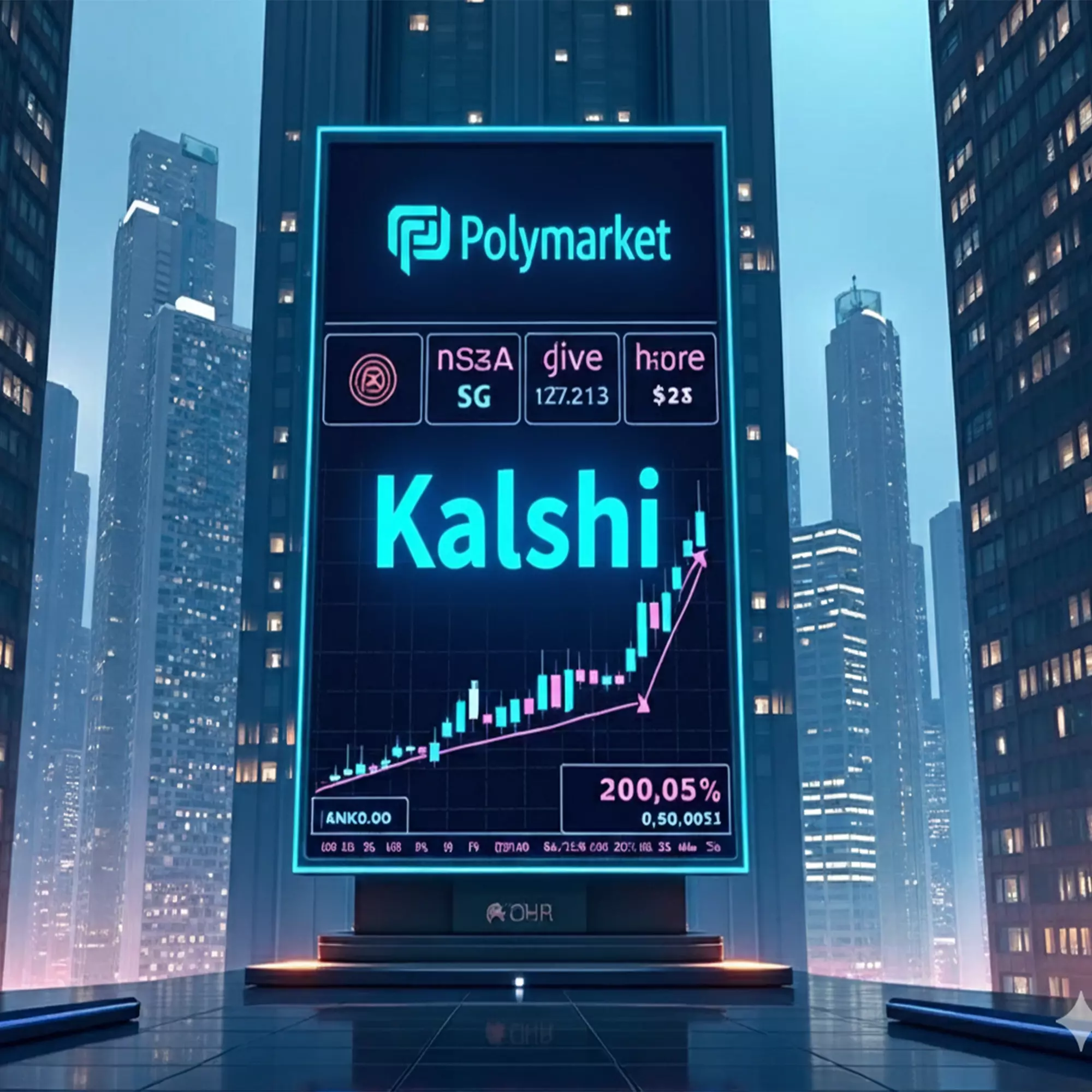
Traditional markets are often slow to react. While analysts at Goldman Sachs are still publishing reports and algorithms are parsing Bloomberg headlines, prediction markets (such as Polymarket, Kalshi, or Interactive Brokers’ ForecastTrader) have already “priced in” the information through the wallets of thousands of participants.
The core principle: A price on a prediction market is a direct expression of probability. If a contract like “Candidate X wins” or “The Fed cuts rates in March” trades at $0.65, it means the market assigns a 65% probability to that outcome.
2. Practical value: prediction markets as a leading indicator
For an analyst in 2026, a key skill is identifying divergence — a mismatch between futures/equities and the implied probabilities on prediction markets.
Case study: interest rates and inflation
Instead of waiting for CPI data, professionals look at Kalshi. If the probability of “CPI above 2.5%” spikes while Treasuries haven’t started selling off yet, that’s your early entry signal.
The analyst’s toolkit:
- Sentiment analysis via liquidity: Unlike surveys, where respondents may lie or posture, Polymarket participants vote with real money. Heavy volume at a stable price signals a “high-conviction” market view.
- Event arbitrage: Comparing implied probabilities across platforms. If Manifold Markets (play money) shows a 70% probability while Polymarket (real money) prices the same event at 55%, dig deeper. Insider information often leaks first onto decentralized venues.
3. Technical implementation: pulling data via API
To use this data professionally, it needs to be integrated into your terminal or trading software. Below is a Python example showing how to fetch current probabilities from Polymarket (the liquidity leader for event contracts in 2026).
import requests
import pandas as pd
def get_polymarket_odds(market_slug):
    """
    Fetches current probabilities (prices) for a specific market.
    By 2026, Polymarket’s CLOB API had become the de facto standard.
    """
    url = f"https://clob.polymarket.com/markets/{market_slug}"
    try:
        response = requests.get(url)
        data = response.json()

        # In 2026, contracts are binary: Yes / No
        # A price of 0.75 = 75% implied probability
        yes_price = data.get('tokens')[0].get('price')
        no_price = data.get('tokens')[1].get('price')

        return {
            "Event": data.get('description'),
            "Prob_Yes": float(yes_price),
            "Prob_No": float(no_price),
            "Volume_24h": data.get('volume_24h')
        }
    except Exception as e:
        return f"Error fetching data: {e}"
# Example: Fed rate decision at the next meeting
market_id = "fed-interest-rate-cut-march-2026"
odds = get_polymarket_odds(market_id)
print(f"Probability of a rate cut: {odds['Prob_Yes'] * 100}%")
4. Lesser-known features and mechanics of 2026
- UMA oracles and dispute resolution: Few people realize that outcome verification on decentralized prediction markets is handled not by site administrators, but by a distributed network of token holders (for example, via the UMA protocol). This largely eliminates platform-level manipulation.
- Information asymmetry and “dark events”: In 2026, markets emerged around “AI system failures” or “clinical trial outcomes for specific drugs.” Big pharma quietly uses these markets to hedge risk. If you see abnormal volume flowing into a market like “Drug X fails FDA approval” while the stock is rallying, that’s a red flag.
- Conditional markets: This is the highest level of sophistication. “If event A happens, what is the probability of event B?” For example: “If oil breaks $100, does the probability of Country Y default increase?” These markets allow for complex correlation modeling that traditional analysis simply can’t replicate.
5. Practical usage tips
- Look for fat tails: Prediction markets often underestimate low-probability but catastrophic outcomes. If a market assigns 1% to an event you consider entirely plausible (a true black swan), buying “cheap” No shares can be one of the best hedges in your portfolio.
- Use them as a news filter: In the deepfake-driven media environment of 2026, headlines spread instantly. When you see a shocking story, check Polymarket first. If the relevant outcome price hasn’t moved, the news is likely fake. Money doesn’t lie.
6. Deep Analytics: Correlation Between Prediction Markets and Traditional Markets
In 2026, professionals use a metric called Prediction-Equity Gap. It measures the difference between the implied probability of a company's success on prediction markets and its market capitalization.
How it works in practice:
Imagine a company called QuantumDrive, claiming a breakthrough in solid-state batteries.
Stock Market: Shares jump 15% on the news.
Prediction Market: The contract "Will QuantumDrive deliver a working prototype by year-end?" trades at $0.30 (30% probability).
Takeaway: Insiders and experts on the prediction market (often more technically informed than the average retail investor) are skeptical. This is a classic Short or exit signal.
7. Advanced Toolkit: Building a Probability Density Function
Unlike binary options, prediction markets allow you to construct entire expectation curves. Platforms like Polymarket or Insight often open a series of markets over value ranges (e.g., BTC price at the end of 2026: <$50k, $50k-$100k, $100k-$150k, etc.).
Mathematical approach:
Analysts use this data to calculate expected value ($EV$). Instead of relying on a single bank’s point estimate, you sum probabilities:

Where P is the contract price (probability) and V is the value of the range. This provides a more precise "anchor" for fair asset valuation than traditional forward P/E.
8. Lesser-Known Aspect: Futarchy in Corporate Governance
By 2026, leading DAOs (decentralized autonomous organizations) and even some tech startups began integrating elements of futarchy — Robin Hanson’s idea: “vote on values, bet on the best strategy.”
Concept: A company opens an internal prediction market for employees: "Will our revenue increase if we fire the CEO?"
Analyst Practice: Accessing internal prediction market data (or public equivalents for large corporations) gives you the collective intelligence of employees, who often see company issues months before official reports.
9. Risks and "Traps" of Prediction Markets
Despite their effectiveness, prediction markets have specific vulnerabilities that are important to know in 2026:
Liquidity Manipulation (Wash Trading): On low-liquidity markets, large players can artificially inflate contract prices to create false confidence or influence public opinion and algorithmic feeds.
Echo Chamber Effect: If market participants consume the same media and rely on identical LLM models for analysis, the "wisdom of the crowd" turns into "madness of the crowd." In 2026, this is often called Model Collapse.
Legal Status: Even though legal in many jurisdictions, regulators (SEC, CFTC) can still block certain markets, causing price spikes due to liquidity outflows.
10. Code Example: Arbitrage Bot (Concept)
To detect inefficiencies between a decentralized platform (Polymarket) and a centralized one (Kalshi), analysts use real-time price comparison scripts.
import time

def check_arbitrage(poly_price, kalshi_price, threshold=0.05):
    """
    Detects discrepancies in probabilities for the same expiry date.
    threshold: 5% difference is enough to investigate.
    """
    diff = abs(poly_price - kalshi_price)
    if diff > threshold:
        print(f"!!! Arbitrage window detected: {diff*100:.2f}%")
        if poly_price > kalshi_price:
            print("Action: Sell on Polymarket, Buy on Kalshi")
        else:
            print("Action: Buy on Polymarket, Sell on Kalshi")
    else:
        print("Markets are in sync.")

# 2026 data simulation
while True:
    # In reality, this would call APIs
    poly_p = 0.62  # Event probability on Poly
    kalshi_p = 0.54 # Probability of the same event on Kalshi
    check_arbitrage(poly_p, kalshi_p)
    time.sleep(60) # Check every minute
Conclusion: How to Become a Next-Gen Analyst
To dominate in 2026, stop treating prediction markets like a "casino." They are a layer of informational reality.
Your checklist for tomorrow:
- Open accounts on Polymarket (Web3) and Kalshi (Regulated).
- Add event contract price widgets next to charts of related stocks/currencies.
- On any sharp price move, look for confirmation on prediction markets. If the asset price drops but the probability of a negative event on Prediction Markets does not rise, that’s "noise" and a buying opportunity.
Summarize this blog post with: