
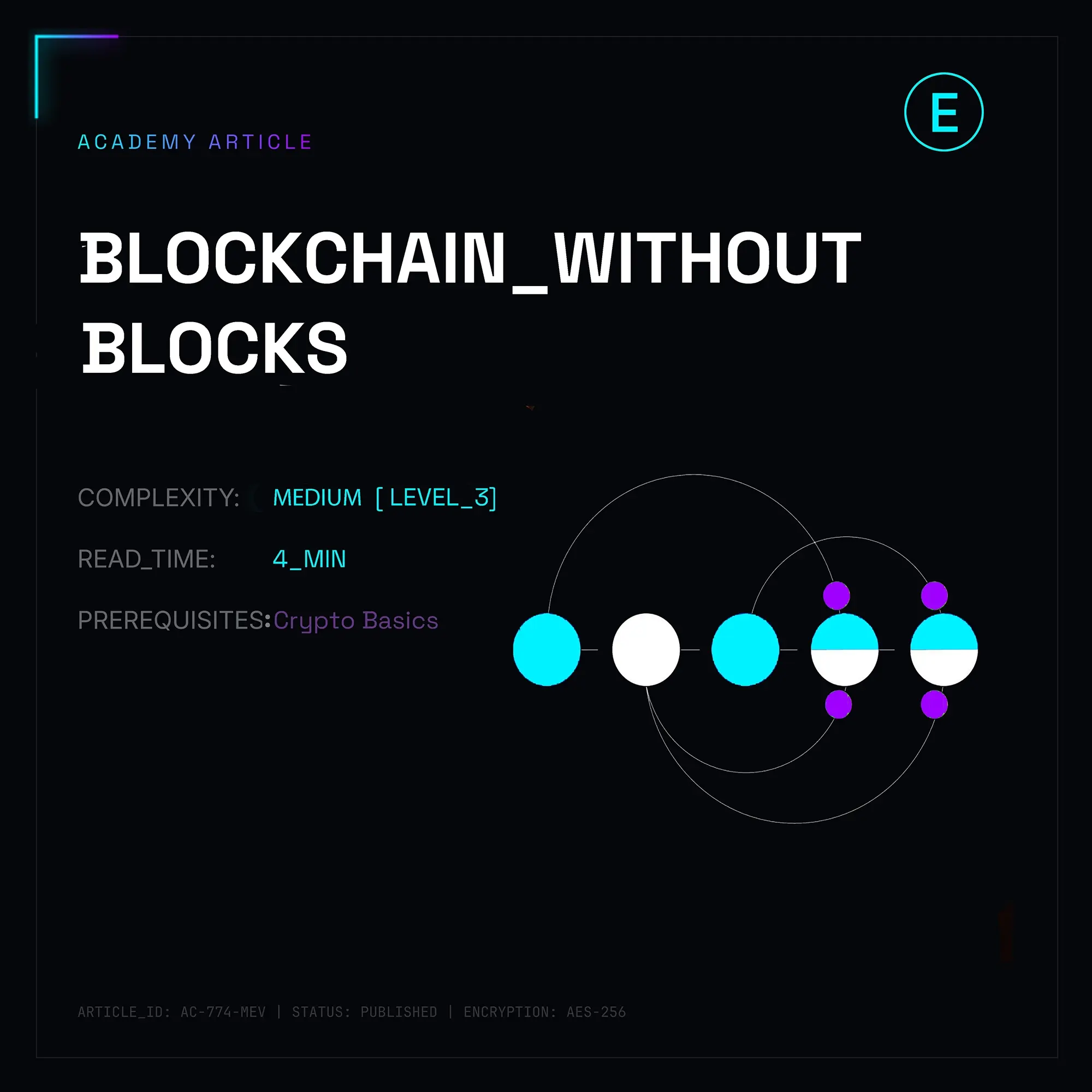
DAG (Directed Acyclic Graph) is an alternative data structure to traditional blockchains. Instead of queuing up transactions into blocks, DAGs let transactions confirm each other directly in a web-like mesh—delivering instant, practically fee-less transfers.
Think of it like this: instead of waiting for a bus (where the block is the bus capped at 500 people, and a ticket costs $10), every passenger just jumps in their car and carpools two other people. The more traffic on the road, the faster everyone gets where they're going. That’s a DAG in a nutshell.
How It Differs from Legacy Networks
Legacy networks like Bitcoin or Ethereum force you through a massive bottleneck. A blockchain is basically a rigid freight train where cars are hitched strictly one after another. High traffic? Prepare to get wrecked by insane $50–$100 gas fees just to move some USDC, or watch your transaction rot in the mempool for hours.
DAGs ditch blocks entirely. It's all vertices and directed edges. When you send $5 to a buddy, your system simultaneously validates two prior transactions from other users. You literally become a validator yourself.
This is where the brutal engineering trade-offs kick in.
It sounds like the holy grail, so why hasn't the entire crypto space migrated to DAGs yet? Because trading away fees and speed limits means inheriting absolute node-synchronization hell under the hood.
The Double-Spend Problem and Dirty Workarounds
Blockchains keep it simple: block #100 is followed by #101. History is strictly linear. In a DAG, transactions fly in asynchronously from across the globe, and the graph spreads like wild mold. That's where the ultimate final boss emerges: Double Spending.
If an attacker broadcasts the exact same $1,000 to an Asian node and an American node at the exact same millisecond, the DAG won't immediately know which branch is legit. The edges haven't intersected yet!
Engineers tackle this using bloody hacks and brute force:
- IOTA (Tangle architecture): Relied on the "Coordinator" for years—a centralized server acting as a crypto helicopter mom to dictate which branch was official. Without it, the network would get utterly clobbered by spam attacks. Deprecating this crutch took forever because decentralizing an asynchronous graph without tanking throughput is a mathematical nightmare.
- Kaspa (GHOSTDAG): Instead of ditching blocks, they allowed them to be minted in parallel (up to 10 blocks/sec). Their algorithm topologically sorts these blocks on the fly, turning pure entropy into an ordered chain without forfeiting parallel block rewards.
- Nano: Gave every account its own personal blockchain (block-lattice). You write your own ledger history, and the rest of the network only chimes in to vote when someone tries to pull a fast one.
Head-to-Head: Blockchain vs. Directed Acyclic Graph (DAG)
To break it down, here’s how the raw numbers and underlying mechanics stack up:
| Parameter | Traditional Blockchain | Directed Acyclic Graph (DAG) |
|---|---|---|
| Structure | Single-lane highway packed with semi-trucks | Unmarked multi-lane superhighway with parallel traffic |
| Transaction Fees | Spikes through the roof during congestion | Approaches absolute zero (no greedy miners to feed) |
| MEV & Bot Exploits | Sandwich attacks siphon millions from traders | No global mempool means front-running is basically dead on arrival |
| Hardware Requirements | Standard SSD and a mid-range CPU | Brutal RAM and bandwidth bottlenecks (the graph must live in memory) |
Real Risks DAG Maximalists Don't Talk About
Let's take off the rose-colored glasses for a second.
Network Partitioning: If an undersea fiber cable snaps between the US and Europe, a DAG network will happily keep processing transactions on both sides, splitting into two independent graphs. But once connectivity is restored, merging those massive parallel structures triggers a validation storm violent enough to blow out low-spec nodes from memory starvation.
Then there's smart contracts. Ethereum executes transactions sequentially: Step A, then B, then C. That's ideal for DeFi composability. On a DAG where transactions settle asynchronously, trying to run a complex multi-leg Uniswap arbitrage loop is like trying to solve a Rubik's cube during a major earthquake.
Where DAG Actually Shines
DAG wasn't built to crush Ethereum or steal its DeFi ecosystem. It’s tailored for microtransactions, IoT telemetry between autonomous fleets, or gaming bots spamming sub-cent state updates. Whenever you need to throw around fractions of a penny in milliseconds with zero overhead, traditional blockchains choke while DAGs glide effortlessly.