

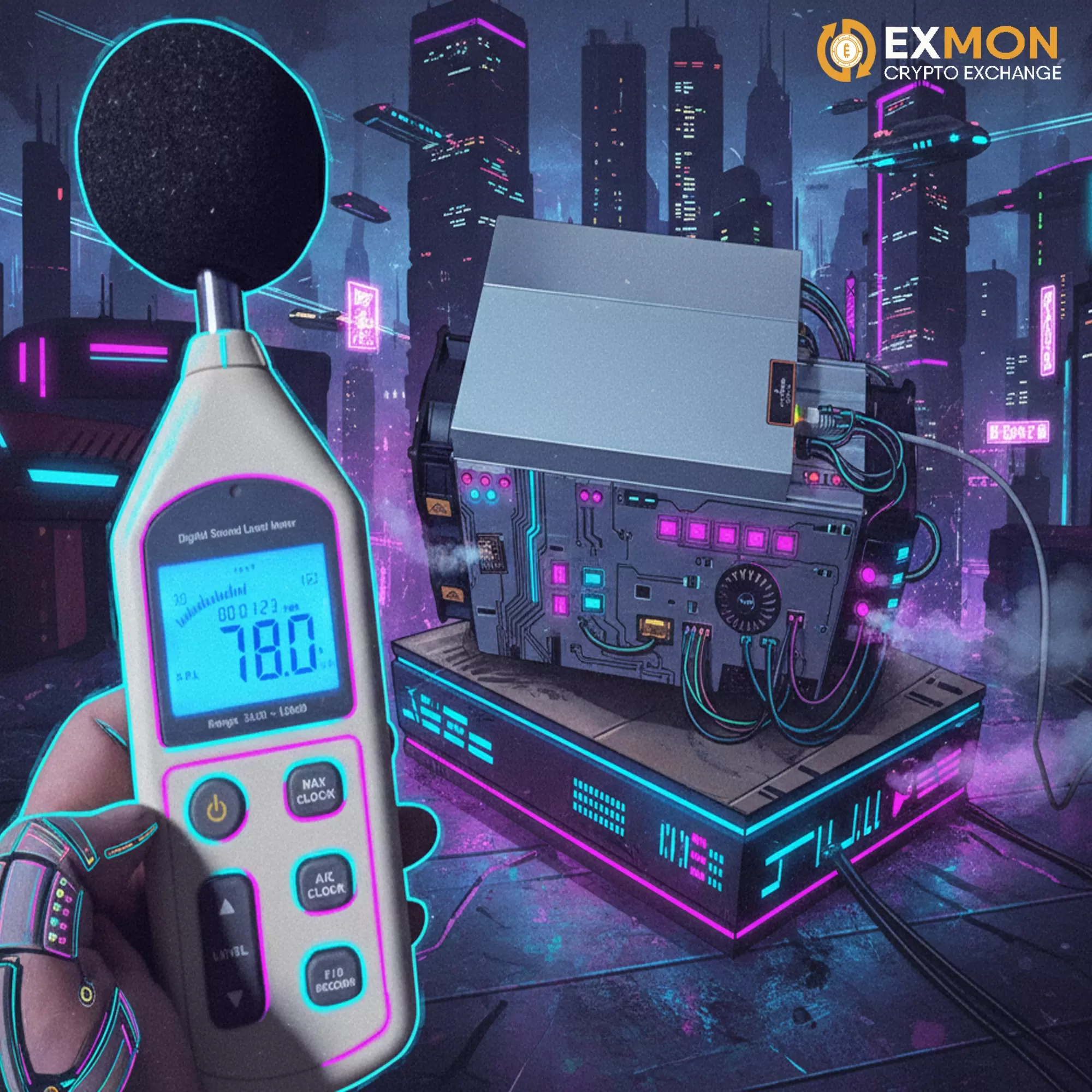
If our first article sparked the idea of using mining as a home heating solution, now it’s time to pick up the tools. The main headache with any ASIC miner is the high-pitched whine of fans spinning at 6000+ RPM. A proper noise suppression box (noisebox) isn't just about locking the device in a crate; it’s about letting it "breathe" while cutting off the sound waves.
1. The Golden Rule: The "S-Curve Labyrinth"
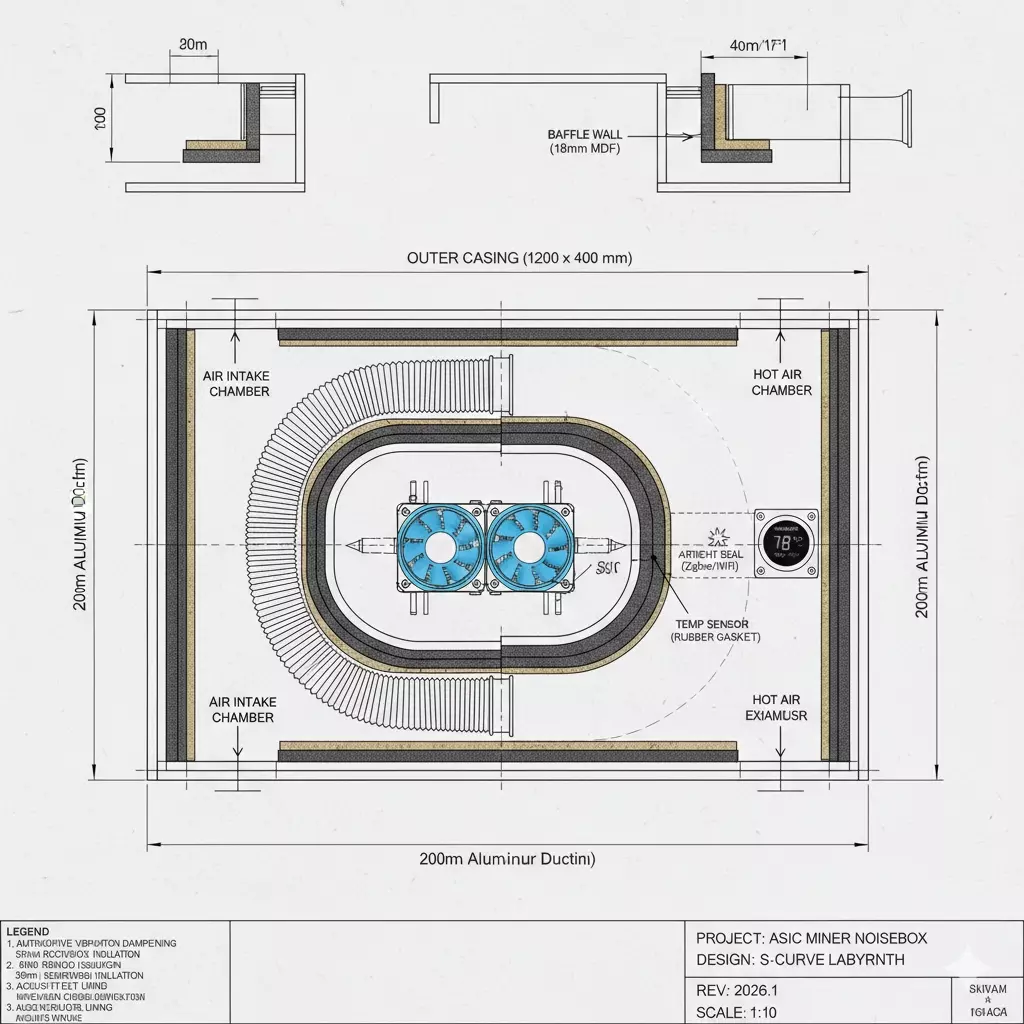
Sound is a wave; air is a flow. A sound wave dissipates when it hits an obstacle, but airflow can be forced to go around corners. A proper 2026-spec noisebox is built on the dual-chamber labyrinth principle.
Conceptual Layout:
[Air Intake] --> [Chamber 1: Silencer] --> [ASIC] --> [Chamber 2: Silencer] --> [Hot Air Exhaust]
      |                   /                         |                 \                  |
      |________[Baffle Wall]________________________|________[Baffle Wall]_______________|
Important: The total cross-section of the air channel inside the box should be 1.5–2 times larger than the ASIC fan diameter (minimum 200 mm for a 120 mm fan) to avoid air resistance and overheating.
2. Choosing Materials: The 2026 Budget
Forget about standard acoustic foam—it’s flammable and does a poor job of dampening low frequencies. Before buying materials, make sure to check the overall crypto heating economics to ensure your silencer box investment fits your ROI goals.
| Material | Purpose | Est. Price |
|---|---|---|
| MDF / Plywood (18-22 mm) | Dense enclosure for sound reflection | $40 - $60 |
| Mineral Wool (50 mm) | Sound wave absorption (Non-combustible!) | $20 |
| Acoustic Felt | Finish layer to prevent fibers from entering chips | $15 |
| Vibration Dampening (Automotive) | Lining the walls to kill chassis vibrations | $25 |
| Aluminum Ducting (200 mm) | Heat venting to a window or heating system | $15 |
| Sealant & Screws | For airtight joints | $10 |
Total: Around $125 - $150 for peace and quiet at home.
3. Step-by-Step Assembly
Step 1: Building the Frame
Build a long box out of MDF (typical dimensions: 120 cm long, 40 cm wide, 45 cm high). Install two internal baffles to create that "labyrinth" effect.
Step 2: Vibration and Sound Insulation
- First, apply a layer of automotive vibration dampening (butyl sheets) to the inner walls. This eliminates low-end hum.
- Mount the mineral wool (Rockwool) on top.
- Critical: Cover the wool with dense acoustic felt or a vapor barrier. If you skip this, micro-particles of glass/stone will get sucked into the ASIC and kill it over time.
Step 3: Flow Separation ("Cold" and "Hot" Zones)
There must be a partition inside the box with a cutout specifically for the ASIC’s face. The miner is inserted into it through a gasket. This ensures that hot exhaust air isn't recirculated back into the intake.
4. Airflow Math and "Safe Ducting"
Pro-tip for avoiding rookie mistakes: don't use thin 100-125 mm ducting.
Physics 101: An ASIC pushes about 400-600 cubic meters of air per hour. If the duct is too narrow, backpressure builds up. Fans work harder, noise increases, and cooling performance drops.
Recommendation: Stick to 200 mm diameter ducting. If you need to vent the heat far away (over 3 meters), install an auxiliary inline fan (like a Soler & Palau Silent) to "help" the ASIC push the air out.
5. Safety and Monitoring
A noisebox is an enclosed space. If an ASIC fan fails, the device will fry in minutes.
- Temp Sensor: Place an external sensor (Zigbee/Wi-Fi) in the "hot" chamber.
- Automation: Set up a Home Assistant script: "If box temperature > 75°C, kill the smart plug power." This is crucial for any DIY crypto-based home heating system to prevent fire hazards.
YAML
# Safety Automation Example
trigger:
  - platform: numeric_state
    entity_id: sensor.box_out_temp
    above: 75
action:
  - service: switch.turn_off
    target:
      entity_id: switch.asic_main_power
Summary
A properly built noisebox can drop noise levels from 80 dB to 40 dB. That’s the difference between "unbearable" and "background AC hum."
However, if a bulky box doesn't fit your interior, you should consider immersion cooling for your home miners as a more compact 0dB alternative. In our next article, we’ll dive into "wet" mining: “Immersion Cooling: A Guide to Building Your Home Mining Bath.”
Crypto Heating Series 2026: Part 2 of 5
Summarize this blog post with: