


VCs and Web3 marketing departments have pulled off the greatest heist in tech history: they sold us cryptographically audited distributed databases and called them sovereign blockchains. They brainwashed us into believing that as long as transactions are packed into hashed blocks and signed with private keys, the system magically becomes part of the decentralized future. It’s total BS. Looking at Hyperliquid and the rampant trend of projects launching "their own L1/L2 appchains," it’s painfully obvious how the industry did a complete u-turn right back to Web2 infrastructure—just wrapped in a trendy cryptographic mask.
Let’s dissect what the industry currently hypes up as "high-performance Appchains" and expose exactly how we're being played.
Anatomy of a Hoax: Where Did the Smart Contracts Go?
The technical core of platforms like Hyperliquid is built completely differently from Ethereum, Solana, or even Cosmos-based networks. In the classic sense, a blockchain is a general-purpose distributed virtual machine (like the EVM) that sequentially or concurrently executes arbitrary bytecode from user-deployed smart contracts. On Hyperliquid, smart contracts serving the core trading engine literally do not exist.
The entire business logic of the exchange—the order book (Central Limit Order Book), margin calculations, the liquidation engine, and PnL distribution—is hardcoded directly into the node's compiled binary. It’s just a standard monolithic Rust backend. The developers built a specialized state machine (Deterministic State Machine) where, instead of the flexible programmatic logic of smart contracts, you get a strictly hardcoded set of transaction types:
OrderCancelDepositWithdraw
Of course, it’s lightning fast. The system doesn't waste CPU cycles parsing bytecode, managing dynamic memory allocations within a VM, or calculating gas limits for every single instruction. Validators are just pushing structured binary data straight through the bare metal. But calling this a blockchain platform is pure technical illiteracy. What we actually have here is a distributed exchange backend whose functionality is completely locked down by its creators.
Later on, sure, they slapped on an EVM-compatible layer for third-party dApps just to ride the hype train. But the core execution environment is totally isolated from that sandbox; otherwise, a single buggy smart contract for some random token would instantly tank the performance of the entire exchange.
The Illusion of Decentralization on 24 Servers
A blockchain without decentralization is technically dead on arrival. Strip that away, and the entire overhead of hash chains, cryptographic signatures, and consensus mechanisms turns into a bloated, inefficient mess that does nothing but burn resources. Why do you need a complex Byzantine Fault Tolerant (BFT) algorithm when the network topology is controlled by a closed pool of just two dozen validators?
The answer is simple: to stop the whales and cartel members from backstabbing each other in the dark.
On the Hyperliquid network, active validation and block signing are handled by barely over twenty nodes. It’s a closed club. You can’t just clone the repo, spin up a node on your own rig, and natively join the consensus as the 25th peer. The validator set is heavily gated, and voting power is tied to token stake allocation—the lion's share of which is directly or indirectly controlled by the core team and affiliated market makers.
With this kind of topology, the mathematical consensus of HyperBFT isn't protecting the average user from an exchange rug pull. It’s protecting the institutional cartel members from each other. If five competing high-frequency trading (HFT) firms run servers inside this consortium, they use the blockchain protocol as a trustless referee: no one can frontrun someone else's order in the book or forge transaction logs on their own server without the rest of the nodes rejecting the bad block. For them, it’s a technical arbiter. But to an outside user, this system is a centralized monolith.
If 2/3 of this private club (the threshold for an attack in BFT networks) gets hit with a regulatory subpoena or simply decides to collude for astronomical profits, they can rewrite the database state however they want. Retroactively. Freezing any address they choose. And no amount of cryptography is going to stop them.
The Bridge Trap: How You Lose Absolute Ownership
The myth that you "always control your private keys" in these types of networks shatters the moment it hits the harsh reality of cross-chain architecture. Hyperliquid exists in a vacuum; it has no direct rails to fiat or Ethereum's native liquidity. To start trading, a user has to fire off a transaction on Arbitrum, sending their actual, liquid USDC tokens to a bridge smart contract address.
From that exact moment, your actual ownership is effectively liquidated.
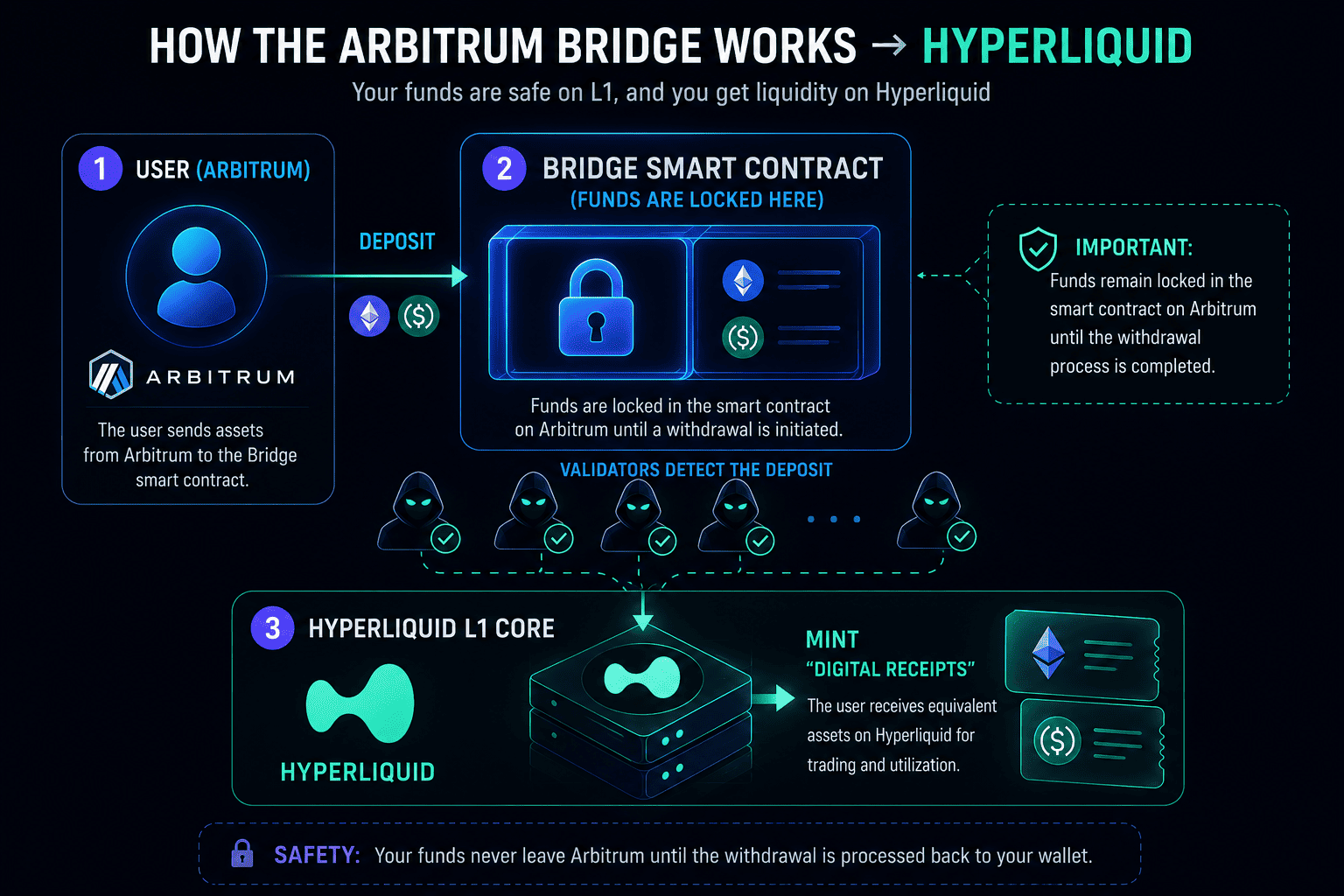
Your real dollars are sitting on the balance sheet of a smart contract on an entirely different network. Hyperliquid's validators simply log this event and increment a number in their own database, minting an internal equivalent. You are trading IOUs. Paper claims. When you hit that withdraw button, you are pitching a request to a closed server pool. They must collectively sign off on the transaction to instruct the contract on Arbitrum: "Give this guy his real USDC back."
If this cartel decides to block or ignore your transaction, your funds are stuck on Arbitrum forever. You have zero technical leverage to force their hand, because the keys to the vault belong to the 24 people running the node infrastructure. It is pure custody, just wrapped in the fancy marketing speak of "native bridging."
Economic Incentives as Fake Security
The only thing keeping this whole setup from instantly collapsing into an outright rug pull is game theory mixed with massive, legitimate cash flows. For the validator owners, stealing your money is simply bad business. The exchange prints millions of dollars in pure profit from trading fees, and the market cap of the network's native token is in the billions.
If the cartel ever pulled an exit scam and drained the bridge contracts, the news would break instantly. The mathematical continuity of the blocks would turn against them: the discrepancy in balances and signatures would be glaringly obvious to any external observer within a block time. Trust in the platform would crater, the token would dump to zero, and a multi-billion-dollar business would turn into a pumpkin overnight. Validators play by the rules not because the code binds them, but because collecting a perpetual tax from retail traders is vastly more lucrative than a one-time heist.
It is a textbook market-driven collusion. Tech-enforced honesty has been swapped out for basic pragmatism.
Sovereignty or Marketing Oxymoron
By spinning up "their own blockchains," dApps are solving strictly commercial problems:
- Pocketing 100% of the gas fees that used to go to the underlying L1/L2 validators.
- Capturing and monetizing all incoming MEV (Maximal Extractable Value) inside their own isolated order book.
- Artificially pumping the utility of their local token by forcing it as the sole asset for transaction fees or collateral.
But this has absolutely nothing to do with the foundational concept of blockchain laid out by Satoshi Nakamoto. Blockchain was engineered as an open, censorship-resistant environment where consensus rules protect an anonymous user from any consortium, state, or admin. Systems like Hyperliquid have completely inverted this paradigm. They took efficient cryptographic primitives (hash chains, asymmetric cryptography, and p2p log syncing) and weaponized them to build an ultra-fast, walled-garden distributed database.
It is a high-tech Web2 server forced to run on the rails of a cryptographic audit trail. It is a brilliant commercial product that solved the trust issue within a closed pool of heavy market makers, giving them insane execution speeds. But the next time someone tells you that launching yet another appchain is a "step toward decentralization and financial freedom," remember: you are looking at a private cartel that simply leased blockchain's vocabulary so you would feel safe throwing your money into their private database.