For an active trader in 2026, the fight for those last basis points of profit doesn’t start with picking the right coin, it starts with choosing the right layer to trade on. If you’re still trading exclusively on Ethereum mainnet (L1), you’re willingly giving up a meaningful share of your PnL to miners and validators.
In this article, we’ll break down how modern blockchain infrastructure is built and share practical, hands-on ways to reduce your transaction costs.
What Are L2 and L3? The “Matryoshka” Architecture
To understand where the savings come from, you first need to understand the hierarchy.
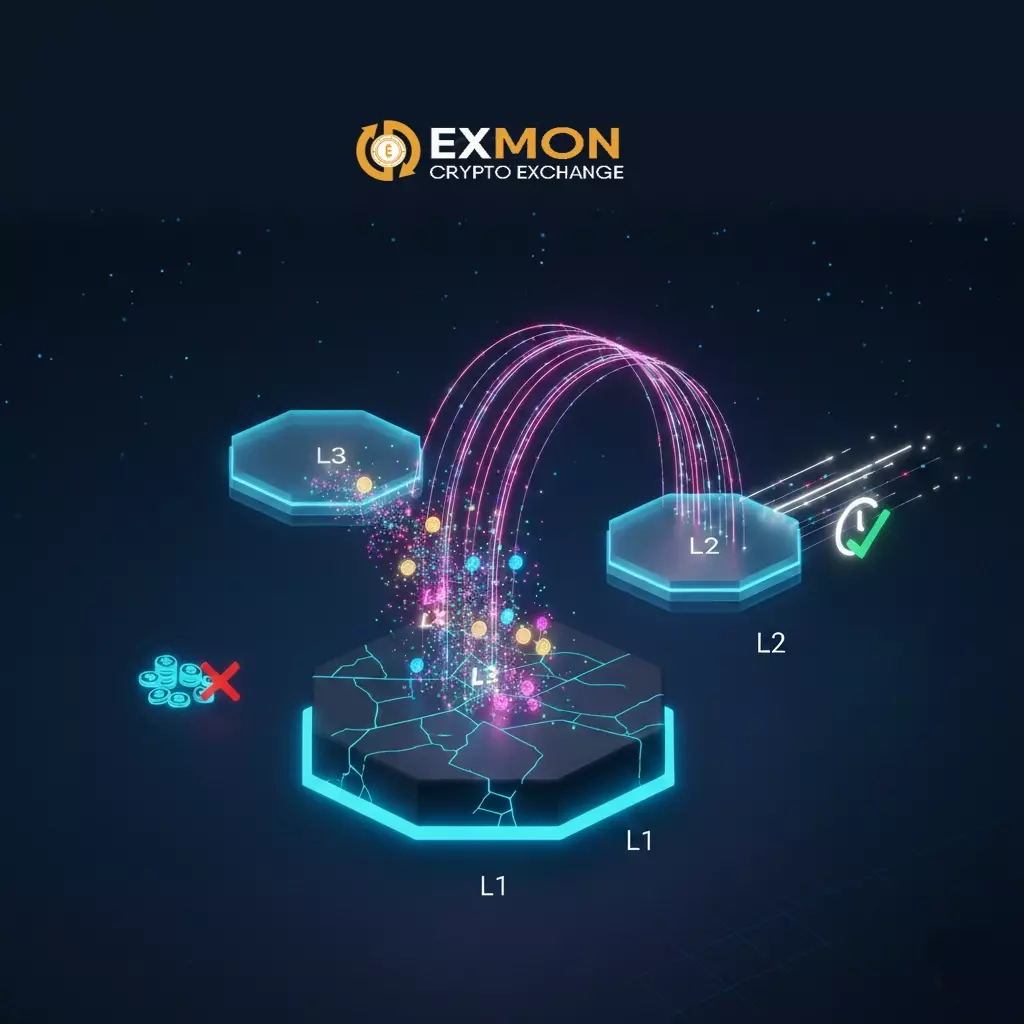
- Layer 1 (L1) - The Foundation: The base layer (for example, Ethereum). It’s the most secure and decentralized, but also slow and expensive. Its core role is final transaction settlement.
- Layer 2 (L2) - Scaling: Protocols built on top of L1. They process thousands of transactions off-chain, bundle them together, and submit a single proof back to L1.
- Examples: Arbitrum, Optimism, Base, zkSync, Starknet.
- Layer 3 (L3) - Hyper-Specialization: A relatively new concept that emerged between 2024 and 2026. These are networks built on top of L2, designed for very specific use cases: microtransactions, high-frequency trading, or gaming.
- Examples: Xai, Degen Chain, Orbit (by Arbitrum).
Core Technology: Rollups
Most L2s are powered by rollups. There are two main types, and the distinction matters if you’re an active trader:
- Optimistic Rollups (Arbitrum, Optimism): Assume transactions are valid unless someone proves otherwise.
- Pro: Low fees.
- Con: Withdrawing funds back to L1 via the native bridge takes ~7 days because of the challenge window.
- ZK-Rollups (zkSync, Starknet, Polygon zkEVM): Use zero-knowledge proofs. Transaction validity is mathematically proven almost instantly.
- Pro: Near-instant L1 withdrawals and top-tier security.
- Con: Proof generation is computationally heavy (by 2026, this is largely a solved problem).
Practical Tips: How to Save the Smart Way
1. Use L3 for High-Frequency Strategies
If you trade small sizes or run bots that execute hundreds of trades per hour, move to L3. Fees are 10–100× lower than on L2. On networks like Arbitrum Orbit, you’re often paying fractions of a cent per trade.
2. Forget About “Native Bridges”
Official (native) bridges are slow and expensive, especially when exiting optimistic rollups.
- Solution: Use cross-chain bridges (Across, Stargate, Orbiter). They work via liquidity pools: you deposit assets on chain A and receive them instantly on chain B. This saves time and can cut L1 fees by up to 90%.
3. Account Abstraction (EIP-4337)
By 2026, most modern L2 wallets support account abstraction.
- Pro tip: Look for wallets that let you pay gas not in the network’s native token (ETH), but in stablecoins (USDC/USDT). This removes the need to keep small gas balances across multiple chains and reduces unnecessary swaps.
4. Transaction Batching
Some advanced L2 DEXs allow you to sign a single approval for an entire sequence of trades. This is significantly cheaper than approving each transaction one by one.
Pro-Level Terminology
- Gasless Trading: A setup where the trader signs an off-chain message, while a relayer submits the transaction on-chain and takes its fee directly from the traded asset.
- Data Availability (DA): Where an L2 publishes its transaction data. With EIP-4844 (Proto-Danksharding) and blobs, Ethereum data costs dropped dramatically — the main reason L2 fees are so low today.
- Sequencer: The node that orders transactions on an L2. By 2026, the industry trend is toward shared sequencers, reducing censorship risk and execution delays.
Lesser-Known Tricks and Pro Strategies
Let’s go a bit deeper into the architectural details that help traders maintain an edge in 2026.
1. Shared Liquidity
One major drawback of L2s is liquidity fragmentation. Large trades on Arbitrum, for example, can experience more slippage than on Ethereum mainnet.
- Practical advice: Use aggregators that support cross-L2 routing (such as newer versions of 1inch or Uniswap v4). They can split your order - partially filling it on Optimism and partially on Base - using atomic swaps. Better execution often outweighs the extra gas.
2. Intents - A UX Revolution
Instead of manually choosing networks and gas settings, traders in 2026 increasingly rely on intent-based protocols like UniswapX or CowSwap.
- How it works: You don’t send a transaction yourself. You sign an “intent” (for example: “Swap 1 ETH for at least 3,500 USDC”).
- The upside: Specialized market participants called solvers compete to execute your order. They find the best route, pay for gas, and often tap into off-chain liquidity — making the trade effectively gasless for you.
3. L3 Specifics: App-Chains and “Quiet” Networks
Many L3 solutions are built as app-chains - chains dedicated to a single application.
- Example: When trading derivatives on platforms like Hyperliquid or dYdX (regardless of whether they’re technically L1 or L2), you’re effectively operating in an isolated trading environment.
- Little-known fact: Some L3 networks offer zero fees for order cancellations. On L1, every cancellation is a transaction. On specialized L3s, you can move orders around freely, just like on a CEX, reacting instantly to even small price moves.
Risks No One Mentions in the Marketing
Saving on fees always comes with trade-offs. Traders should keep in mind:
- Sequencer centralization: Most L2s and L3s still rely on a single sequencer. If it goes down, funds remain safe (thanks to L1), but trading may halt at the worst possible moment.
- Interoperability risks: The more layers between you and Ethereum L1, the more smart contracts are involved. Every bridge and every extra layer is a potential attack surface.
- L3 isolation: Exiting an L3 often requires routing through its parent L2, which can introduce additional delays.
Cost-Optimization Checklist for Active Traders
- Monitor blob gas: After EIP-4844, L2 fees depend on blob space congestion. Use analytics dashboards (for example, Dune Analytics) to see where costs are lowest right now.
- Use RPC aggregators: Set up fast RPC endpoints in MetaMask or Rabby. Slow public nodes increase latency and slippage, which often costs more than gas.
- Prioritize ZK networks for large amounts: If you need fast capital rotation back to L1 for arbitrage or withdrawals, ZK-rollups (zkSync, Polygon zkEVM) help you avoid week-long delays.
Bottom Line
In 2026, the difference between “just a trader” and an efficient one comes down to infrastructure awareness. Moving activity to L2 for liquidity and L3 for trade frequency isn’t just about saving on fees, it’s a necessity for surviving in an increasingly competitive trading environment.
Summarize this blog post with: