
Hundreds of zombie tokens are still actively trading on exchanges despite having zero dev activity for years. Their GitHub repos are collecting dust, the founders have long since bailed for new startups or are stuck in legal battles with regulators, yet their order books are thriving. We're talking millions in daily volume. The secret behind it is simple: market makers (MMs) are either getting paid by whatever is left of the project's treasury or milked directly by the exchange algorithms via rebates and liquidity mining incentives.
Exchanges have zero incentive to delist them. The trading fees keep rolling in.
Every single one of these tokens is basically a ghost asset kept on life support by algorithmic trading desks like Wintermute, GSR, or DWF Labs. For MMs, these assets are a goldmine: absolute zero organic sell pressure, highly predictable retail reactions to technical patterns, and a zero percent chance of a surprise product drop ruining their TA setup.
Anatomy of a Zombie Project
Spotting vaporware isn't rocket science if you step away from TradingView charts and look under the hood. First up is developer activity. According to Santiment data and commit logs, projects like Peercoin (PPC), Namecoin (NMC), or Waltonchain (WTC) have seen dev activity drop straight to zero—even though WTC spent a long time being propped up by algorithmic grid bots before getting nuked from major venues.
Second is volume distribution. Real assets trade organically with news-driven spikes and quiet consolidation phases. Zombie tokens print perfect "sawtooth" patterns or flat rectangular bars on 15-minute candles. That’s classic wash-trading in action. Bots shuffle the token back and forth between a few internal wallets to spoof a deep order book.
Third is the glaring gap between Volume and On-chain activity. A token might print $40M in 24-hour volume while having fewer than 50 unique active addresses on-chain. Every single trade is happening purely inside centralized exchange databases.
| Ticker | Dev Status | Primary Venue | Market Dynamics |
|---|---|---|---|
| SNT (Status) | Barely any commits, shifted focus | Binance, Upbit | Asia-session pumps, liquidity farming |
| XVG (Verge) | Abandoned, occasional forks | Binance, Gate.io | Periodic short squeezes driven by low float |
| FTT (FTX Token) | Liquidated | KuCoin, Binance (Spot/Futures) | Pure speculation on bankruptcy payouts and court headlines |
| ELF (aelf) | Ghost town repo | Bithumb, OKX | Localized manipulation by Korean MM bots |
| BTS (BitShares) | Active development halted | Poloniex, Gate.io | Algo grid trading on razor-thin liquidity |
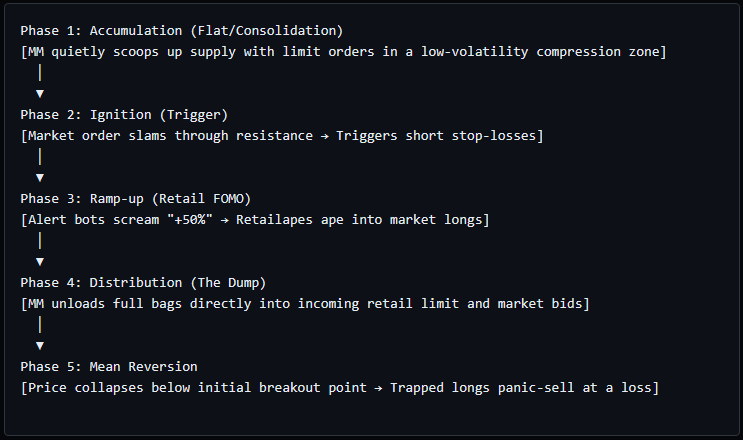
Take Verge (XVG) as a case study. A 2017-era meme coin that survived multiple 51% attacks and source code leaks. The core team scattered long ago. Yet XVG still randomly prints +300% God candles over a 48-hour span. How? An MM quietly sweeps up 70% to 80% of the circulating supply while it bottoms out and order books are completely dead. They accumulate stealthily via scaled limit orders over several months. Then comes the pump phase: the MM smashes market buys to clear out the ask side, slapping a massive vertical green candle onto the chart.
Screener bots instantly flag the massive Volume Surge. Retail traders jump in alongside short-liquidation algorithms, and the MM unloads their heavy bag right into the faces of FOMOing retail buyers.
Shorting these tokens is way more dangerous than buying them.
Anything over 3x leverage is a guaranteed liquidation speedrun. Because the asset is entirely controlled by a single market maker or a cartel of quant funds, short interest on the exchange is tracked in real time through Open Interest. The moment net short positions cross the MM’s risk threshold, they simply trigger a 50–100% wick upward, incinerating bear accounts and triggering a cascade of liquidations that fuels the rally even further.
When dealing with dead coins, traders at EXMON rely on a specific playbook:
- Spot Order Book Monitoring. Keep an eye out for dead-quiet periods with unnaturally tight spreads and zero news catalysts.
- On-Chain Sleuthing. Watch for transfers from treasury/MM wallets to exchange deposits. If massive token batches move to exchange addresses, a move is brewing.
- Ditch Traditional Indicators. Standard TA like RSI, MACD, and moving averages are useless against algorithmic manipulation. Stick strictly to VSA (Volume Spread Analysis) and Depth of Market (DOM).
- Laddered Profit Taking. Only enter during deep consolidation, and exit on the very first massive impulse leg up. Don't fall into the trap of holding out for a "fundamental turnaround."
Here's the cold hard truth: zombie tokens are pure PvP machinery designed to extract capital from naive retail traders and transfer it to quant desks. You can trade the volatility, but holding them long-term is pure portfolio suicide.
Let’s pull back the curtain on how market makers actually deal with exchanges. Very few traders truly get why assets with zero GitHub activity for years never actually get delisted.
The secret sauce is in the Liquidity Provision Agreements (LPAs).
When a project dies, it usually leaves behind a treasury full of stablecoins or native tokens. The market maker signs a deal getting a call option to buy tokens at a fixed, below-market rate plus a monthly retainer fee just for spoofing volume. The MM's job is to keep the spread tight at 0.2–0.5% and stack the order book with at least $10k–$50k on both bid and ask.
If the project's treasury is completely bone-dry, the exchange itself steps in. The CEX needs to keep farming trading fees and collecting funding on Perpetual Swaps.
Delisting means instantly throwing away trading volume. So exchanges set up internal desks or hire external MMs under VIP9+ terms with negative maker fees (Maker Rebates). The MM is literally getting paid to have its bots wash-trade with themselves.
Top "Zombie" Tokens Still Printing Millions
Here’s a breakdown of real-world zombie projects whose original vision died ages ago, yet they keep wildly volatility-pumping thanks to algo trading.
- LUNC (Terra Classic) – The classic rotting corpse of Do Kwon’s ecosystem. The network is essentially on life support powered by a few diehard validator enthusiasts—zero fundamentals left. Yet, it carries a massive retail cult and huge open interest on leverage. MMs treat LUNC as pure speculative casino fuel: any fake "token burn" rumor triggers a violent 40–70% god candle, immediately followed by a slow bleed back to crab season.
- OMG (OMG Network) – Once an overly hyped Ethereum Layer-2 backed by OmiseGO. Sold off, then totally abandoned. Volume today is almost entirely algorithmic grid bots farming range-bound traders for fees in tight crab channels.
- REV (Revain) – A blockchain review platform whose actual site traffic is basically dead. For years, its chart has shown absurd vertical scam wicks followed by a 100% round-trip dump within sixty seconds. Classic algo liquidity grabs.
- SRM (Serum) – The Solana-based DEX ecosystem tied straight to FTX. After the mother ship imploded, the project effectively died and its admin keys were compromised. Regardless, SRM perp contracts keep nuking and squeezing shorts due to paper-thin spot depth. A random $20k market order moves the order book by 5%.
- BTS (BitShares) – The OG DPoS relic created by Dan Larimer. Larimer walked away nearly a decade ago, and the tech is prehistoric. Trading it now is pure high-frequency trading (HFT) math bots scraping sub-penny spreads.
- WTC (Waltonchain) – An infamous IoT project infamous for faking its own Twitter giveaway back in 2018. The team ghosted, but exchanges keep bouncing the token around just to farm liquidations off people trying to short it to zero.
- NEBL (Neblio) – A legacy platform token with zero core devs left. Its volume is sustained solely by arbitrage cross-exchange bots arbitraging micro-inefficiencies across shit-tier exchanges.
The price action mechanics behind these tokens follow the exact same playbook every time.
Since there’s zero organic spot demand (nobody is adding SRM or OMG to their 5-year cold storage portfolio), every upward leg is a Trap. The market maker simply needs exit liquidity to dump the position they scooped up at the absolute bottom.
To pull this off, they run a classic Pump & Dump, fine-tuned for institutional execution algorithms.
The single worst mistake a trader can make on these coins is trying to dollar-cost average (DCA) down against the MM's trend. If you short LUNC on the first green god candle, but the MM has budgeted a 200% short squeeze, your account will get wiped clean long before the price ever trickles back down to its true fundamental valuation of zero.
An MM's algorithmic engine doesn't give a damn about classic technical analysis. It completely ignores your Fib retracements and overbought RSI readings.
The bot is strictly reading the liquidation Heatmap on its terminal. If there’s $2 million worth of short liquidations sitting at $0.05, and pushing the thin order book up there costs a mere $300k, the bot will hunt that liquidity down in three seconds flat.
Let’s tackle the fundamental question: where are market makers sourcing the liquidity to run these games if retail is getting smarter and overall volume is drying up?
Simple—arb bots and cross-exchange liquidity pools.
Unlike EXMON, most tier-2 and tier-3 exchanges don't keep dedicated, locked-in MMs for hundreds of dead tokens. Instead, they hook directly into liquidity aggregators via FIX protocols and WebSocket APIs. A heavy-hitting MM (think DWF Labs or GSR) streams its order book across 10 to 15 venues simultaneously. If a sudden market order sweeps the book on one exchange, arbitrage scripts immediately tighten and level the spread everywhere else.
This creates the illusion that a project has genuine "across-the-board" activity. In reality, the entire order book is just a mirror of a single algorithmic engine running on one primary venue.
Indicators of a Technically Dead Project
Before touching any mid-cap asset, the EXMON research team recommends running it through a strict checklist. If it triggers three or more of these red flags, you're dealing with a toxic zombie token.
- On-Chain Velocity is Near Zero. Velocity measures token turnover (the ratio of on-chain transaction volume to total market cap). If a token has a $100M market cap and $30M in daily CEX volume, but only $10,000 moving on-chain daily—99.9% of that trading volume is fake CEX wash trading generated by bots.
- Devs Ghosted Socials or Switched to Auto-Pilot. Posts on X (Twitter) drop maybe once a month, regurgitating generic "We are building" fluff with zero links to actual GitHub PRs or code commits.
- Deposit Imbalance. Exchange wallets only receive large inflows from 2 or 3 addresses (usually treasury or the MM's own wallets), while user withdrawals to cold storage have been non-existent for months.
- Abnormal Perpetual Funding Rates. Funding rates on perpetual swaps skew to extreme negatives (like -0.75% every 4 hours) and stay pegged there for days. This signals that retail is heavily piled into shorts, and the MM is holding spot to engineer a short squeeze.
- DEX Spreads are 10–20x Wider than CEX. Liquidity pools on Uniswap or PancakeSwap are practically empty—a modest $5,000 buy order incurs 15% slippage. Meanwhile, the CEX order book shows fake $50,000 bid/ask walls.
Below is a breakdown of projects where core development is essentially dead or reduced to vanity commits, yet trading volatility remains artificially high for speculation.
| Project / Ticker | Original Thesis | Cause of Technical Death | Market Maker Playbook |
|---|---|---|---|
| PPC (Peercoin) | First hybrid PoS/PoW chain | Complete loss of market share, legacy tech | Tight-spread micro-HFT, harvesting maker rebates |
| NMC (Namecoin) | Decentralized DNS | Zero scaling, core devs abandoned project | Artificial order book sweeps on Poloniex/Gate |
| QTUM (Qtum) | Bitcoin/Ethereum hybrid chain | Irrelevant tech stack, crushed in the L1 wars | Asian session momentum pumps around perp listings |
| XVG (Verge) | Privacy-focused currency | Exploited code, repeated 51% attacks, hard forks | Manufactured supply squeezes via 80% float cornering |
| GAS (Neo Gas) | Neo network gas token | Slow death of the Neo ecosystem | Wild volatility spikes during Korean trading hours (Upbit) |
| STRAX (Stratis) | Enterprise C# blockchain | Rebrands/token swaps, zero enterprise adoption | Speculative pumps timed around tokenomics announcements |
| ARK (Ark) | Cross-chain interoperability | Lost out entirely to Cosmos (IBC) and Polkadot | Price range pinning via grid-trading bots |
| STEEM (Steem) | Blockchain-based social media | Hostile takeover by Justin Sun, community hard-forked to Hive | Internal circular wash trading algorithms |
The takeaway for traders: zombie tokens aren't "buy-the-dip value plays." They are strictly short-term PvP playgrounds.
Trade them only by riding the tailwinds of institutional manipulation. Spot a tight consolidation range with volatility crushed to multi-year lows? Set volume breakout alerts. The moment the bot starts pushing price up, ride the momentum with a tight stop, and take profit on the very first "panic buy" retail candle.
Don't try to outplay the market maker at their own game. You don't have visibility into their bankroll or their risk management parameters.