


The days when parsing Twitter (X) for keywords was enough to analyze the market are long gone. We’ve entered the era of Sentiment Analysis 3.0 — multimodal systems that “hear” streamers’ tone of voice, “see” their micro-expressions, and tap into closed Telegram and Discord ecosystems to uncover coordinated manipulation.
In this article, we’ll break down the technical stack and practical methods that allow AI to predict pumps (explosive price spikes) minutes before they begin.
1. From Text to Pixels: Multimodal Stream Analysis

Modern pumps often start on YouTube, Twitch, or TikTok Live. While the average trader is just watching the stream, an AI agent is processing it across three parallel channels: Text (OCR/Subtitles), Audio (Speech-to-Intent), and Video (Facial Expression Analysis).
Technical stack:
- Text: Using models like Whisper v3 to transcribe speech in real time.
- Video: Micro-expression analysis via FaceNet or AffectNet. The AI looks for mismatches between words (for example, “this is not financial advice”) and nonverbal cues (excitement, confidence).
- Synchronization: Leveraging Multimodal Transformer architectures to fuse features together.
Practical example:
If a popular influencer mentions a little-known ticker during a stream and their pulse (measured through subtle facial skin color fluctuations using Remote Photoplethysmography) rises at the same time, the system assigns a high Confidence Score to a potential pump.
2. Infiltrating the “Dark” Chats: Telegram and Discord
Most pump groups (Pump & Dump communities) operate behind closed doors. Sentiment 3.0 doesn’t just read messages — it builds social influence graphs.
Methods for analyzing closed channels:
- Narrative Velocity: Tracking how fast a specific “shill” (coin promotion) spreads. If the same text or image shows up in 50 chats within 10 seconds, that’s a sign of a coordinated bot-driven push.
- Entity Linking: The AI connects wallet mentions in chats to real blockchain transactions (on-chain data).
- Detecting "Shill-bots": Identifying bots based on stylistic similarity. The AI uses cosine similarity of sentence embeddings to determine whether 90% of the “positive” sentiment in a chat was generated by a single model.
3. Practical Implementation: Code Example (Python)
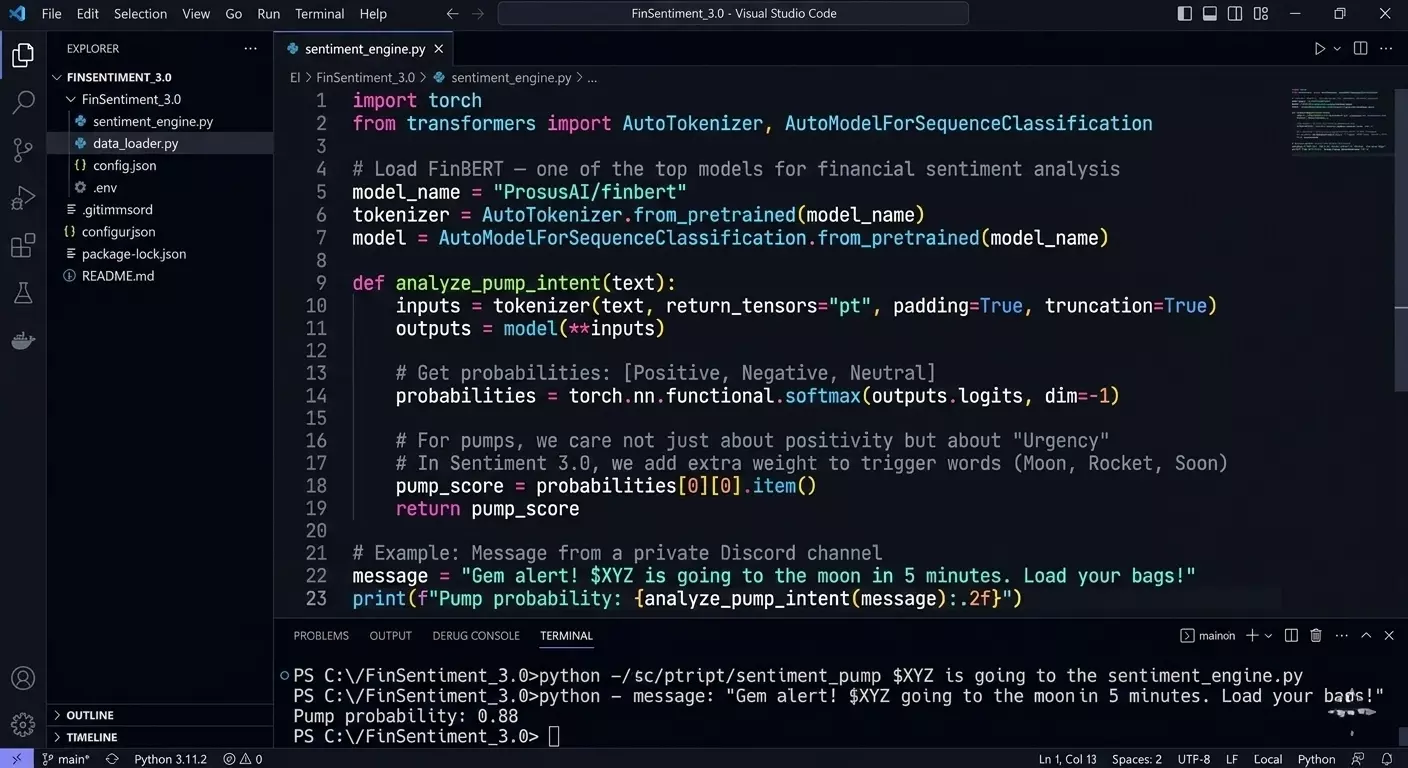
For real-time sentiment analysis, professionals often combine RisingWave (a streaming database) with FinBERT (a model trained on financial texts).
Below is a simplified script for estimating “explosive” interest in a ticker within a live message stream:
import torch
from transformers import AutoTokenizer, AutoModelForSequenceClassification
# Load FinBERT — one of the top models for financial sentiment analysis
model_name = "ProsusAI/finbert"
tokenizer = AutoTokenizer.from_pretrained(model_name)
model = AutoModelForSequenceClassification.from_pretrained(model_name)
def analyze_pump_intent(text):
    inputs = tokenizer(text, return_tensors="pt", padding=True, truncation=True)
    outputs = model(**inputs)

    # Get probabilities: [Positive, Negative, Neutral]
    probabilities = torch.nn.functional.softmax(outputs.logits, dim=-1)

    # For pumps, we care not just about positivity but about "Urgency"
    # In Sentiment 3.0, we add extra weight to trigger words (Moon, Rocket, Soon)
    pump_score = probabilities[0][0].item()
    return pump_score
# Example: Message from a private Discord channel
message = "Gem alert! $XYZ is going to the moon in 5 minutes. Load your bags!"
print(f"Pump probability: {analyze_pump_intent(message):.2f}")
4. Lesser-Known Indicators: What the Pros Watch
Beyond text, 3.0-level AI systems also pay attention to:
- Emoji Density: A sudden spike in emojis like "🚀", "🔥", or "💎" per unit of text often precedes volatility by 1.5–3 minutes.
- Audio Pitch Shift: A noticeable rise in the host’s vocal pitch when mentioning a specific coin during a stream.
- Liquidity Wall Front-running: The AI correlates a surge in chat positivity with the disappearance of sell orders (ask-side liquidity) from the exchange order book.
Important: Sentiment Analysis 3.0 is most effective when the Sentiment Score is combined with a trading volume Z-score. If there’s a lot of hype but no real money (volume) behind it, that’s a false signal.
5. Ethics and Risks
Using AI to predict pumps is an arms race. Pump organizers are also using AI to generate more “human-like” positive sentiment. As a result, 3.0 systems are increasingly shifting toward Adversarial Analysis — attempts to detect AI-generated content in other users’ messages.
6. On-chain Verification: Anti-Fake Filter
The key challenge in analyzing chats and streams is Fake Sentiment. Pump organizers create the illusion of hype using thousands of bots. Sentiment 3.0 tackles this with real-time blockchain cross-checking.
"Wallet-to-Chat Attribution" Technology
Advanced systems use clustering algorithms to link social activity with fund movements:
- Smart Money Analysis: If the AI detects a spike in token mentions in a private Discord, it instantly checks whether high Win-rate wallets (percentage of profitable trades) are entering that token.
- Burn Rate & Liquidity Injection: Before a pump, developers often add liquidity with small transactions. The AI matches chat message timestamps with transaction hashes. If the correlation $ > 0.85 $, the signal is considered genuine.
7. Video Processing: Screen Space Analysis
A little-known but powerful feature of Sentiment 3.0 is OCR monitoring of charts on streams. The AI not only listens to the streamer but also "watches" their screen using computer vision:
- Pattern Recognition: The AI sees which support/resistance levels the influencer is drawing.
- Order Flow on Video: Streamers often show their open positions or order book. The AI reads these numbers faster than the human eye and estimates the real volume behind statements like "I'm going long."
8. System Architecture: From Collection to Execution
The professional pipeline of Sentiment 3.0 looks like this:
- Ingestion Layer: Kafka cluster receiving streams from the Telegram API, Discord webhooks, and audio streams (via FFmpeg).
- Vector Store: All messages are converted into vectors (embeddings) and stored in a database (e.g., Pinecone or Milvus). This allows the system to instantly find similar pump patterns from the past.
- Inference Engine: The model (often a custom Llama 3 or Claude Haiku) analyzes context: "Is this an ironic joke or a real buy signal?"
- Execution Layer: Automatic API calls to exchanges (Binance/Bybit/DEX) when the Sentiment_Score > 0.92 threshold is reached.
9. Practical Example: Audio Signal Processing (Python)
Imagine we intercepted an audio stream from a live broadcast. We need to understand whether the speaker's voice is getting too "heated."
import librosa
import numpy as np
def analyze_voice_energy(audio_path):
    # Load the audio snippet
    y, sr = librosa.load(audio_path)

    # Extract the spectral centroid (indicates brightness or sharpness of the sound)
    cent = librosa.feature.spectral_centroid(y=y, sr=sr)

    # Extract energy (RMS)
    rms = librosa.feature.rms(y=y)

    # If average energy and frequency rise — the speaker is moving into shouting/excitement
    stress_level = np.mean(cent) * np.mean(rms)
    return stress_level
# If stress_level spikes sharply when a ticker is mentioned — pay attention!
10. Little-Known Insight: "Ghost Groups" Analysis
There are so-called "Ghost Groups" on Telegram. They may have no activity for years, but 5-10 minutes before a pump, a sudden "ping check" occurs. Sentiment 3.0 tracks these "woken-up" clusters. If 100 "sleeping" accounts come online simultaneously and start reposting a token contract — there's a 99% chance of a coordinated pump.
Trader Checklist (how to use it today):
- Watch the lag: If you read a news item on a major channel, the AI has already processed it 30 seconds ago. Look for "primary sources" (small developer chats).
- Use aggregator bots: Set filters on keywords + trading volumes (Volume Spikes).
- Skepticism towards "hype": If Sentiment rises while price falls — that's a Distribution, where large holders are closing positions on the crowd.
Moving on to the final and most pragmatic stage: Predictive Liquidation Mapping and integrating all signals into a unified trading strategy.
Sentiment Analysis 3.0 is not just about finding entry points; it’s about understanding where the “crowd” will be forced out at a loss.
11. Liquidation Map: Using Sentiment as a Contrarian Indicator
When AI detects extremely high positivity (Euphoria) in chats and streams, professional systems start looking for the “fuel” for a reversal.
How the Process Works:
- Sentiment Overheat: AI calculates the Z-score of sentiment. If the value deviates 3 standard deviations from the mean, it means the least experienced players (“weak hands”) are in long positions.
- Liquidation Clusters: The system cross-references chat data with open interest on exchanges. AI builds a price map showing levels at which these “believers’” positions will be forcibly closed.
- The "Squeeze" Prediction: If positivity in chats is off the charts and the price stops rising, AI signals an imminent Long Squeeze.
12. Lesser-Known Detail: Metadata Analysis and the “Digital Footprint”
Few realize that Sentiment 3.0 analyzes not just content, but also message metadata:
- Device Affinity: If 500 “Buy now!” messages across different chats come from the same device models (e.g., only iPhone 13) within 2 minutes, that’s a sign of a single bot farm.
- Time-Delta Analysis: AI measures micro-delays between messages. Humans type at varying speeds, bots type with mathematical precision or a set randomizer, which AI can easily decode.
13. Automation: Turning Data into Money
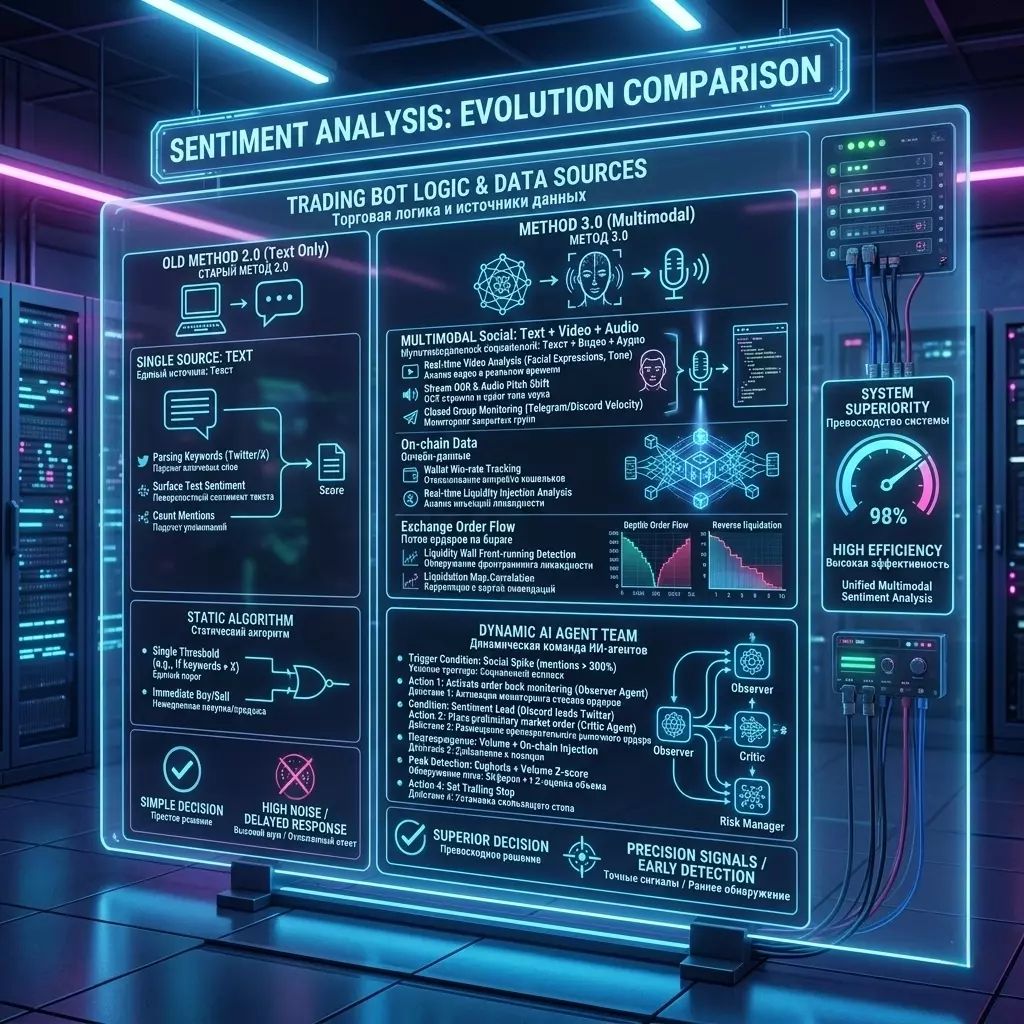
To use Sentiment 3.0 effectively, traders employ Logic-Based Execution. Here’s an example of logic for a trading bot:
| Trigger | Condition | Action |
|---|---|---|
| Social Spike | Mentions of the ticker increase > 300% in 10 minutes | Activate order book monitoring |
| Sentiment Lead | Positivity in closed chats (Discord) leads Twitter by 2+ minutes | Place preliminary market order (Small Size) |
| Volume Confirmation | Large purchases appear On-chain | Add to position (Full Size) |
| Euphoria Peak | Streamers start using caps lock and rocket emojis | Set Trailing Stop |
14. Technical Insight: Using LLM Agents (Auto-GPT Style)
Modern Sentiment 3.0 isn’t a single model, but a team of AI agents:
- Observer Agent: Continuously parses streams and converts audio to text.
- Critic Agent: Analyzes text for manipulation and irony.
- Risk Manager Agent: Compares “hype” with actual liquidity in the order book.
Practical Example: In 2024, systems detected a meme coin pump 15 seconds after AI “heard” a specific Phantom wallet notification sound on a popular trader’s stream, even before the trader could say the coin’s name.
Conclusion: The Future is Already Here
Sentiment Analysis 3.0 has turned trading into an algorithmic competition. The key to success today isn’t to “believe” in a pump, but to use AI to see its structure: who initiated it, how much real money is behind it, and when the “crowd” will become liquidity for big players to exit.
Practical Tip:
If you want to start implementing this today, begin with Python + Telegram API (Telethon) and a simple library like TextBlob or VADER for basic scoring. Gradually move to FinBERT and audio stream analysis.
Summarize this blog post with: