
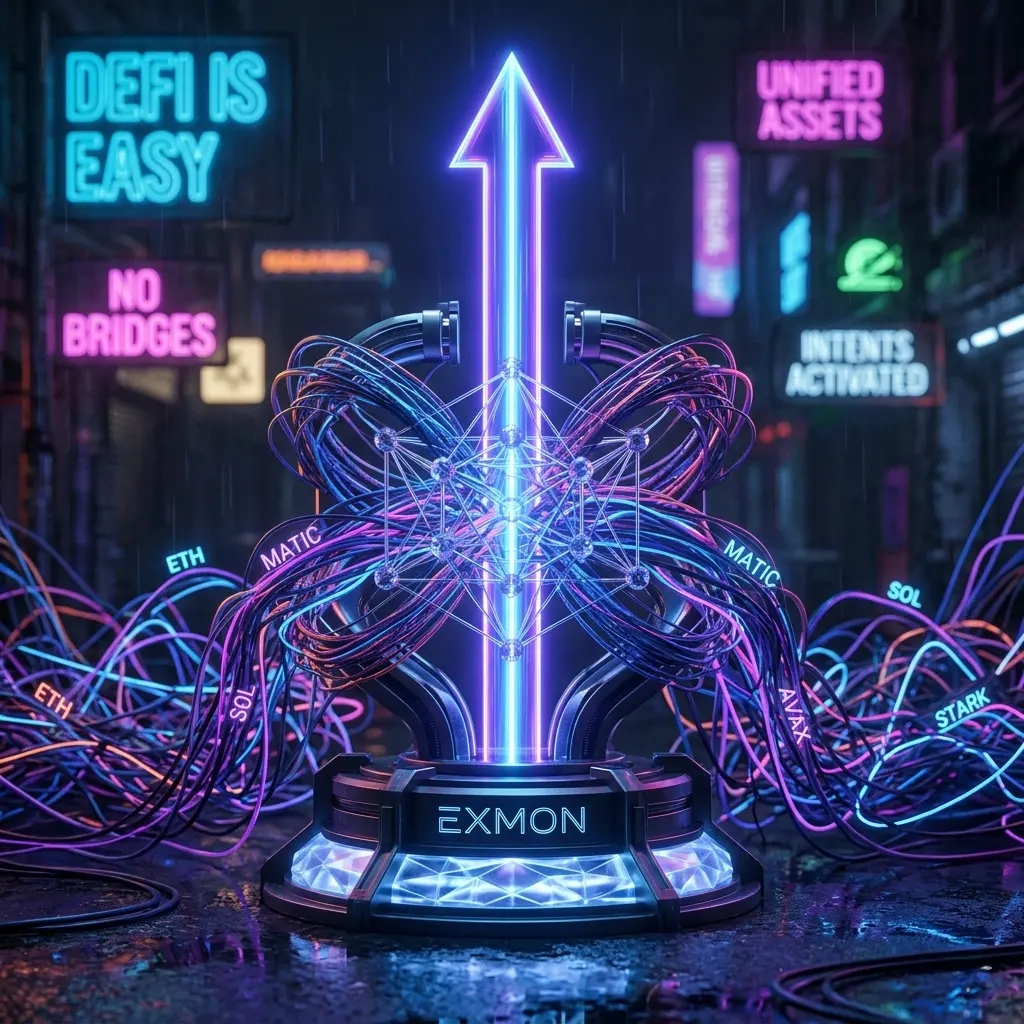
Welcome to the era of the "invisible blockchain." Back in 2021, we had to manually add RPC nodes to MetaMask, and by 2024 we were getting lost in dozens of L2 networks. By 2026, the concept of Chain Abstraction (ChA) has fully turned crypto into the "internet of money," where the user interface matters more than the architecture under the hood.
In this article, we'll break down how this magic works, why liquidity fragmentation is no longer a problem, and how developers implement it in practice.
1. The Problem We Solved: The "Network Zoo"
Before Chain Abstraction, the Web3 user experience was like trying to pay in a store with five different wallets, each with its own currency, and to buy bread you'd first have to exchange some "wrong" tokens for the "right" ones, paying a fee in euros.
Main barriers of the past:
- Gas Management: You had to hold the native coin (ETH, SOL, MATIC) in every network.
- Bridging: Fear of losing assets when moving them across bridges and waiting for confirmations.
- Balance Fragmentation: You have $1000, but it’s spread across 5 networks, and you can't buy an $800 NFT with a single click.
2. The Three Pillars of Chain Abstraction
Chain Abstraction isn't a single technology, but an orchestration of multiple layers.
A. Account (Account Abstraction - ERC-4337 and beyond)
Your wallet is no longer just a key pair. It’s a smart contract.
- Paymasters: Allow you to pay gas in any token (USDC) or even shift the payment to the app (DApp).
- Session Keys: Let you perform transactions in a game or on a DEX without constant wallet confirmations.
B. Liquidity (Liquidity Aggregation)
Protocols like Across, Connext, or LayerZero create a unified liquidity layer. To the user, it looks like a "single balance." If you buy an asset on Arbitrum using funds on Optimism, the system performs a "quick bridge" in fractions of a second.
C. Orchestration (Orchestration Layer)
This is the "brain" of the system. It analyzes your request and builds a route:
- Take $200 from Polygon.
- Swap it through an aggregator.
- Send the result to Base.
- All in a single user signature.
3. Practical Example: Buying in 2026
Imagine you want to buy a rare artifact in a blockchain game running on Starknet. Price: 50 USDC. You only have ETH on the Ethereum mainnet.
How it works now (via ChA):
- You click "Buy."
- The wallet shows: "We'll debit 0.015 ETH from Mainnet. Item received on Starknet. Fee: $0.50 in ETH."
- You confirm with biometrics (FaceID).
- Done.
No need to hunt for a faucet to pay gas on Starknet, and no need to wait 20 minutes for bridge confirmation.
4. Lesser-Known Detail: Intents
The key shift in 2026 is moving from transactions to intents.
Instead of telling the network: "Call function X on contract Y," you specify the outcome: "I want this NFT and I’m willing to spend up to $50."
Special network participants — Solvers — compete to fulfill your intent in the cheapest and fastest way. They take on all the risks and complexities of interacting with blockchains.
5. For Developers: How to Implement ChA (Logic Example)
If you’re building an app, you no longer need to force the user to switch networks in their wallet. Using SDKs (like NEAR, Particle Network, or Safe), you can programmatically execute a cross-chain transaction.
Conceptual code example (pseudo-code based on intents integration):
// Using a universal Chain Abstraction provider
const userIntent = {
  action: "SWAP_AND_STAKE",
  sourceAssets: [{ chain: "Ethereum", asset: "USDC", amount: "100" }],
  targetDestination: { chain: "Avalanche", protocol: "Benqi", action: "Deposit" },
  maxSlippage: "0.5%"
};
// Solver executes the intent
const tx = await chaProvider.execute(userIntent);
// User signs ONCE
await tx.sign();
6. Security and Risks
Despite the convenience, Chain Abstraction introduces new attack vectors:
- Solver Risk: What if the solver takes the money and doesn’t fulfill the intent? (Handled via staking and slashing mechanisms).
- Audit Complexity: Verifying a chain of 5 transactions across different networks is harder than one.
By 2026, security standards (ZKP proofs for cross-chain operations) became the industry norm, minimizing these risks.
7. Universal Signatures (Signature Abstraction)
One of the main challenges in the multichain world was the incompatibility of cryptographic curves. For example, Ethereum uses secp256k1, while newer networks like NEAR or Aptos may prefer Ed25519.
By 2026, Chain Signatures technology (first implemented at scale in NEAR-level protocols and modular stacks like Celestia/Avail) allows a single account to sign transactions for any blockchain.
How it works technically:
MPC (Multi-Party Computation) is used at the network validator level. When you initiate an action, the network generates a partial signature, which together forms a valid signature for the target network (for example, Bitcoin or Solana).
Result: Your smart contract on an L2 network can directly hold Bitcoin or trade on Raydium without leaving its "native" interface.
8. Leading Protocols of 2026: Who's Behind This?
For practical understanding, three key players shaped this landscape:
- NEAR Protocol (BOS & Chain Signatures): They were the first to implement the "Blockchain Operating System" concept. Their approach allows frontends to interact directly with multiple networks, and users can create accounts via email (Fast Auth), with keys distributed across the network.
- Particle Network: Built a "Modular L1" that serves as a computation layer for account coordination. Their Universal Liquidity combines balances from 50+ networks into a single virtual wallet.
- Everclear (formerly Connext): The first "clearing layer" for Web3. They solve the problem of debt "settlement" between networks so that cross-chain transactions cost cents instead of tens of dollars.
9. Practical Case: Arbitrage and Borderless DeFi
Previously, arbitrage between DEXes on different networks required complex bots and deposits in each network. With Chain Abstraction, it's available "in one click" via intents.
Scenario:
- On Uniswap (Ethereum) the $ALPHA token costs $10.
- On Jupiter (Solana) the $ALPHA token costs $10.2.
- User Action: You click the "Arbitrage" button in the aggregator.
- Backend (ChA): The system takes your loan (Flash Loan) on Ethereum, buys the token, instantly sells it on Solana via Chain Signatures, and returns the profit to your wallet on Arbitrum.
- Your Role: You just confirmed the intent and received net profit minus the solver fee.
10. Code Example: Integrating a Universal Wallet (EIP-7702)
By 2026, EIP-7702 (proposed by Vitalik Buterin) replaced ERC-4337, allowing temporary conversion of standard EOA addresses into smart contracts.
Example of how a developer can pay gas in an app token (pseudocode):
import { createSmartAccountClient } from "@universal-cha/sdk";

// Initialize an account that "sees" all networks at once
const smartAccount = await createSmartAccountClient({
  signer: eoaSigner, // Your normal private key or FaceID
  bundlerUrl: "https://bundler.mainnet.io",
  paymasterUrl: "https://paymaster.myapp.com"
});

// Send a transaction on Base network, paying gas in $APP token on Polygon
const txHash = await smartAccount.sendTransaction({
  to: "0xContractAddressOnBase",
  data: "0x...",
  value: parseEther("1.0"),
  gasToken: "0xAppTokenAddressOnPolygon" // Gas abstraction magic
});
11. Lesser-Known Fact: "Cold" Storage in the ChA Era
Many worry that abstraction reduces security. But by 2026, "ZK-Email Wallets" became popular. You can recover access to your assets across all networks simply by sending an email to yourself. Zero-knowledge proof (ZKP) confirms ownership without revealing your email to the blockchain. This makes crypto access for "regular people" as easy as resetting a password in Apple ID.
12. Conclusion: Why It Matters Now
We are moving from Network-Centric design to User-Centric design.
In 2026, blockchain finally became the "backend," like an SQL database or AWS servers. You don't ask what type of database Instagram uses when you like a post. Money works the same way: what matters is that you have it and can spend it.
Practical tips for 2026:
- Abandon manual bridges: If an app asks you to manually transfer tokens through a bridge, it's outdated software. Look for alternatives supporting Intents.
- Use Smart Accounts: Move from standard seed phrases to accounts with social recovery.
- Monitor Solvers: Choose wallets that let you pick between different solvers to minimize fees.