

Investigating the Hyperliquid Attack: The FARTCOIN Case and HLP Exploitation
This is a professional breakdown of the attack on the Hyperliquid protocol involving the manipulation of the low-liquidity FARTCOIN token. This incident serves as a textbook example of "toxic arbitrage" and the exploitation of Auto-Deleveraging (ADL) mechanics in decentralized systems.
Unlike classic smart contract hacks, this attack didn't rely on a bug in the code. Instead, it was an economic exploit targeting risk management logic. The attacker leveraged a core architectural feature of Hyperliquid—the HLP (Hyperliquid Liquidity Provider) vault—acting as a "forced buyer" for their losing positions.
1. Anatomy of the Attack: A Step-by-Step Breakdown
The attack was carried out in four distinct stages, requiring precise timing and a deep understanding of order book depth.
Stage A: Setup and the "Pump"
- Action: Several linked wallets deposited USDC. A massive $15 million long position was opened on Hyperliquid for the FARTCOIN/USDC pair.
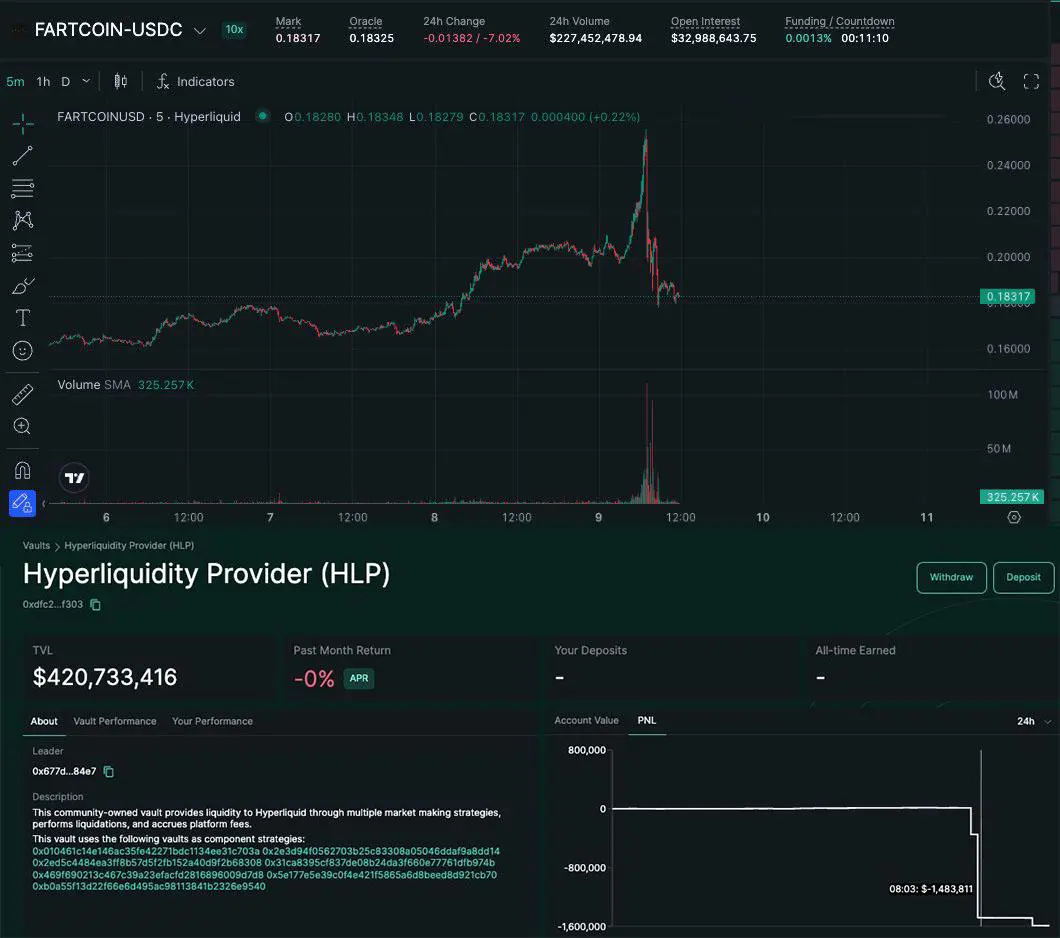
- The Catch: FARTCOIN suffers from low liquidity on Hyperliquid. With a thin order book, a $15 million buy (even if executed in clips) drives the price up by 20% or more.
Stage B: Creating Artificial Liquidity
- Action: To prevent an immediate price collapse, the attacker placed large limit buy orders (Buy Walls) just below the current market price.
- Goal: To trick the exchange's algorithms and other traders into thinking there was genuine market support, thereby pinning the "Mark Price" at an artificially high level.
Stage C: The "Squeeze" and ADL Activation
- Action: The attacker abruptly pulled their buy orders and began dumping the token on other platforms or through smaller sub-accounts.
- Result: The price plummeted. Due to the lack of organic liquidity, the $15 million position went deep into the red instantly. Standard liquidation was impossible—there simply weren't enough bids in the order book to absorb that kind of volume.
Stage D: Offloading Losses to HLP
- Action: When the insurance fund is exhausted, the ADL mechanism kicks in. The system forcibly closes the position against counterparties. On Hyperliquid, the primary counterparty is the HLP Vault.
- Outcome: HLP "inherits" the long position at an inflated price, even though the assets are effectively worthless in the real market. HLP ended up eating a loss of approximately $1–1.5 million.
2. Technical Foundation: Why Did It Work?
The key concept here is the Oracle vs. Internal Liquidity Gap.
Hyperliquid uses oracles to determine the Mark Price. If the price on external exchanges (Binance, OKX, etc.) stays high, the oracle validates it. However, the internal liquidity within Hyperliquid may be non-existent.
The ADL (Auto-Deleveraging) Mechanism
Under normal conditions, ADL protects the exchange from insolvency. If Trader A loses more than their balance and cannot be liquidated against the market, the exchange closes the profitable position of Trader B to settle the debt.
In this attack, the attacker engineered a scenario where their massive long became "unliquidatable," forcing the system to hand over this "toxic asset" to the liquidity providers (HLP).
3. Profit Breakdown: The Hedging Strategy
Many wonder: "Why would an attacker intentionally lose $1.5 million on Hyperliquid?"
The answer: Cross-platform Arbitrage.
The attacker opens:
- On Hyperliquid: A massive LONG.
- On an external DEX/CEX (with deep liquidity): A matching SHORT.
While the price on Hyperliquid is artificially pumped, their SHORT on the other exchange might be in the red. HOWEVER, once they "dump" the Hyperliquid position onto HLP, they realize a loss there that is more than offset by the profits from the short on the other platform, where they had already set the stage for a crash.
4. Practical Advice for Users and Developers
How to Avoid ADL (for Traders):
- Avoid high leverage on low-cap coins: ADL priority is given to positions with the highest effective leverage and profit.
- Monitor HLP health: If the Vault starts taking hits (Pnl trending down), it’s a red flag for toxic activity on the platform.
Example Monitoring Code (Python/Pseudocode):
Developers should track the gap between the oracle price and the order book depth.
def check_liquidity_risk(symbol, position_size_usd):
    oracle_price = get_oracle_price(symbol)

    # Calculate the average exit price against the order book (Slippage)
    execution_price = get_market_impact(symbol, position_size_usd, side='SELL')

    slippage_percent = (oracle_price - execution_price) / oracle_price * 100

    if slippage_percent > 15: # 15% risk threshold
        print(f"ALARM: Liquidity Gap for {symbol} is too high! ADL Risk detected.")
        return "High Risk"
    return "Safe"
5. Final Thoughts and Key Takeaways
These types of attacks are often called "Reverse JIT (Just-In-Time) Liquidations." Instead of providing liquidity, the attacker "force-feeds" toxic debt to the protocol.
Interestingly, Hyperliquid has previously updated leverage parameters (Max Leverage) for BTC and ETH following similar incidents. However, for new tokens like FARTCOIN, these parameters are often too lenient during the initial days of listing, creating a window of opportunity for exploits.
6. Deep Dive into the Vulnerability: Oracles vs. Order Book Depth
One of the "hidden" reasons behind the attack's success lies in the specifics of Oracle Latency and Skew Management.
In most decentralized perpetual exchanges (Perp DEXs), the mark price ($Mark Price$) is pulled from external venues via oracles. However, the actual execution price ($Execution Price$) is derived from the local order book or a virtual AMM.
The Problem: If an attacker creates an artificial imbalance ($Skew$) within the protocol, the system attempts to balance it through the funding rate ($Funding Rate$). However, during a flash crash, the funding rate doesn't react fast enough to make holding the position "expensive" for the attacker.
HLP's Weak Spot: The Hyperliquid Liquidity Provider vault acts as the market maker of last resort. It is fundamentally obligated to "absorb" trades when other market participants are absent. The attacker essentially turned HLP into forced exit liquidity.
7. Practical Case Study: How to Spot an Impending Attack
If you are analyzing on-chain data or monitoring the market in real-time, the following "Red Flags" may signal a pending exploit:
- Open Interest (OI) Concentration: If the $OI$ for a low-liquidity asset (like FARTCOIN) surges within hours to amounts exceeding 20-30% of the token's total market cap, it is an anomaly.
- Linked Wallets (Cluster Analysis): In this case, four interconnected wallets were used. Often, these are funded from a single address or through mixers shortly before the attack begins.
- Abnormal Spread: If the token price on Hyperliquid is 2-3% higher than on other DEXs (like Raydium or Uniswap), and arbitrageurs aren't rushing to close the gap, it means there is no liquidity for shorting, and the price is being held up solely by the manipulator’s actions.
8. Technical Recommendations for Protocol Security
For DeFi developers and architects, this case dictates the need for stricter risk parameters:
- Dynamic Open Interest Caps: Limits on the maximum open position should be tied to real order book depth ($Depth$), not just volatility. If there is only $500k of liquidity within a 5% price range, the system should never allow a $15m long to be opened.
- ADL Haircuts: Implementing penalty coefficients during an ADL event ensures the manipulator loses a significant portion of their collateral ($Collateral$) before the position is offloaded to HLP.
- Velocity Checks: Speed limits on position changes. For example, preventing a position from increasing by more than X% within a 10-minute window for high-risk assets.
9. Code Scenario: Attack Simulation (Python / Brownie style)
Below is an example of the logic auditors use to test a protocol’s resilience against such manipulations:
# Liquidity manipulation simulation pseudocode
def simulate_attack():
    asset = "FARTCOIN"
    initial_liq = protocol.get_liquidity(asset) # e.g., $1M within 10% of price

    # Attacker deposits collateral
    attacker_margin = 2_000_000 # $2M USDC

    # Opening a massive leveraged position
    # The protocol mistakenly allows 7x leverage on shitcoins!
    protocol.open_position(symbol=asset, size=14_000_000, side="LONG", margin=attacker_margin)

    # Price skyrockets due to lack of liquidity
    new_price = protocol.get_mark_price(asset) * 1.20 # +20%

    # Sudden withdrawal of liquidity by attacker (via linked wallets)
    protocol.remove_limit_orders(asset, attacker_linked_wallets)

    # Simulate a market crash
    market.crash(asset, drop_percent=30)

    # Check: can the liquidator close the position?
    liquidation_status = protocol.attempt_liquidation(attacker_address)

    if liquidation_status == "FAILED_NO_LIQUIDITY":
        print("ADL Triggered! HLP takes the loss.")
        hlp_loss = protocol.calculate_adl_impact(attacker_position)
        print(f"Total HLP Loss: ${hlp_loss}")
Conclusion: A Lesson for the Ecosystem
The Hyperliquid attack via FARTCOIN wasn't a "hack" in the traditional sense; it was an intelligent use of the existing rules. As long as Perp DEXs chase hype-driven tokens to attract volume, they will remain vulnerable to "whales" who know how to weaponize exchange safeguards like ADL into their personal exit strategy.
For the average user, the lesson is simple: HLP is not "risk-free yield." It is a backstop fund that can, at any moment, end up footing the bill for a clever manipulator’s feast.
Summarize this blog post with: