
The exploit on the Liquid Network sidechain—draining nearly 4,000 BTC ($320M)—just exposed a massive blind spot in the industry's mental model. With the network forced to halt operations and exchanges freezing LBTC deposits and withdrawals, the incident drew a hard line between Bitcoin's mathematically secured distributed ledger and a glorified federated multisig run by a closed group of corporate entities.
Inside the Liquid Network Exploit
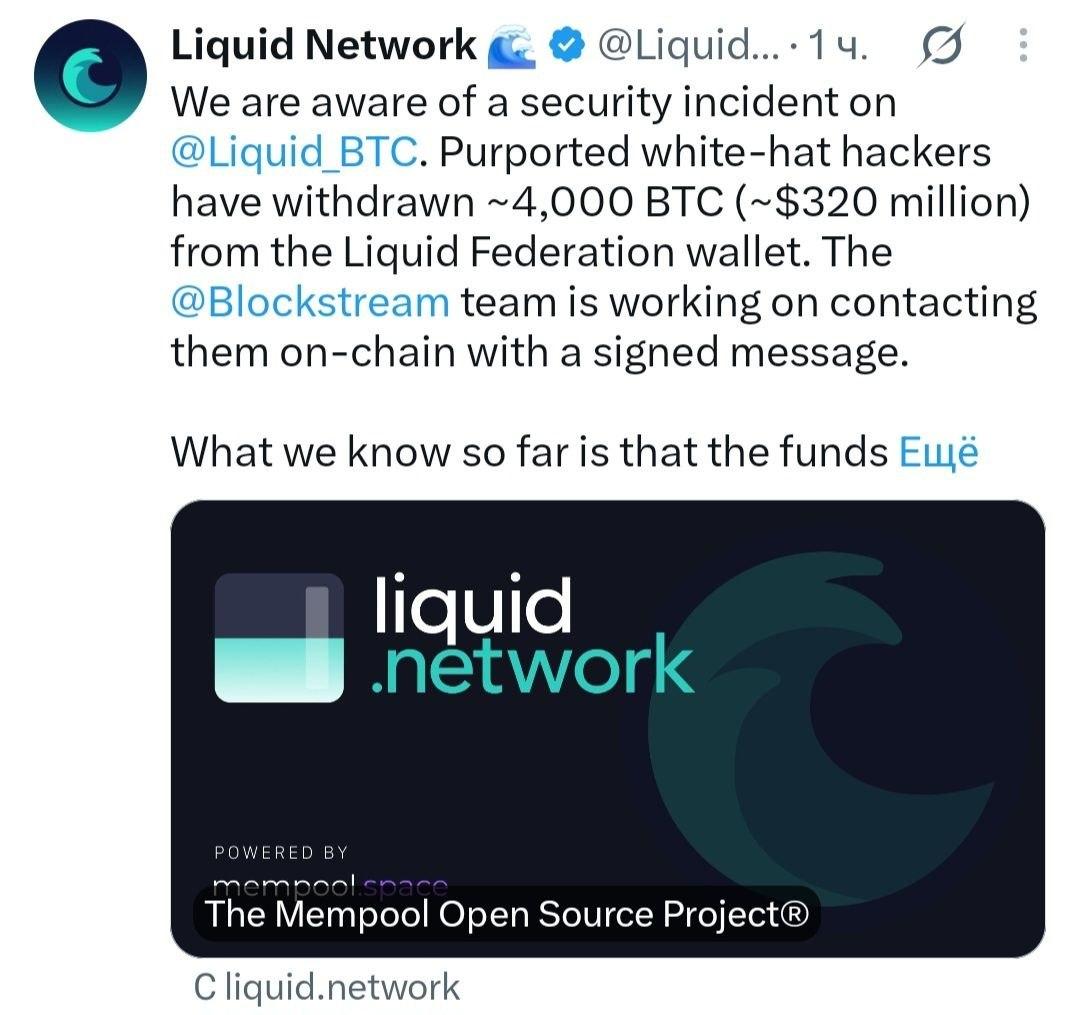
The hack hit Liquid, the sidechain backed by Adam Back’s Blockstream, draining nearly 4,000 BTC worth $320 million—wiping out roughly 95% of the total BTC backing LBTC. Liquid operators hit the emergency kill switch to halt processing while exchanges instantly paused all LBTC deposits and withdrawals.
For years, Blockstream’s PR machine and crypto media sold the network as a "Layer 2 blockchain." In reality, this exploit showed the stark difference between a mathematically secure distributed ledger and a federated multisig setup managed by a handful of corporate nodes. The stolen 95% collateral was never erased from the Bitcoin blockchain itself; the breach compromised the external bridge gateway held by federation functionaries.
Why Bitcoin Can’t Be Hacked, But Liquid Was
The core difference between Bitcoin and sidechains, cross-chain bridges, or L2 solutions boils down to their security models and consensus mechanisms.
Bitcoin is hardened by Proof-of-Work (PoW) and enforced by tens of thousands of independent full nodes verifying every single block against strict protocol rules. To execute an invalid transaction on Bitcoin—like moving funds without a valid ECDSA/Schnorr signature—controlling even 99% of the hash rate won't cut it. Full nodes worldwide will instantly drop the invalid block. The only theoretical vector against transaction history is a 51% attack, which can only reorder past transactions (double-spending), not forge signatures or drain wallets out of thin air.
Liquid Network operates under a fundamentally different model. It’s not an independent blockchain—it’s a Strong Federated Sidechain.
| Parameter | Bitcoin (L1) | Liquid Network (Sidechain) |
|---|---|---|
| Consensus Mechanism | Proof-of-Work (PoW) | Federated Consensus (Strong Federation) |
| Block Validation | ~50,000+ independent full nodes | 15-of-20 (or 11-of-15) Functionaries |
| Collateral Custody (BTC) | Distributed user private keys | Multisig Custodian (Watchmen / Functionaries) |
| Exploit Attack Vector | Mathematically impossible (ECDSA/Secp256k1 cryptography) | Compromise of federation signers' private keys |
| Network Halt Capacity | Impossible (Autonomous P2P network) | Manual pause triggered by operator decision |
Liquid relies on a two-way peg. Users deposit native BTC into a multisig address on the Bitcoin base layer, which is controlled by "Functionaries"—a group of selected exchanges and institutional actors. In return, an equivalent amount of LBTC is minted on the Liquid side.
The 4,000 BTC heist wasn't caused by a breakdown in elliptic-curve cryptography or a zero-day in Bitcoin Core. Attackers simply compromised the signing keys for the multisig address holding the collateralized Bitcoin on Layer 1.
The Architectural Illusion: Blockchains vs. Permissioned Multisigs
Crypto marketing has popularized a dangerous trope: labeling any linked list of blocks signed by a few servers as an "innovative blockchain."
A true blockchain guarantees three non-negotiables:
- Trustless Environment: Zero privileged actors. No single entity can censor a transaction or tamper with state balances.
- Immutability: Rewriting history post-finality becomes exponentially cost-prohibitive with every block appended.
- Trustless Validation: Every node independently validates protocol rules back to the Genesis block.
Designs like Liquid are essentially closed corporate databases with cryptographic signatures—glorified multisig custody. When wrapping BTC into LBTC, WBTC, or synthetic assets, you trade the mathematical guarantees of the Bitcoin network for the legal and operational trust of a custodian group.
[User]
      │
      ▼ (Lock: PoW Math + Secp256k1)
[Bitcoin Blockchain] ──► [Federation Multisig Vault] ◄── [ATTACK VECTOR (Keys/Servers)]
                                   │
                                   ▼ (Lock: Reputation of 15 Companies)
                            [Liquid Network / LBTC]
If the multisig keys get compromised (as Liquid just experienced), the underlying collateral vanishes, leaving tokenized LBTC backed by nothing.
Why You Can’t "Hack" Native Bitcoin
Whenever a sidechain gets drained, the same question pops up: if hackers can yank $320M out of Liquid, can they hack Bitcoin itself?
No. Bitcoin has no honeypot, central vault, master smart contract, or custodian server.
Every BTC exists as an Unspent Transaction Output (UTXO) locked by a mathematical script. Spending a UTXO requires absolute cryptographic proof: the private key corresponding to the public address script.
- Private Key Brute-Forcing: Secp256k1 keys use a 256-bit space. The total number of key combinations is 2256 (roughly 1077). Cracking a single key by brute force would take all global computing power longer than the lifespan of the universe.
- Protocol Code Attacks: Changes to Bitcoin Core undergo ruthless peer review, and any invalid block gets immediately rejected by the network. Even if miners tried to mint extra supply past 21 million BTC, non-mining full nodes would drop their blocks instantly and refuse to propagate them.
Vulnerabilities only emerge where human trust and key aggregation enter the picture—in cross-chain bridges, sidechains, centralized exchanges, and custom multisig setups.
Anatomy of a Threat Vector: Why Custodial Bridges Are Perpetual Honeypots
The Liquid Network exploit just put a massive spotlight on the ultimate bottleneck in cross-chain infrastructure: liquidity aggregation.
In the rush to solve L1 scalability, the industry doubled down on wrapped tokens and sidechains. But here’s the catch: any system that locks native assets at a single address to mint synthetic "twins" on another chain inherently creates a single point of failure (SPOF).
For an attacker, trying to crack Secp256k1 elliptic curve cryptography is a fool's errand. It’s lightyears cheaper and easier to hit the key management infrastructure instead:
- Node Infrastructure: The servers running functionary nodes are often concentrated across a handful of cloud providers (AWS, Hetzner, GCP). Compromise an API endpoint or the hypervisor, and an attacker can scrape encrypted keys straight out of RAM.
- Social Engineering & Human Vectors: In an M-of-N threshold scheme, you don't need to break math. You just need to spear-phish or compromise a few DevOps engineers at key validator firms.
- Threshold Signature / MPC Flaws: When federations use Multi-Party Computation (MPC) to generate signatures off-chain, math bugs in the underlying libraries (looking at you, historical Fireblocks and Thorchain vulns) can let an attacker reconstruct the master key from a handful of intercepted signatures.
Security Breakdown: L1 vs. L2 vs. Sidechains vs. Bridges
To cut through the marketing noise, our risk team mapped out the threat landscapes of these architectures using raw engineering metrics:
| Architecture Type | Example | Collateral Security Mechanism | Risk of Total Collateral Loss | L1 Exit Controller |
|---|---|---|---|---|
| L1 Blockchain | Bitcoin, Ethereum | Consensus Math (PoW/PoS) + ECDSA/Ed25519 | None (Requires private key compromise) | Private Key Owner |
| Trustless L2 / Rollups | Arbitrum, Optimism | ZK-proofs or Fraud Proofs enforced by L1 Smart Contracts | Minimal (Bounded by L1 contract bugs) | L1 Contract via Math/Cryptographic Proofs |
| Federated Sidechain | Liquid, RSK (base model) | Custodial Multisig (Federation) | High (Federator key compromise) | Board of Functionaries / Custodians |
| Cross-Chain Bridges | Ronin, Wormhole, Multichain | Smart Contracts + Multisig/Relayer Nodes | Critical (Historically the #1 exploit target) | Restricted Relayer Pool or Multisig |
Key Takeaways for Traders and Investors
Our engineering and risk teams at EXMON boiled this incident down into three golden rules for protecting capital when dealing with third-party protocol risks:
- Don't confuse tickers with real underlying assets: LBTC, WBTC, tBTC, and BTCB aren't Bitcoin. They’re IOUs with varying trust assumptions minted on secondary networks. They track BTC 1:1 only as long as the L1 collateral pool stays safe. If the vault gets drained, the synthetic token drops straight to zero.
- Audit the custody chain: If you're holding synthetic assets for cheap gas or arbitrage, you need to know exactly who's holding the keys to the vault. If it's a 10-of-15 corporate multisig, your attack surface is the cumulative security posture of every single member in that federation.
- Keep cold storage native: No sidechain or bridge can match L1 security guarantees. For long-term capital preservation, stick strictly to native L1 transactions with self-custodied keys (cold hardware wallets or non-custodial multisig).
Real blockchains rely on math and game-theoretic economic incentives. The second you try to swap decentralized consensus for "a pinky promise between a few trusted entities," it's only a matter of time before those entities get popped.